

160
ANTON F. BRUUN
are at most allowed to consider temperature occurring between the
oceanic thermocline, at about 10°C and 200-500 m below the surface;
the hundreds of thousands of leptocephali of species of the order of eels,
Apodes, have always been caught in the oceanic thermosphere, the
upper layers of the ocean warmor than about 10°C (Bruun, 1947,
pp. 164-165) ; even leptocephali with tubular eyes, like those belonging
to the deep-sea eel Synaphbranchus live in the thermosphere (Bruun,
1937). But it is likely that the larvae of the genus Anguilla are hatched
well above the oceanic thermocline, firstly because, as mentioned above,
the newly hatched larvae were actually found between 200-500 m, and
secondly because the temperature preference of Anguilla is probably at
least 15°C. As may be seen from Schmidt (1929) and Jacobsen (1929)
15°C was found about 500 m below the surface all over the area where
the Dana found the tiny larvae of both species of Anguilla. If we take
the actual observations made in the area on the stations in the area
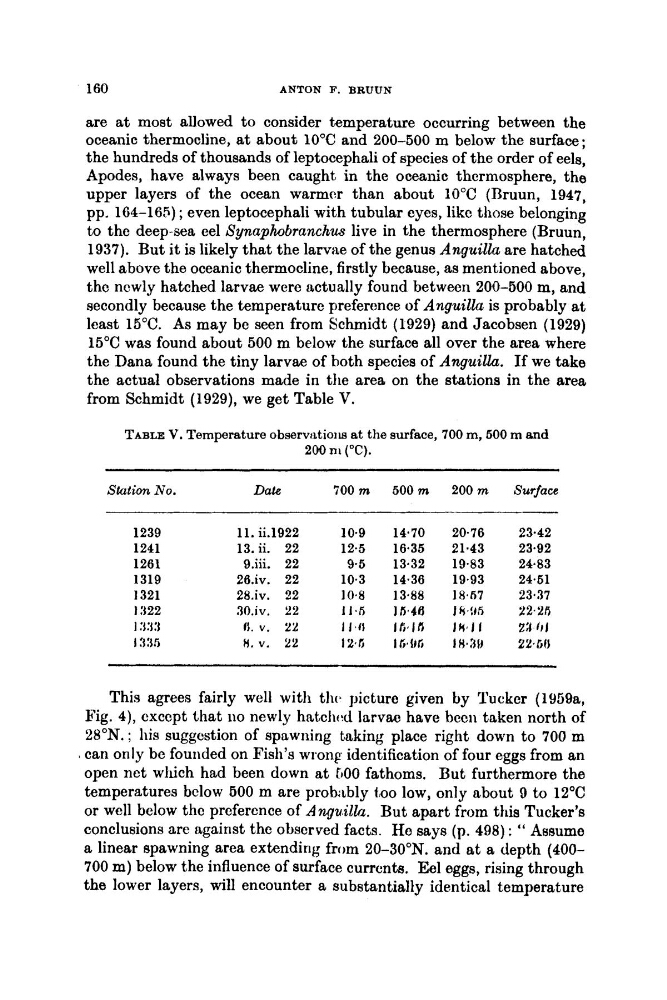
from Schmidt (1929), we get Table V.
TABLE V. Temperature observatioils at the surface, 700 m, 500 m and
200 nl ("C).
Station No.
~~
Date
700 m
500 m
200 m
1239
1241
1261
1319
1321
1322
1 :w
1335
11. ii.1922
13. ii. 22
9.iii. 22
26.iv. 22
28.iv. 32
30.iv. 22
0. v. 22
8 . v. 22
10.9
12-5
9.5
10.3
10.8
1I.h
1 1,(1
i 2.fi
14.70
16.35
13.32
14.36
13.88
1 k46
I f i ~ l I 5
I G 4 G
20.76
21.43
19-83
19.93
I11.M
18.1 1
18.67
i n m
Surface
23.42
23-92
24.83
24.51
23.37
22.56
21 frl
Z2,fiO
This agrees fairly well with thv picture given by Tucker (l959a,
Fig. 4), exccpt that no newly hatchtd larvae have becii taken north of
28"N. ; liis suggestion of spawning taking place right down to 700 m
I can only be founded on Fish's wrong identification of four eggs from an
open net which had been down at to0 fathoms. But furthermore the
temperatures below 500 m are probably Loo low, only about 9 to 12OC
or well below the preference of Anpilla. But apart from this Tucker's
conclusions arc against the observed facts. He says (p. 498) : " Assume
a linear spawning area extending from 20-30"N. and at a depth (400700 m) below the influence of surface currents. Eel eggs, rising through
the lower layers, will encounter a substantially identical temperature
ANTON F. BRUUN
are at most allowed to consider temperature occurring between the
oceanic thermocline, at about 10°C and 200-500 m below the surface;
the hundreds of thousands of leptocephali of species of the order of eels,
Apodes, have always been caught in the oceanic thermosphere, the
upper layers of the ocean warmor than about 10°C (Bruun, 1947,
pp. 164-165) ; even leptocephali with tubular eyes, like those belonging
to the deep-sea eel Synaphbranchus live in the thermosphere (Bruun,
1937). But it is likely that the larvae of the genus Anguilla are hatched
well above the oceanic thermocline, firstly because, as mentioned above,
the newly hatched larvae were actually found between 200-500 m, and
secondly because the temperature preference of Anguilla is probably at
least 15°C. As may be seen from Schmidt (1929) and Jacobsen (1929)
15°C was found about 500 m below the surface all over the area where
the Dana found the tiny larvae of both species of Anguilla. If we take
the actual observations made in the area on the stations in the area
from Schmidt (1929), we get Table V.
TABLE V. Temperature observatioils at the surface, 700 m, 500 m and
200 nl ("C).
Station No.
~~
Date
700 m
500 m
200 m
1239
1241
1261
1319
1321
1322
1 :w
1335
11. ii.1922
13. ii. 22
9.iii. 22
26.iv. 22
28.iv. 32
30.iv. 22
0. v. 22
8 . v. 22
10.9
12-5
9.5
10.3
10.8
1I.h
1 1,(1
i 2.fi
14.70
16.35
13.32
14.36
13.88
1 k46
I f i ~ l I 5
I G 4 G
20.76
21.43
19-83
19.93
I11.M
18.1 1
18.67
i n m
Surface
23.42
23-92
24.83
24.51
23.37
22.56
21 frl
Z2,fiO
This agrees fairly well with thv picture given by Tucker (l959a,
Fig. 4), exccpt that no newly hatchtd larvae have becii taken north of
28"N. ; liis suggestion of spawning taking place right down to 700 m
I can only be founded on Fish's wrong identification of four eggs from an
open net which had been down at to0 fathoms. But furthermore the
temperatures below 500 m are probably Loo low, only about 9 to 12OC
or well below the preference of Anpilla. But apart from this Tucker's
conclusions arc against the observed facts. He says (p. 498) : " Assume
a linear spawning area extending from 20-30"N. and at a depth (400700 m) below the influence of surface currents. Eel eggs, rising through
the lower layers, will encounter a substantially identical temperature