

158
ANTON F. BRUUN
Marquesas having 106.9, but this is naturally not statistically significant.
These general observations may serve as a background for the
following.
With Tucker (1959a, p. 498) we may assumc that Anguilla shares
the common susceptibility to factors, such as temperature, as has been
shown to inf-Iuvnce the numher of vertebrae in other fishes, like Zoarca
and Salmo (Schmidt, 1920, 1921 ; Tbning, 1952).
Schmidt (1!)27, 1928) was aware of this when he divided Anguilh
australis Richardson into two geographical races, an eastern one from
Ncw Zcaland, and a western from East Australia. After Schmidt’s
death, Ege (1939) worked this up in greater detail, showing that the
eastern race, 9nguilla australis schmidti Philipps, has on an average
111.7 vertebrae (1666 specimens) and the western race, A . australi,q
Richardson has 112.6 (559 specimens). Similarly the Indian Ocean
population of A . bicolor bicolor McClelland, distributed from East
Africa, India, and Java to N.W. Australia, has 109.5 vertebrae (1251
specimens from nine localities in the whole range of distribution) and
the Pacific population, A . bicolor paci$ca Schmidt, distributed from
Celebes along the north coast of New Guinea, has 107.1 vertebrae (324
specimens from four localities in the whole range of distribution).
This is what would be expected in a species of fish with several breeding
places, but it is certainly in sharp contrast to the conditions in the two
North Atlantic species, A . anguilla having 114-7 vertebrae and A .
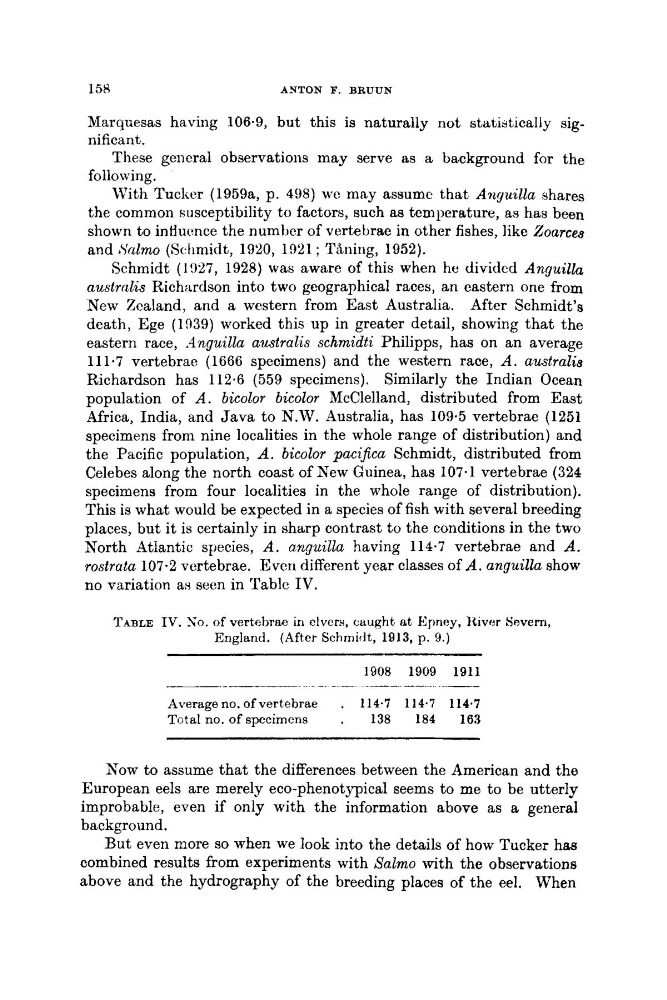
rostrata 107.2 vertebrae. Even different year classes of A . anguilla show
no variation as seen in Table IV.
TABLE IV. S o . of vertehrr: in clvcrs, caught at Epncy, ltiver Severri,
England. (After Schmidt, 1913, p. 9.)
1908 1909 1911
Averageno. ofvertebrae
. 114.7 114.7 114.7
Totalno. ofspecimens
. 138 184 163
Now to assume that the differences between the American and the
European eels are merely eco-phenotypical seems to me to be utterly
improbable, even if only with the information above as a general
background.
But even more so when we look into the details of how Tucker has
combined results from experiments with Salmo with the observations
above and the hydrography of the breeding places of the eel. When
ANTON F. BRUUN
Marquesas having 106.9, but this is naturally not statistically significant.
These general observations may serve as a background for the
following.
With Tucker (1959a, p. 498) we may assumc that Anguilla shares
the common susceptibility to factors, such as temperature, as has been
shown to inf-Iuvnce the numher of vertebrae in other fishes, like Zoarca
and Salmo (Schmidt, 1920, 1921 ; Tbning, 1952).
Schmidt (1!)27, 1928) was aware of this when he divided Anguilh
australis Richardson into two geographical races, an eastern one from
Ncw Zcaland, and a western from East Australia. After Schmidt’s
death, Ege (1939) worked this up in greater detail, showing that the
eastern race, 9nguilla australis schmidti Philipps, has on an average
111.7 vertebrae (1666 specimens) and the western race, A . australi,q
Richardson has 112.6 (559 specimens). Similarly the Indian Ocean
population of A . bicolor bicolor McClelland, distributed from East
Africa, India, and Java to N.W. Australia, has 109.5 vertebrae (1251
specimens from nine localities in the whole range of distribution) and
the Pacific population, A . bicolor paci$ca Schmidt, distributed from
Celebes along the north coast of New Guinea, has 107.1 vertebrae (324
specimens from four localities in the whole range of distribution).
This is what would be expected in a species of fish with several breeding
places, but it is certainly in sharp contrast to the conditions in the two
North Atlantic species, A . anguilla having 114-7 vertebrae and A .
rostrata 107.2 vertebrae. Even different year classes of A . anguilla show
no variation as seen in Table IV.
TABLE IV. S o . of vertehrr: in clvcrs, caught at Epncy, ltiver Severri,
England. (After Schmidt, 1913, p. 9.)
1908 1909 1911
Averageno. ofvertebrae
. 114.7 114.7 114.7
Totalno. ofspecimens
. 138 184 163
Now to assume that the differences between the American and the
European eels are merely eco-phenotypical seems to me to be utterly
improbable, even if only with the information above as a general
background.
But even more so when we look into the details of how Tucker has
combined results from experiments with Salmo with the observations
above and the hydrography of the breeding places of the eel. When