

154
ANTON F. BRUUN
VII. SCHMIDT’S COLLECTIONS OF Anguillu LEPTOCEPHALI
Tucker (1959a, p. 499) gives the following statement : “ In fairness
to Schmidt, it must be said that he lacked much of the information now
available and that his terms of reference from his Government were to
locate the birthplace of the European eel. The ‘A. rostrata ’ larvae were,
to him: an unexpected nuisance. In the area now suggested as the
source of the ‘A. rostrata’ phenotypes the Danish Expeditions took only
a score of stations (Schmidt, 1919) ; those of the R. V. Margrethe were
worked in during November-December 1913, too late in the year, whiIe
the remainder, at miscellaneous dates and shallow depths, were worked
by amateurs from commercial vessels, in a region of rapid currents and,
on my hypothesis, minute deep-lying prelarvae. Closing nets were not
used.
“ It may be objected that ‘A. rostrata’is said to breed during JanuaryFebruary, A . anguilla during February-March (Schmidt, 1922 ; Thing,
1938). Against this simple statement must be balanced the fortunes of
collecting, the lengths of overall journeys from various starting-points,
disparities in sexual maturation, velocities of currents at various
possible migration-depths, duration of spawning periods and annual
variations in all these ; effects of temperature on rates of hatching and
early development and rates ofascent of larvae over different parts of the
spawning area. The criticism is more easily answered than made.”
But Schmidt (1925, p. 307) has really given some of the answers.
He was very much aware of the lack of material from the early months
of the year; therefore the Dana expedition 1920-21 and the Dana I1
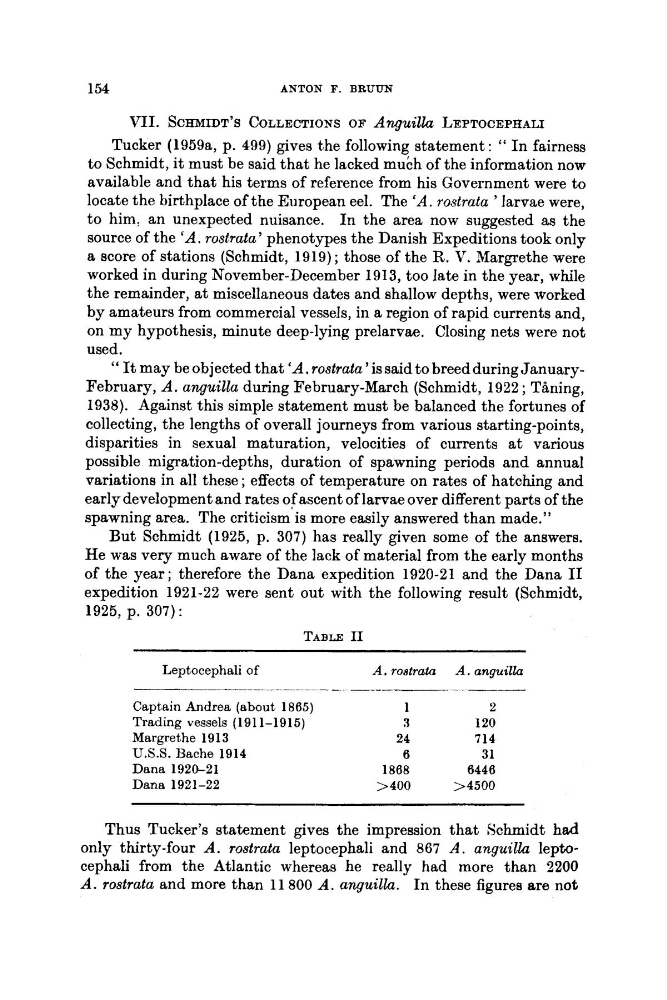
expedition 1921-22 were sent out with the following result (Schmidt,
1925, p. 307):
TABLE I1
Leptocephali of
A . rocltrata A . anguillu
Captain Andrea (about 1865)
1
2
Trading vessels (191 1-1916)
3
120
Margrethe 1913
24
714
U.S.S. Bache 1914
6
31
Dana 1920-21
1868
6446
Dana 1921-22
> 400
>4500
Thus Tucker’s statement gives the impression that Schmidt had
only thirty-four A . rostrata leptocephali and 867 A . anguilla leptocephali from the Atlantic whereas he really had more than 2200
A . rostrata and more than 11 800 A . anguilla. In these figures are not
ANTON F. BRUUN
VII. SCHMIDT’S COLLECTIONS OF Anguillu LEPTOCEPHALI
Tucker (1959a, p. 499) gives the following statement : “ In fairness
to Schmidt, it must be said that he lacked much of the information now
available and that his terms of reference from his Government were to
locate the birthplace of the European eel. The ‘A. rostrata ’ larvae were,
to him: an unexpected nuisance. In the area now suggested as the
source of the ‘A. rostrata’ phenotypes the Danish Expeditions took only
a score of stations (Schmidt, 1919) ; those of the R. V. Margrethe were
worked in during November-December 1913, too late in the year, whiIe
the remainder, at miscellaneous dates and shallow depths, were worked
by amateurs from commercial vessels, in a region of rapid currents and,
on my hypothesis, minute deep-lying prelarvae. Closing nets were not
used.
“ It may be objected that ‘A. rostrata’is said to breed during JanuaryFebruary, A . anguilla during February-March (Schmidt, 1922 ; Thing,
1938). Against this simple statement must be balanced the fortunes of
collecting, the lengths of overall journeys from various starting-points,
disparities in sexual maturation, velocities of currents at various
possible migration-depths, duration of spawning periods and annual
variations in all these ; effects of temperature on rates of hatching and
early development and rates ofascent of larvae over different parts of the
spawning area. The criticism is more easily answered than made.”
But Schmidt (1925, p. 307) has really given some of the answers.
He was very much aware of the lack of material from the early months
of the year; therefore the Dana expedition 1920-21 and the Dana I1
expedition 1921-22 were sent out with the following result (Schmidt,
1925, p. 307):
TABLE I1
Leptocephali of
A . rocltrata A . anguillu
Captain Andrea (about 1865)
1
2
Trading vessels (191 1-1916)
3
120
Margrethe 1913
24
714
U.S.S. Bache 1914
6
31
Dana 1920-21
1868
6446
Dana 1921-22
> 400
>4500
Thus Tucker’s statement gives the impression that Schmidt had
only thirty-four A . rostrata leptocephali and 867 A . anguilla leptocephali from the Atlantic whereas he really had more than 2200
A . rostrata and more than 11 800 A . anguilla. In these figures are not