

128
VICTOR L. LOOSANOFF A N D HARRY C. DAVIS
of a female Teredo were cultured to metamorphosis in 28 days at a
temperature of about 20°C. Grave (1928) thought that the entire period
of development of Teredo from the moment of fertilization to melamorphosis takes about 5 weeks. Judging by data offered by Imai et al.
(1950a), setting in their cultures occurred between the 24th and 34th
days.
A brief description of early stages of development of eggs and
larvae of T. navalis are given by Costello et ul. (1957) and of later stages,
by Sigerfoos (1908). Imai et aE. (1950b) gave a good account for all
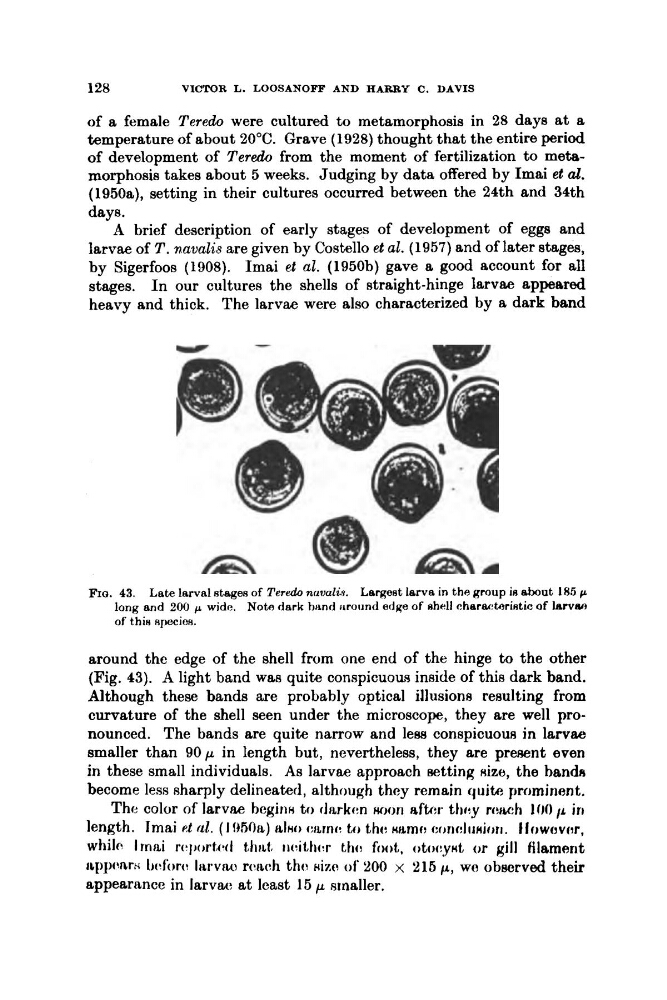
stages. In our cultures the shells of straight-hinge larvae appeared
heavy and thick. The larvae were also characterized by a dark band
FIG. 43. Late larval stages of Teredo nuvuli.9. Large&. larva in the group h about 185 p
N o h dark hand tworind edge of nhtll charachristic of hrvw
long and 300 p wide.
of this species.
around the edge of the shell from one end of the hinge to the other
(Fig. 43). A light band was quite conspicuous inside of this dark band.
Although these bands are probably optical illusions r e d t i n g from
curvature of the shell seen under the microscope, they are well pronounced. The bands are quite narrow and lees conspicuous in l&rvaa
smaller than 9Op in length but, nevertheless, they are preAent even
in these small individuals. As larvae approach Betting H i m , the ban&
become less sharply delineated, although they remain quite, prominont.
The color of larvae hogiriH to dnrkan Hoon aftm ttwy rcriwh 100 p in
length. Tmai at d. ( I MOu) t t l ~ ~
aamn to thtt namo aonalirniort. flowcwrr,
whilc I rnai r.c.l,ortsc*tl thnt. tic:ithcv tho foot,, oto(:.yHt or gill filamerlt
eppnw bc*f’orct larvno rcmh thv H i m of‘ ‘LOO x 216 p, wo observed their
appearance in larvac at least 16 p smaller.
VICTOR L. LOOSANOFF A N D HARRY C. DAVIS
of a female Teredo were cultured to metamorphosis in 28 days at a
temperature of about 20°C. Grave (1928) thought that the entire period
of development of Teredo from the moment of fertilization to melamorphosis takes about 5 weeks. Judging by data offered by Imai et al.
(1950a), setting in their cultures occurred between the 24th and 34th
days.
A brief description of early stages of development of eggs and
larvae of T. navalis are given by Costello et ul. (1957) and of later stages,
by Sigerfoos (1908). Imai et aE. (1950b) gave a good account for all
stages. In our cultures the shells of straight-hinge larvae appeared
heavy and thick. The larvae were also characterized by a dark band
FIG. 43. Late larval stages of Teredo nuvuli.9. Large&. larva in the group h about 185 p
N o h dark hand tworind edge of nhtll charachristic of hrvw
long and 300 p wide.
of this species.
around the edge of the shell from one end of the hinge to the other
(Fig. 43). A light band was quite conspicuous inside of this dark band.
Although these bands are probably optical illusions r e d t i n g from
curvature of the shell seen under the microscope, they are well pronounced. The bands are quite narrow and lees conspicuous in l&rvaa
smaller than 9Op in length but, nevertheless, they are preAent even
in these small individuals. As larvae approach Betting H i m , the ban&
become less sharply delineated, although they remain quite, prominont.
The color of larvae hogiriH to dnrkan Hoon aftm ttwy rcriwh 100 p in
length. Tmai at d. ( I MOu) t t l ~ ~
aamn to thtt namo aonalirniort. flowcwrr,
whilc I rnai r.c.l,ortsc*tl thnt. tic:ithcv tho foot,, oto(:.yHt or gill filamerlt
eppnw bc*f’orct larvno rcmh thv H i m of‘ ‘LOO x 216 p, wo observed their
appearance in larvac at least 16 p smaller.