

REARING OF BIVALVE MOLLUSKS
126
the large foot. However, the velum normally begins t o disappear
soon after a length of 172 to 175 p is reached and sometimes even
earlier. In most individuals 200p in length the velum is already
resorbed. Some larvae measuring only 175 p in length, and having no
velum, were seen actually crawling, using their feet.
The balancing organ, the otocyst, can be clearly seen at the base
of the foot of larvae measuring about 175p in length. The byssua
gland also can be seen in larvae less than 200p in length, and the
gills may be clearly discerned in some individuals of about the same
size. The byssus thread is strong, and our attempts to break it by
directing a strong jet of water from a pipette caused the larvae to
sway from side to side, but did not break the thread.
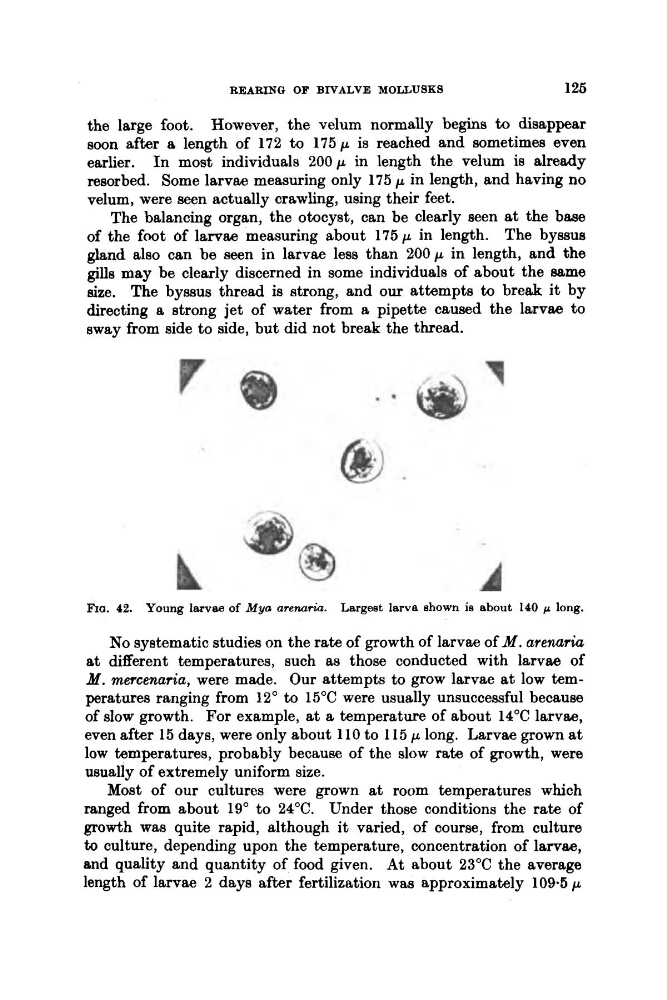
FIQ. 42. Young larvas of M y o arena&. Largest larva shown ia about 140 p long.
No systematic studies on the rate of growth of larvae of M. arenuria
at different temperatures, such as those conducted with larvae of
Y. mercenaria, were made. Our attempts to grow larvae at low temperatures ranging from 12" to 15°C were usually unsuccessful because
of slow growth. For example, at a temperature of about 14°C larvae,
even after 15 days, were only about 110 to 115 p long. Larvae grown at
low temperatures, probably because of the slow rate of growth, were
usually of extremely uniform size.
Most of our cultures were grown at room temperatures which
ranged from about 19" to 24°C. Under those conditions the rate of
growth was quite rapid, although it varied, of course, from culture
to culture, depending upon the temperature, concentration of larvae,
and quality and quantity of food given. A t about 23°C the average
length of larvae 2 days after fertilization was approximately 1 0 9 . 6 ~
126
the large foot. However, the velum normally begins t o disappear
soon after a length of 172 to 175 p is reached and sometimes even
earlier. In most individuals 200p in length the velum is already
resorbed. Some larvae measuring only 175 p in length, and having no
velum, were seen actually crawling, using their feet.
The balancing organ, the otocyst, can be clearly seen at the base
of the foot of larvae measuring about 175p in length. The byssua
gland also can be seen in larvae less than 200p in length, and the
gills may be clearly discerned in some individuals of about the same
size. The byssus thread is strong, and our attempts to break it by
directing a strong jet of water from a pipette caused the larvae to
sway from side to side, but did not break the thread.
FIQ. 42. Young larvas of M y o arena&. Largest larva shown ia about 140 p long.
No systematic studies on the rate of growth of larvae of M. arenuria
at different temperatures, such as those conducted with larvae of
Y. mercenaria, were made. Our attempts to grow larvae at low temperatures ranging from 12" to 15°C were usually unsuccessful because
of slow growth. For example, at a temperature of about 14°C larvae,
even after 15 days, were only about 110 to 115 p long. Larvae grown at
low temperatures, probably because of the slow rate of growth, were
usually of extremely uniform size.
Most of our cultures were grown at room temperatures which
ranged from about 19" to 24°C. Under those conditions the rate of
growth was quite rapid, although it varied, of course, from culture
to culture, depending upon the temperature, concentration of larvae,
and quality and quantity of food given. A t about 23°C the average
length of larvae 2 days after fertilization was approximately 1 0 9 . 6 ~