

122
VICTOR L. LOOSANOFF AND HARRY C. DAVIS
at two different temperatures. Eggs obtained from several females
and fertilized with spermatozoa of three ripe males were mixed together
and then divided into two groups, one to be grown at a temperature
of about 22°C and the other at 14OC. The concentration of eggs per rnl
of water was the same in both cultures. During the experiment the
larvae were fed equal quantities of phytoplankton composed largely
of ChEorella sp.
Eggs placed in watkr at 14°C were in the trochophore stage at the
end of 40 hr. After 72 hr the culture contained normal and active
straight-hinge larvae averaging 85 p in length, which were quite
uniform in size and appearance. At 22°C this stage was reached after
only 28 hr. Young straight-hinge larvae of M . solidissirnu were usually
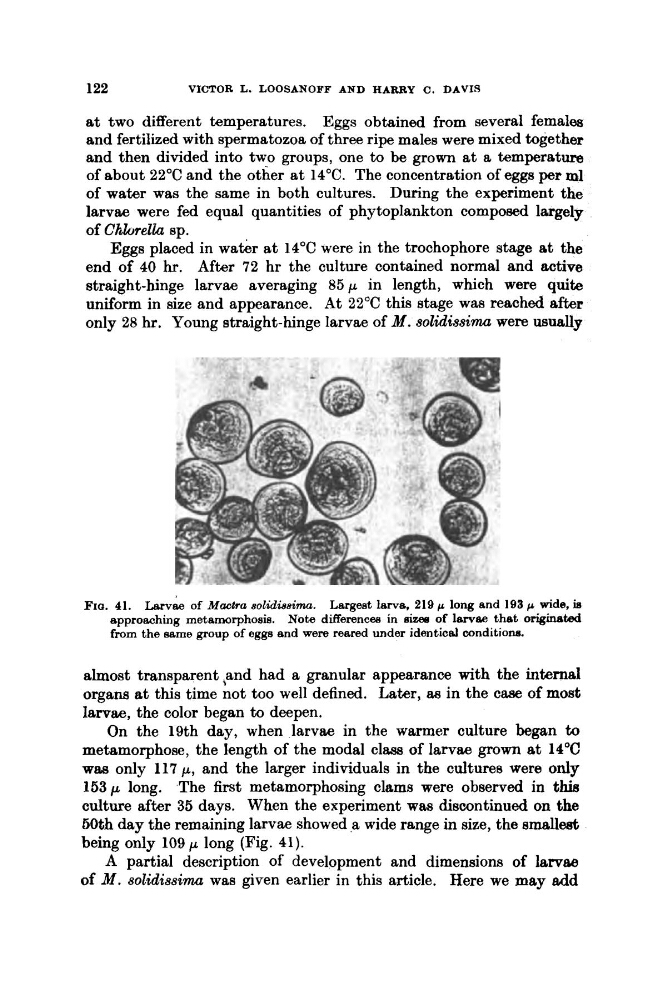
FIQ. 41. Larvae of Mactra 80lidb8hZ. Largest larva, 219 p long and 193 p wide, is
Note differences in sizee of larvae that Originetea
approaching metamorphosis.
from the same group of eggs and were reared under identical conditions.
almost transparent >and had a granular appearance with the internal
organs at this time not too well defined. Later, as in the caae of most
larvae, the color began to deepen.
On the 19th day, when larvae in the warmer culture began to
metamorphose, the length of the modal class of larvae grown at 14OC
waa only 117 p, and the larger individuals in the cultures were ody
153p long. The first metamorphosing clams were observed in thie
culture after 35 days. When the experiment waa discontinued on the
60th day the remaining larvae showed a wide range in size, the small&
being only 109 p long (Fig. 41).
A partial description of development and dimensions of larvae
of M. solidissirnu was given earlier in this article. Here we may add
VICTOR L. LOOSANOFF AND HARRY C. DAVIS
at two different temperatures. Eggs obtained from several females
and fertilized with spermatozoa of three ripe males were mixed together
and then divided into two groups, one to be grown at a temperature
of about 22°C and the other at 14OC. The concentration of eggs per rnl
of water was the same in both cultures. During the experiment the
larvae were fed equal quantities of phytoplankton composed largely
of ChEorella sp.
Eggs placed in watkr at 14°C were in the trochophore stage at the
end of 40 hr. After 72 hr the culture contained normal and active
straight-hinge larvae averaging 85 p in length, which were quite
uniform in size and appearance. At 22°C this stage was reached after
only 28 hr. Young straight-hinge larvae of M . solidissirnu were usually
FIQ. 41. Larvae of Mactra 80lidb8hZ. Largest larva, 219 p long and 193 p wide, is
Note differences in sizee of larvae that Originetea
approaching metamorphosis.
from the same group of eggs and were reared under identical conditions.
almost transparent >and had a granular appearance with the internal
organs at this time not too well defined. Later, as in the caae of most
larvae, the color began to deepen.
On the 19th day, when larvae in the warmer culture began to
metamorphose, the length of the modal class of larvae grown at 14OC
waa only 117 p, and the larger individuals in the cultures were ody
153p long. The first metamorphosing clams were observed in thie
culture after 35 days. When the experiment waa discontinued on the
60th day the remaining larvae showed a wide range in size, the small&
being only 109 p long (Fig. 41).
A partial description of development and dimensions of larvae
of M. solidissirnu was given earlier in this article. Here we may add