

114
VICTOR L. LOOSANOFF AND HARRY C. DAVIS
organisms are grown. I n some cases straight-hinge larvae were formed
after 24 hr at a temperature of about 21°C.
The size of the smallest normal straight-hinge larvae waa approximately 78 x 64 p. Several smaller larvae meafluring only 75 p b
length were also observed, but appeared to be abnormal. Some larvae
began developing an umbo when 95 p long, and the majority
possessed a well-developed umbo by the time they reached 8 length
of 125 p. No " eye " spots were observed in either larvae or recently
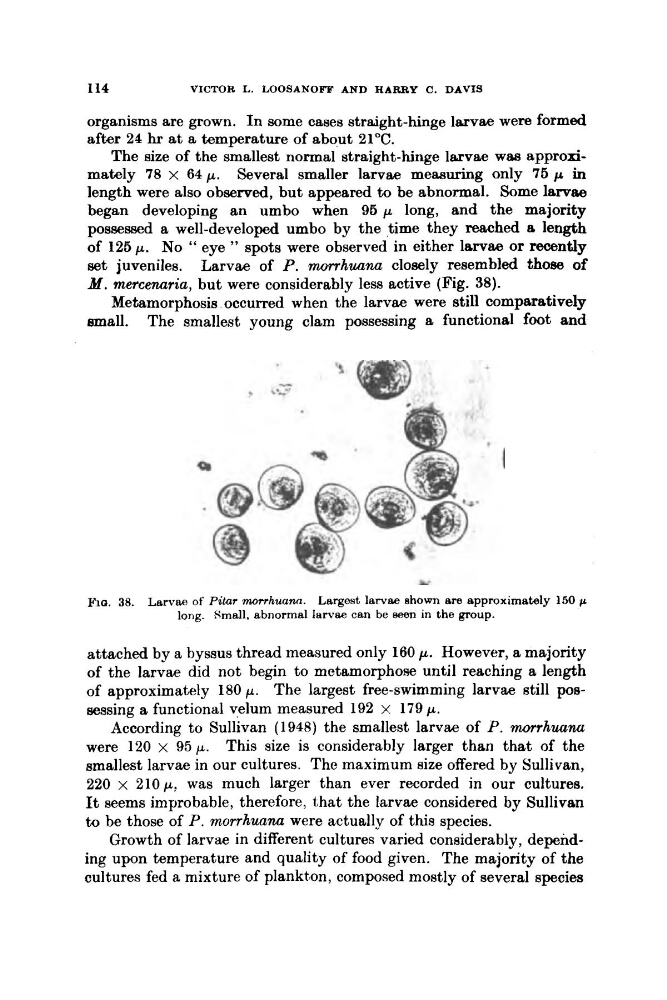
set juveniles. Larvae of P. morrhwznu closely resembled those of
M. mercenaria, but were considerably less active (Fig. 38).
Metamorphosis occurred when the larvae were still comparatively
small. The smallest young clam possessing a functional foot and
pc
Fio. 38. Larvae of Pitar morrhuunn. Largest larvae shown are approximately 150 p
long. Small, abnormal larvae can be seen in the group.
attached by a byssus thread measured only 160 p. However, a majority
of the larvae did not begin to metamorphofle until reaching a length
of approximately 180 p. The largest free-swimming larvae still possessing a functional velum measured 192 x 179 p.
According to Sullivan (1948) the smallest larvae of P, morrhuunu
were 120 x 95p. This size is considerably larger than that of the
smallest larvae in our cultures. The maximum size offered by Sullivan,
220 x 210pL, was much larger than ever recorded in our cultures.
It seems improbable, therefore, that the larvae considered by Sullivan
to be those of P. morrhuanu were actually of this species.
Growth of larvae in different cultures varied considerably, depending upon temperature and quality of food given. The majority of the
cultures fed a mixture of plankton, composed mostly of several species
VICTOR L. LOOSANOFF AND HARRY C. DAVIS
organisms are grown. I n some cases straight-hinge larvae were formed
after 24 hr at a temperature of about 21°C.
The size of the smallest normal straight-hinge larvae waa approximately 78 x 64 p. Several smaller larvae meafluring only 75 p b
length were also observed, but appeared to be abnormal. Some larvae
began developing an umbo when 95 p long, and the majority
possessed a well-developed umbo by the time they reached 8 length
of 125 p. No " eye " spots were observed in either larvae or recently
set juveniles. Larvae of P. morrhwznu closely resembled those of
M. mercenaria, but were considerably less active (Fig. 38).
Metamorphosis occurred when the larvae were still comparatively
small. The smallest young clam possessing a functional foot and
pc
Fio. 38. Larvae of Pitar morrhuunn. Largest larvae shown are approximately 150 p
long. Small, abnormal larvae can be seen in the group.
attached by a byssus thread measured only 160 p. However, a majority
of the larvae did not begin to metamorphofle until reaching a length
of approximately 180 p. The largest free-swimming larvae still possessing a functional velum measured 192 x 179 p.
According to Sullivan (1948) the smallest larvae of P, morrhuunu
were 120 x 95p. This size is considerably larger than that of the
smallest larvae in our cultures. The maximum size offered by Sullivan,
220 x 210pL, was much larger than ever recorded in our cultures.
It seems improbable, therefore, that the larvae considered by Sullivan
to be those of P. morrhuanu were actually of this species.
Growth of larvae in different cultures varied considerably, depending upon temperature and quality of food given. The majority of the
cultures fed a mixture of plankton, composed mostly of several species