

REARING OF BIVALVE MOLLUSKS
111
Sperm or eggs were released in a constant stream from the excurrent
siphon, sometimes continuously for 30 min or longer.
Eggs of T . semidecussata range from GO to 7 5 p in diameter, including the transparent membrane around the eggs that measures
from 5 to 10 p in thickness. The average diameter of the egg, including
the membrane, is approximately 6 9 . 6 ~ . According to Cahn (1951)
.Japanese workers found that eggs of this clam memured between
63 and 6 6 p in diameter with a perivitelline space measuring from
3-3 to 4-6 p in width and surrounded by a gelatinous coating approximately 23 p in thickness.
Most of the cultures of T . semidecussata were grown at room temperature. They were fed a variety of algal cultures, but no systematic
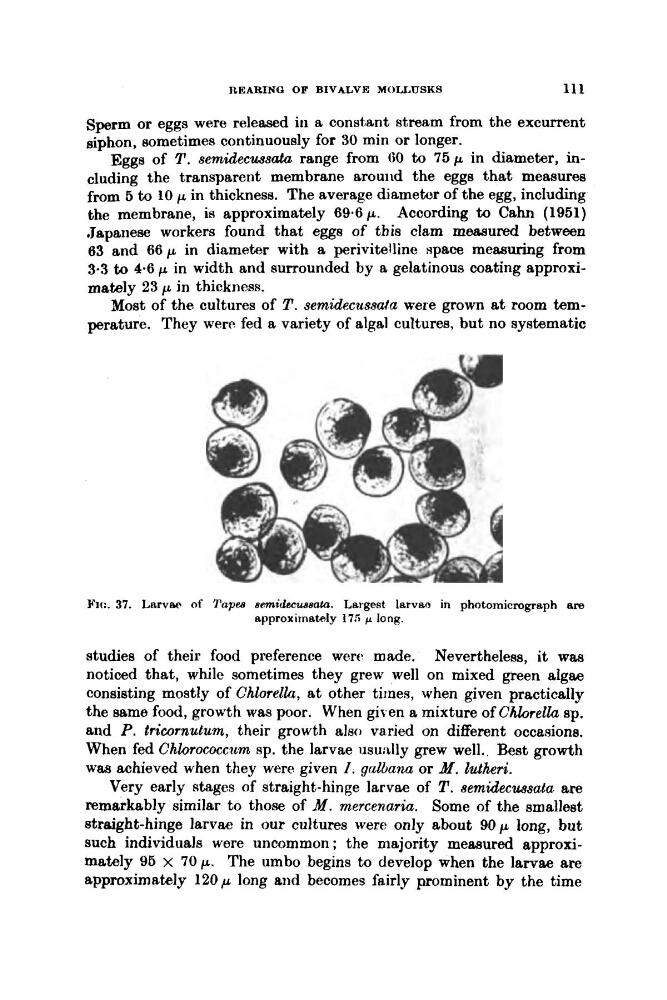
PIC:. 37. Larvae of Tape8 sam~dem.88ala. Largest larvae in photomicrograph are
approximately 17.5 p long.
studies of their food preference were made. Nevertheless, it wm
noticed that, while sometimes they grew well on mixed green algae
consisting mostly of Chlorella, at other times, when given practically
the same food, growth was poor. When git en a mixture of Chlorella sp.
and P . tricornutum, their growth also varied on different occasiona.
When fed Chhococcum sp. the larvae usu:dly grew well. Best growth
waa achieved when they were given 1. galbana or N. Zutheri.
Very early stages of straight-hinge larvae of T . semidecussata are
remarkably similar to those of M. mercenaria. Some of the smallest
straight-hinge larvae in our cultures were only about 9Op long, but
such individuals were uncommon ; the majority measured approximately 95 x 7 0 p . The umbo begins to develop when the larvae are
approximately 120p long and becomes fairly prominent by the time
111
Sperm or eggs were released in a constant stream from the excurrent
siphon, sometimes continuously for 30 min or longer.
Eggs of T . semidecussata range from GO to 7 5 p in diameter, including the transparent membrane around the eggs that measures
from 5 to 10 p in thickness. The average diameter of the egg, including
the membrane, is approximately 6 9 . 6 ~ . According to Cahn (1951)
.Japanese workers found that eggs of this clam memured between
63 and 6 6 p in diameter with a perivitelline space measuring from
3-3 to 4-6 p in width and surrounded by a gelatinous coating approximately 23 p in thickness.
Most of the cultures of T . semidecussata were grown at room temperature. They were fed a variety of algal cultures, but no systematic
PIC:. 37. Larvae of Tape8 sam~dem.88ala. Largest larvae in photomicrograph are
approximately 17.5 p long.
studies of their food preference were made. Nevertheless, it wm
noticed that, while sometimes they grew well on mixed green algae
consisting mostly of Chlorella, at other times, when given practically
the same food, growth was poor. When git en a mixture of Chlorella sp.
and P . tricornutum, their growth also varied on different occasiona.
When fed Chhococcum sp. the larvae usu:dly grew well. Best growth
waa achieved when they were given 1. galbana or N. Zutheri.
Very early stages of straight-hinge larvae of T . semidecussata are
remarkably similar to those of M. mercenaria. Some of the smallest
straight-hinge larvae in our cultures were only about 9Op long, but
such individuals were uncommon ; the majority measured approximately 95 x 7 0 p . The umbo begins to develop when the larvae are
approximately 120p long and becomes fairly prominent by the time