

REARING OF BIVALVE MOLLUSKS
109
of this species found in plankton were about 300 p long. However, he
d d e d that the veliger may leave the plankton at a length of about
256 p, which is not too different from our maximal size.
Jergensen (1946) also offered extensive observations on the length
of larvae of C. edulp. He stated that in rearing experiments at Kristineberg the length at metamorphosis varied from about 275 to 345 p.
Length measurements of prodissoconchs in oyster ponds near Limfjord
varied from 200 to 275 p, averaging 240 p. Jergensen was under the
impression that larvae of this species are distinguished by an excessive
variation in size at the time of metamorphosis. This condition coincides
with our observation that usually in cultures of larvae approaching
metamorphosis there is a great variation in size. For example, in our
cultures of L. mortoni, while some of th(: larvac: had a1rc:mly w t arid
others approaching motarnorphosin mcaxurc4 245 / 805 p, thtr nrnrrlle~t
individualR in thc samc! oulture, growit titidt:r itl(:tit,ical coii(Jit,ions, were
otily 140 x 120 p.
J,. Mercenariu (== V e n w ) canipechienoiu (Gmelin)
1 heso ohins, cornrnoiily knowti ILH noullic:rri (llItthO#R, ww(! Im)tight
to Miffortl fkom t h (iulf of M(:xic:o, iiwr itliriluahic:olrL, I4orida.
Although thcv q p : a r to differ wrnc!wtirht from northcwr quahogu,
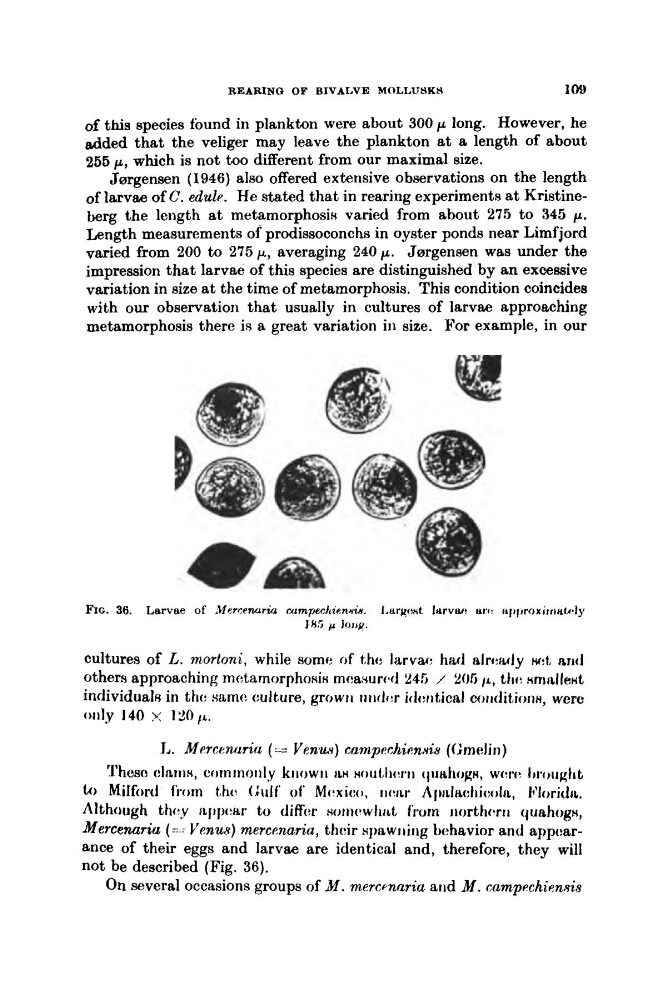
Mercenaria (=-: Yenw) mercanarin, thcir spawriing behavior anti appearance of their eggs and larvae are identical and, therefore, they will
not be described (Fig. 36).
On several occasions groups of M. m,ercrnariu and M . cumpechiensis
t l
109
of this species found in plankton were about 300 p long. However, he
d d e d that the veliger may leave the plankton at a length of about
256 p, which is not too different from our maximal size.
Jergensen (1946) also offered extensive observations on the length
of larvae of C. edulp. He stated that in rearing experiments at Kristineberg the length at metamorphosis varied from about 275 to 345 p.
Length measurements of prodissoconchs in oyster ponds near Limfjord
varied from 200 to 275 p, averaging 240 p. Jergensen was under the
impression that larvae of this species are distinguished by an excessive
variation in size at the time of metamorphosis. This condition coincides
with our observation that usually in cultures of larvae approaching
metamorphosis there is a great variation in size. For example, in our
cultures of L. mortoni, while some of th(: larvac: had a1rc:mly w t arid
others approaching motarnorphosin mcaxurc4 245 / 805 p, thtr nrnrrlle~t
individualR in thc samc! oulture, growit titidt:r itl(:tit,ical coii(Jit,ions, were
otily 140 x 120 p.
J,. Mercenariu (== V e n w ) canipechienoiu (Gmelin)
1 heso ohins, cornrnoiily knowti ILH noullic:rri (llItthO#R, ww(! Im)tight
to Miffortl fkom t h (iulf of M(:xic:o, iiwr itliriluahic:olrL, I4orida.
Although thcv q p : a r to differ wrnc!wtirht from northcwr quahogu,
Mercenaria (=-: Yenw) mercanarin, thcir spawriing behavior anti appearance of their eggs and larvae are identical and, therefore, they will
not be described (Fig. 36).
On several occasions groups of M. m,ercrnariu and M . cumpechiensis
t l