

100
VICTOR L. LOOSANOFF AND HARRY C. DAVIS
in length, which is in close agreement with the measurement of larvae
of our species.
Scallop larvae were grown at room temperatures varying between
20” and 23°C. They were fed either mixed cultures of plankton consisting principally of Chlorella-like forms or a mixture of flagellates,
such as I . galbarn and M . luthari. They grew well on either diet, but
cuiturss fed flagellates grew better. When well fed the growth of larvae
is comparatively rapid, averaging more than 10 p per day. In some
of our cultures setting began 14 days after fertilization.
Larvae are susceptible to fungus diseases, but fungus does not
appear to be as devastating to scallop larvae as it is to larvae of
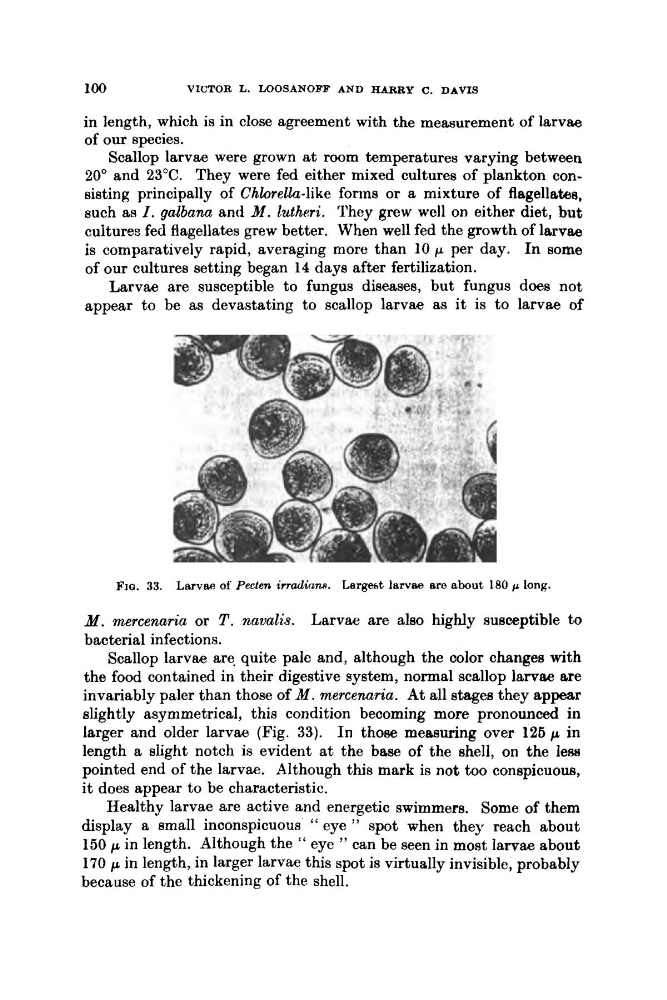
FIQ. 33. Larvae of Peclen irrdionn. Lergeht larvee are about 180 p long.
H. mercenaria or T . navalis. Larvae are also highly susceptible to
bacterial infections.
Scallop larvae are. quite pale and, although the color changes with
the food contained in their digestive system, normal scallop larvae are
invariably paler than those of M . mercenaria. At all stages they appear
slightly asymmetrical, this condition becoming more pronounced in
larger and older larvae (Fig. 33). I n those measuring over 126 p in
length a slight notch is evident at the base of the shell, on the lem
pointed end of the larvae. Although this mark is not too conspicuous,
it does appear to be characteristic.
Healthy larvae are active and energetic swimmers. Some of them
display a small inconspicuous “ e y e ” spot when they reach about
150 p in length. Although the ‘‘ eye ” can be seen in most larvae about
170 p in length, in larger larvae this spot is virtually invisible, probably
because of the thickening of the shell.
VICTOR L. LOOSANOFF AND HARRY C. DAVIS
in length, which is in close agreement with the measurement of larvae
of our species.
Scallop larvae were grown at room temperatures varying between
20” and 23°C. They were fed either mixed cultures of plankton consisting principally of Chlorella-like forms or a mixture of flagellates,
such as I . galbarn and M . luthari. They grew well on either diet, but
cuiturss fed flagellates grew better. When well fed the growth of larvae
is comparatively rapid, averaging more than 10 p per day. In some
of our cultures setting began 14 days after fertilization.
Larvae are susceptible to fungus diseases, but fungus does not
appear to be as devastating to scallop larvae as it is to larvae of
FIQ. 33. Larvae of Peclen irrdionn. Lergeht larvee are about 180 p long.
H. mercenaria or T . navalis. Larvae are also highly susceptible to
bacterial infections.
Scallop larvae are. quite pale and, although the color changes with
the food contained in their digestive system, normal scallop larvae are
invariably paler than those of M . mercenaria. At all stages they appear
slightly asymmetrical, this condition becoming more pronounced in
larger and older larvae (Fig. 33). I n those measuring over 126 p in
length a slight notch is evident at the base of the shell, on the lem
pointed end of the larvae. Although this mark is not too conspicuous,
it does appear to be characteristic.
Healthy larvae are active and energetic swimmers. Some of them
display a small inconspicuous “ e y e ” spot when they reach about
150 p in length. Although the ‘‘ eye ” can be seen in most larvae about
170 p in length, in larger larvae this spot is virtually invisible, probably
because of the thickening of the shell.