

REARING OF BIVALVE MOLLUSKS
97
260 to 270 p. Lebour (1938) stated that A. squumula may metamorphose at a length of only 180 p, which coincides with our observations
on A. simplex, while Stafford maintained that the veliger of A. aculeata
is still pelagic at about 350 p.
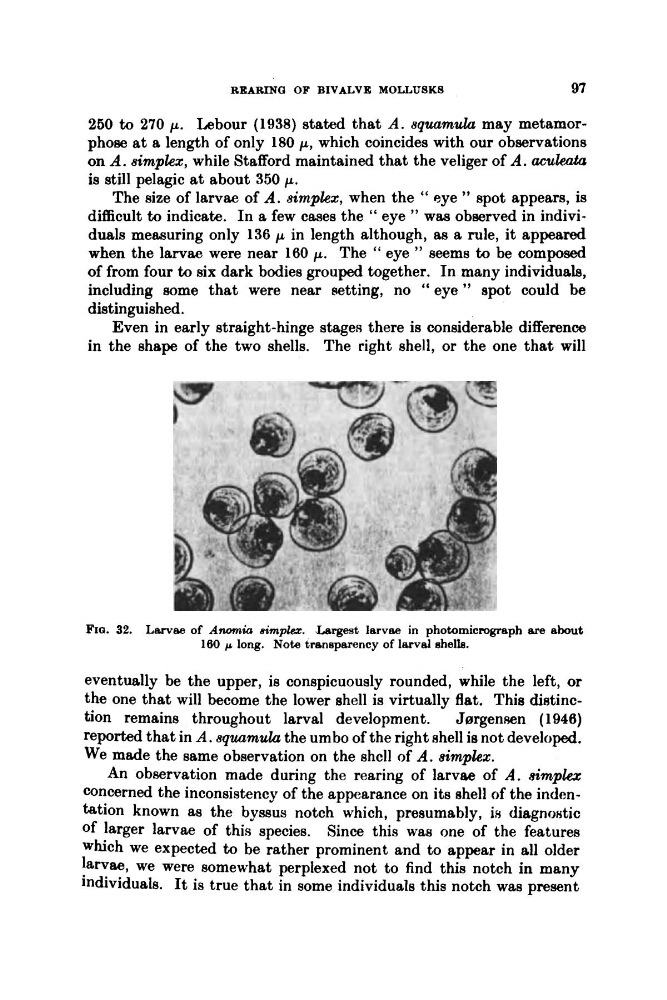
The size of larvae of A. simplex, when the “ eye ” spot appears, is
difficult to indicate. In a few cases the ‘‘ eye ” was observed in individuals measuring only 136 p in length although, as a rule, it appeared
when the larvae were near 160 p. The “ eye ” seems to be composed
of from four to six dark bodies grouped together. In many individuals,
including some that were near Betting, no “ e y e ” spot could be
distinguished.
Even in early straight-hinge stages there is considerable difference
in the shape of the two shells. The right shell, or the one that will
FIQ. 32. Larvae of Anomia simplex. .Largest larvae in photomicrograph are about
160 p long. Note transparency of larval shells.
eventually be the upper, is conspicuously rounded, while the left, or
the one that will become the lower shell is virtually flat. This distinction remains throughout larval developmen t. J s r g e n ~ n ( 1946)
reported that in A. squamula the umbo of the right shell is not developed.
We made the same observation on the shell of A. simplex.
An observation made during the rearing of larvae of A. simplex
concerned the inconsistency of the appearance on its shell of the indentation known as the byssus notch which, presumably, in diagnostic
of larger larvae of this species. Since this was one of the features
which we expected to be rather prominent and to appear in all older
larvae, we were somewhat perplexed not to find this notch in many
individuals. It is true that in some individuals this notch was present
97
260 to 270 p. Lebour (1938) stated that A. squumula may metamorphose at a length of only 180 p, which coincides with our observations
on A. simplex, while Stafford maintained that the veliger of A. aculeata
is still pelagic at about 350 p.
The size of larvae of A. simplex, when the “ eye ” spot appears, is
difficult to indicate. In a few cases the ‘‘ eye ” was observed in individuals measuring only 136 p in length although, as a rule, it appeared
when the larvae were near 160 p. The “ eye ” seems to be composed
of from four to six dark bodies grouped together. In many individuals,
including some that were near Betting, no “ e y e ” spot could be
distinguished.
Even in early straight-hinge stages there is considerable difference
in the shape of the two shells. The right shell, or the one that will
FIQ. 32. Larvae of Anomia simplex. .Largest larvae in photomicrograph are about
160 p long. Note transparency of larval shells.
eventually be the upper, is conspicuously rounded, while the left, or
the one that will become the lower shell is virtually flat. This distinction remains throughout larval developmen t. J s r g e n ~ n ( 1946)
reported that in A. squamula the umbo of the right shell is not developed.
We made the same observation on the shell of A. simplex.
An observation made during the rearing of larvae of A. simplex
concerned the inconsistency of the appearance on its shell of the indentation known as the byssus notch which, presumably, in diagnostic
of larger larvae of this species. Since this was one of the features
which we expected to be rather prominent and to appear in all older
larvae, we were somewhat perplexed not to find this notch in many
individuals. It is true that in some individuals this notch was present