

REAILING O F BIVALVE MOLLUSKS
91
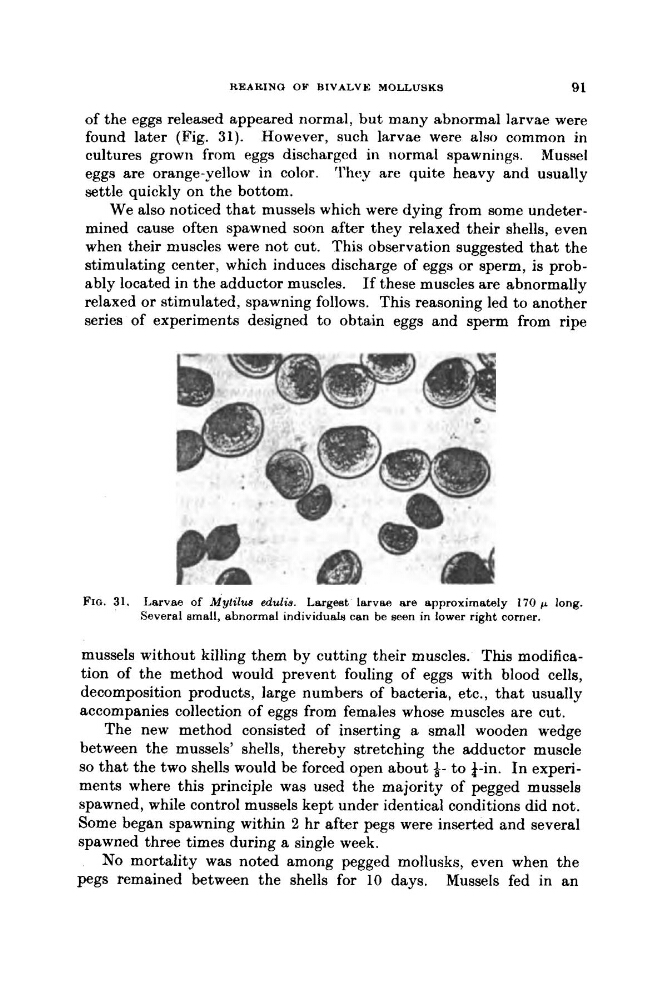
of the eggs released appeared normal, but many abnormal larvae were
found later (Fig. 31). However, such larvae were also common in
cultures grown from eggs discharged in normal spawnings. Mussel
eggs are orange-yellow in color. ‘l’hsy are quite heavy and usually
settle quickly on the bottom.
We also noticed that mussels which were dying from some undetermined cause often spawned soon after they relaxed their shells, even
when their muscles were not cut. This observation suggested that the
stimulating center, which induces discharge of eggs or sperm, is probably located in the adductor muscles. If these muscles are abnormally
relaxed or stimulated, spawning follows. This reasoning led to another
series of experiments designed to obtain eggs and sperm from ripe
FIG. 31. Larvae of Mytilus edulis. Largest larvae are approximately 170 p long.
Several small, abnormal individuals can be seen in lower right comer.
mussels without killing them by cutting their muscles. This modification of the method would prevent fouling of eggs with blood cells,
decomposition products, large numbers of bacteria, etc., that usually
accompanies collection of eggs from females whose muscles are cut.
The new method consisted of inserting a small wooden wedge
between the mussels’ shells, thereby stretching the adductor muscle
so that the two shells would be forced open about Q- t o t-in. I n experiments where this principle was used the majority of pegged mussels
spawned, while control mussels kept under identical conditions did not.
Some began spawning within 2 hr after pegs were inserted and several
spawned three times during a single week.
No mortality was noted among pegged mollusks, even when the
pegs remained between the shells for 10 days. Mussels fed in an
91
of the eggs released appeared normal, but many abnormal larvae were
found later (Fig. 31). However, such larvae were also common in
cultures grown from eggs discharged in normal spawnings. Mussel
eggs are orange-yellow in color. ‘l’hsy are quite heavy and usually
settle quickly on the bottom.
We also noticed that mussels which were dying from some undetermined cause often spawned soon after they relaxed their shells, even
when their muscles were not cut. This observation suggested that the
stimulating center, which induces discharge of eggs or sperm, is probably located in the adductor muscles. If these muscles are abnormally
relaxed or stimulated, spawning follows. This reasoning led to another
series of experiments designed to obtain eggs and sperm from ripe
FIG. 31. Larvae of Mytilus edulis. Largest larvae are approximately 170 p long.
Several small, abnormal individuals can be seen in lower right comer.
mussels without killing them by cutting their muscles. This modification of the method would prevent fouling of eggs with blood cells,
decomposition products, large numbers of bacteria, etc., that usually
accompanies collection of eggs from females whose muscles are cut.
The new method consisted of inserting a small wooden wedge
between the mussels’ shells, thereby stretching the adductor muscle
so that the two shells would be forced open about Q- t o t-in. I n experiments where this principle was used the majority of pegged mussels
spawned, while control mussels kept under identical conditions did not.
Some began spawning within 2 hr after pegs were inserted and several
spawned three times during a single week.
No mortality was noted among pegged mollusks, even when the
pegs remained between the shells for 10 days. Mussels fed in an