

86
VICTOR L. LOOSANOFF A N D HARRY C. DAWS
C . Arca transversa Say
No description of larval development of A . tramversa or any
references to its spawning could be found in the 1iLerature.
Our attempts to condition and spawn A . transversa in winter met
with failure or only partial success. Later in the season, about the
middle of May, some of the “ a r k s ” brought in from Long Island
Sound and placed directly in water of 20°C spawned lightly within
2 or 3 hr. No normal larvae, however, could be grown from these eggs.
Nevertheless, by placing the same ‘‘ arks ” in running sea water a%
15°C from 3 to 7 days to condition them, spawning wag easily induced
by raising the water temperature to 27” or 28°C. Both males and females
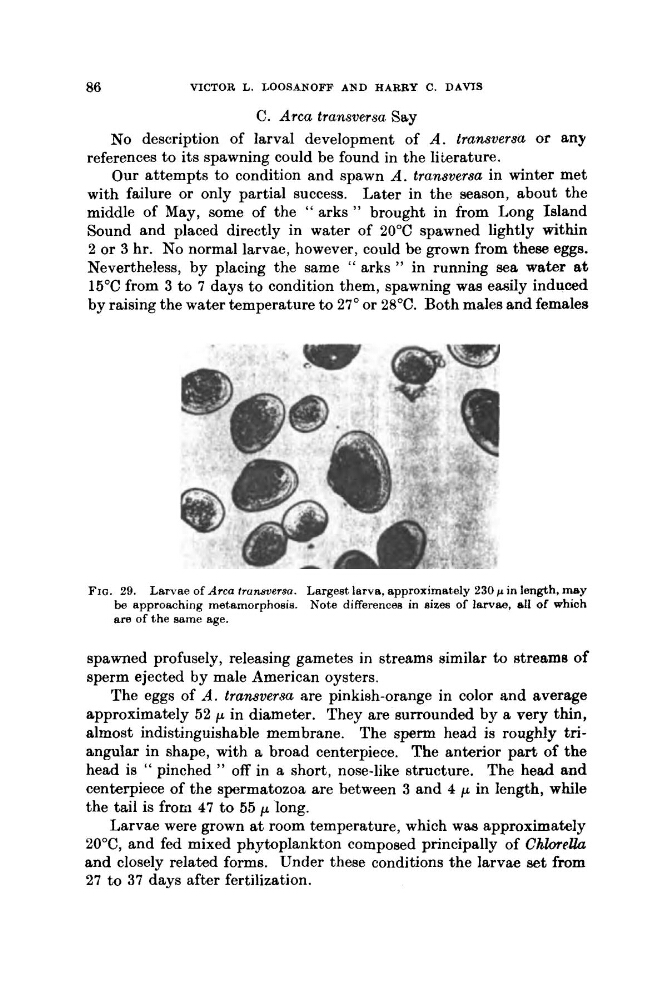
FIQ. 29. Larvae of Arca tramversa. Largest larva, approximately 230 /
.
I in length, m y
be approaching metamorphosis. Note differences in sizea of larvae, etl of which
are of the same age.
spawned profusely, releasing gametes in streams similar to streams of
sperm ejected by male American oysters.
The eggs of ,4. tramversa are pinkish-orange in color and average
approximately 52 p in diameter. They are surrounded by a very thin,
almost indistinguishable membrane. The sperm head is roughly triangular in shape, with a broad centerpiece. The anterior part of the
head is “ pinched ’’ off in a short, nose-like structure. The head and
centerpiece of the spermatozoa are between 3 and 4 p in length, while
the tail is from 47 to 55 p long.
Larvae were grown at room temperature, which was approximately
20°C, and fed mixed phytoplankton composed principally of Chlmellu
and closely related forms. Under these conditions the larvae set from
27 to 37 days after fertilization.
VICTOR L. LOOSANOFF A N D HARRY C. DAWS
C . Arca transversa Say
No description of larval development of A . tramversa or any
references to its spawning could be found in the 1iLerature.
Our attempts to condition and spawn A . transversa in winter met
with failure or only partial success. Later in the season, about the
middle of May, some of the “ a r k s ” brought in from Long Island
Sound and placed directly in water of 20°C spawned lightly within
2 or 3 hr. No normal larvae, however, could be grown from these eggs.
Nevertheless, by placing the same ‘‘ arks ” in running sea water a%
15°C from 3 to 7 days to condition them, spawning wag easily induced
by raising the water temperature to 27” or 28°C. Both males and females
FIQ. 29. Larvae of Arca tramversa. Largest larva, approximately 230 /
.
I in length, m y
be approaching metamorphosis. Note differences in sizea of larvae, etl of which
are of the same age.
spawned profusely, releasing gametes in streams similar to streams of
sperm ejected by male American oysters.
The eggs of ,4. tramversa are pinkish-orange in color and average
approximately 52 p in diameter. They are surrounded by a very thin,
almost indistinguishable membrane. The sperm head is roughly triangular in shape, with a broad centerpiece. The anterior part of the
head is “ pinched ’’ off in a short, nose-like structure. The head and
centerpiece of the spermatozoa are between 3 and 4 p in length, while
the tail is from 47 to 55 p long.
Larvae were grown at room temperature, which was approximately
20°C, and fed mixed phytoplankton composed principally of Chlmellu
and closely related forms. Under these conditions the larvae set from
27 to 37 days after fertilization.