

POPULATION CYCLES IN SMALL MAMMALS
369
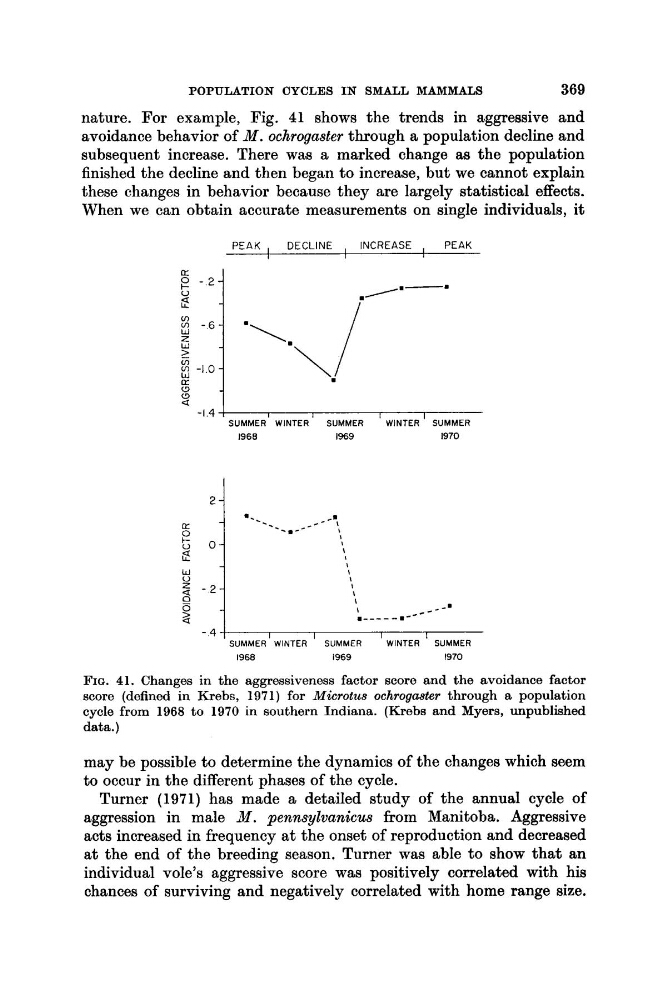
nature. For example, Fig. 41 shows the trends in aggressive and
avoidance behavior of M . ochrogaster through a population decline and
subsequent increase. There was a marked change as the population
finished the decline and then began to increase, but we cannot explain
these changes in behavior because they are largely statistical effects.
When we can obtain accurate measurements on single individuals, it
PEAK , DECLINE , INCREASE I PEAK
I
I
-1.4 !
I
I
I
SUMMER WINTER
SUMMER
WINTER I SUMMER
1968
1969
1970
I
I
I
I
SUMMER WINTER
SUMMER
WINTER
SUMMER
1968
1969
1970
FIG. 41. Changes in the aggressiveness factor score and the avoidance factor
score (defined in Krebs, 1971) for Microtus ochrogmter through a population
cycle from 1968 to 1970 in southern Indiana. (Krebs and Myers, unpublished
data.)
may be possible to determine the dynamics of the changes which seem
to occur in the different phases of the cycle.
Turner (1971) has made a detailed study of the annual cycle of
aggression in male M . pennsylvanicus from Manitoba. Aggressive
acts increased in frequency at the onset of reproduction and decreased
at the end of the breeding season. Turner was able to show that an
individual vole’s aggressive score was positively correlated with his
chances of surviving and negatively correlated with home range size.
369
nature. For example, Fig. 41 shows the trends in aggressive and
avoidance behavior of M . ochrogaster through a population decline and
subsequent increase. There was a marked change as the population
finished the decline and then began to increase, but we cannot explain
these changes in behavior because they are largely statistical effects.
When we can obtain accurate measurements on single individuals, it
PEAK , DECLINE , INCREASE I PEAK
I
I
-1.4 !
I
I
I
SUMMER WINTER
SUMMER
WINTER I SUMMER
1968
1969
1970
I
I
I
I
SUMMER WINTER
SUMMER
WINTER
SUMMER
1968
1969
1970
FIG. 41. Changes in the aggressiveness factor score and the avoidance factor
score (defined in Krebs, 1971) for Microtus ochrogmter through a population
cycle from 1968 to 1970 in southern Indiana. (Krebs and Myers, unpublished
data.)
may be possible to determine the dynamics of the changes which seem
to occur in the different phases of the cycle.
Turner (1971) has made a detailed study of the annual cycle of
aggression in male M . pennsylvanicus from Manitoba. Aggressive
acts increased in frequency at the onset of reproduction and decreased
at the end of the breeding season. Turner was able to show that an
individual vole’s aggressive score was positively correlated with his
chances of surviving and negatively correlated with home range size.