

POPULATION CYCLES IN SMALL MAMMALS
365
The third criterion of Watson and Moss (1970) is that the breeding
animals are not completely depleting some resource, such as food. This
particular criterion brings together most of the controversy over
microtine cycles. We have argued above that the present evidence does
not indicate that populations of cyclic rodents are completely using
some resource such as food. But it is possible to argue that we do not
yet appreciate what a “resource” is to a vole, and consequently we
should consider other types of evidence.
If hostility is part of the mechanism for generating population cycles
in rodents, we must expect that the aggressive behavior of individuals
changes with density. Two types of data are available on this question.
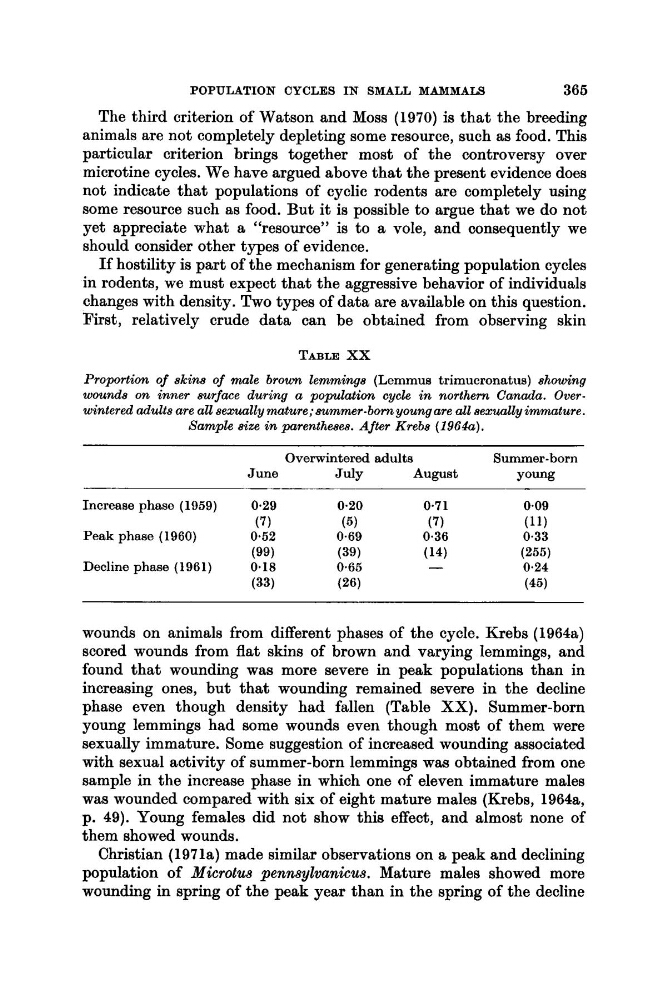
First, relatively crude data can be obtained from observing skin
TABLE XX
Proportion of skins of male brown lemmings (Lemmus trimucronatus) showing
wounds on inner surface during a population cycle in northern Canada. Overwintered adults are all sexually mature;summRr-born youngare all sexually immature.
Sample size in parentheses. After Krebs (1964a).
Overwintered adults
Summer -born
June
JdY
August
Young
Increase phase (1959)
0.29
0.20
0-7 1
0.09
(7)
( 5 )
(7)
(11)
(99)
(39)
(33)
(26)
(45)
Peak phase (1960)
0.52
0.69
0.36
0.33
(14)
(255)
-
0.24
Decline phase (1961)
0.18
0-65
wounds on animals from different phases of the cycle. Krebs (1964a)
scored wounds from flat skins of brown and varying lemmings, and
found that wounding was more severe in peak populations than in
increasing ones, but that wounding remained severe in the decline
phase even though density had fallen (Table XX). Summer-born
young lemmings had some wounds even though most of them were
sexually immature. Some suggestion of increased wounding associated
with sexual activity of summer-born lemmings was obtained from one
sample in the increase phase in which one of eleven immature males
was wounded compared with six of eight mature males (Krebs, 1964a,
p. 49). Young females did not show this effect, and almost none of
them showed wounds.
Christian (1971a) made similar observations on a peak and declining
population of Microtus pennsylvanicus. Mature males showed more
wounding in spring of the peak year than in the spring of the decline
365
The third criterion of Watson and Moss (1970) is that the breeding
animals are not completely depleting some resource, such as food. This
particular criterion brings together most of the controversy over
microtine cycles. We have argued above that the present evidence does
not indicate that populations of cyclic rodents are completely using
some resource such as food. But it is possible to argue that we do not
yet appreciate what a “resource” is to a vole, and consequently we
should consider other types of evidence.
If hostility is part of the mechanism for generating population cycles
in rodents, we must expect that the aggressive behavior of individuals
changes with density. Two types of data are available on this question.
First, relatively crude data can be obtained from observing skin
TABLE XX
Proportion of skins of male brown lemmings (Lemmus trimucronatus) showing
wounds on inner surface during a population cycle in northern Canada. Overwintered adults are all sexually mature;summRr-born youngare all sexually immature.
Sample size in parentheses. After Krebs (1964a).
Overwintered adults
Summer -born
June
JdY
August
Young
Increase phase (1959)
0.29
0.20
0-7 1
0.09
(7)
( 5 )
(7)
(11)
(99)
(39)
(33)
(26)
(45)
Peak phase (1960)
0.52
0.69
0.36
0.33
(14)
(255)
-
0.24
Decline phase (1961)
0.18
0-65
wounds on animals from different phases of the cycle. Krebs (1964a)
scored wounds from flat skins of brown and varying lemmings, and
found that wounding was more severe in peak populations than in
increasing ones, but that wounding remained severe in the decline
phase even though density had fallen (Table XX). Summer-born
young lemmings had some wounds even though most of them were
sexually immature. Some suggestion of increased wounding associated
with sexual activity of summer-born lemmings was obtained from one
sample in the increase phase in which one of eleven immature males
was wounded compared with six of eight mature males (Krebs, 1964a,
p. 49). Young females did not show this effect, and almost none of
them showed wounds.
Christian (1971a) made similar observations on a peak and declining
population of Microtus pennsylvanicus. Mature males showed more
wounding in spring of the peak year than in the spring of the decline