

POPULATION CYCLES IN SMALL MAMMALS
355
. the technique used by Christian and Davis (1966) in their most recent
investigation. Since these authors conclude a “marked parallelism”
between adrenal weights and population density for Microtus pennsylvanicus, this paper deserves further consideration. Overlooking previous
discussions of appropriate methods for analysis of adrenal-body weight
relations (Chitty, 1961; Krebs, 1964a), Christian and Davis used mg
adrenal w t / l O O gm body wt for their comparative index. By doing this
they are assuming a relationship between adrenal weight and body
weight which is linear with a slope of 1, an unlikely situation. The
population index was the number of voles caught/1000 trap nights in
one 24-hour period. This technique of population estimation is not
reliable. Population density declined from its highest point in September
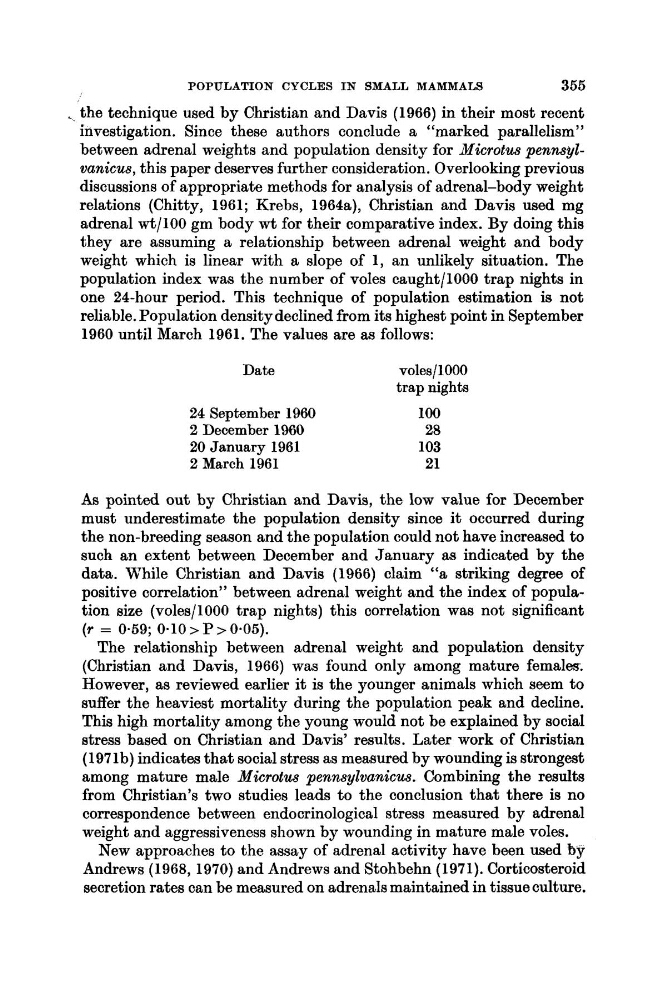
1960 until March 1961. The values are as follows:
Date
24 September 1960
2 December 1960
20 January 1961
2 March 1961
voles/ 1000
trap nights
100
28
103
21
As pointed out by Christian and Davis, the low value for December
must underestimate the population density since it occurred during
the non-breeding season and the population could not have increased to
such an extent between December and January as indicated by the
data. While Christian and Davis (1966) claim “a striking degree of
positive correlation” between adrenal weight and the index of population size (voles/1000 trap nights) this correlation was not significant
(T = 0.59; 0.10 > P > 0.05).
The relationship between adrenal weight and population density
(Christian and Davis, 1966) was found only among mature females.
However, as reviewed earlier it is the younger animals which seem to
suffer the heaviest mortality during the population peak and decline.
This high mortality among the young would not be explained by social
stress based on Christian and David results. Later work of Christian
(1971b) indicates that social stress as measured by wounding is strongest
among mature male Microtus pennsylvanicus. Combining the results
from Christian’s two studies leads to the conclusion that there is no
correspondence between endocrinological stress measured by adrenal
weight and aggressiveness shown by wounding in mature male voles.
New approaches to the assay of adrenal activity have been used by
Andrews (1968, 1970) and Andrews and Stohbehn (1971). Corticosteroid
secretion rates can be measured on adrenals maintained in tissue culture.
355
. the technique used by Christian and Davis (1966) in their most recent
investigation. Since these authors conclude a “marked parallelism”
between adrenal weights and population density for Microtus pennsylvanicus, this paper deserves further consideration. Overlooking previous
discussions of appropriate methods for analysis of adrenal-body weight
relations (Chitty, 1961; Krebs, 1964a), Christian and Davis used mg
adrenal w t / l O O gm body wt for their comparative index. By doing this
they are assuming a relationship between adrenal weight and body
weight which is linear with a slope of 1, an unlikely situation. The
population index was the number of voles caught/1000 trap nights in
one 24-hour period. This technique of population estimation is not
reliable. Population density declined from its highest point in September
1960 until March 1961. The values are as follows:
Date
24 September 1960
2 December 1960
20 January 1961
2 March 1961
voles/ 1000
trap nights
100
28
103
21
As pointed out by Christian and Davis, the low value for December
must underestimate the population density since it occurred during
the non-breeding season and the population could not have increased to
such an extent between December and January as indicated by the
data. While Christian and Davis (1966) claim “a striking degree of
positive correlation” between adrenal weight and the index of population size (voles/1000 trap nights) this correlation was not significant
(T = 0.59; 0.10 > P > 0.05).
The relationship between adrenal weight and population density
(Christian and Davis, 1966) was found only among mature females.
However, as reviewed earlier it is the younger animals which seem to
suffer the heaviest mortality during the population peak and decline.
This high mortality among the young would not be explained by social
stress based on Christian and David results. Later work of Christian
(1971b) indicates that social stress as measured by wounding is strongest
among mature male Microtus pennsylvanicus. Combining the results
from Christian’s two studies leads to the conclusion that there is no
correspondence between endocrinological stress measured by adrenal
weight and aggressiveness shown by wounding in mature male voles.
New approaches to the assay of adrenal activity have been used by
Andrews (1968, 1970) and Andrews and Stohbehn (1971). Corticosteroid
secretion rates can be measured on adrenals maintained in tissue culture.