

POPULATION CYCLES IN SMALL MAMMALS
349
arctic microtines. There is great variation from year to year in the
timing of the snow melt, and this might affect summer population
growth. Without winter sampling it is difficult to judge accurately the
beginning of the summer breeding season of arctic microtines. However,
Mullen (1968) attempted to do this by looking for signs of recent
reproduction in female brown lemmings taken in June. From this
analysis he proposed that the date of beginning of the summer breeding
season is crucial to the demographic performance of the population
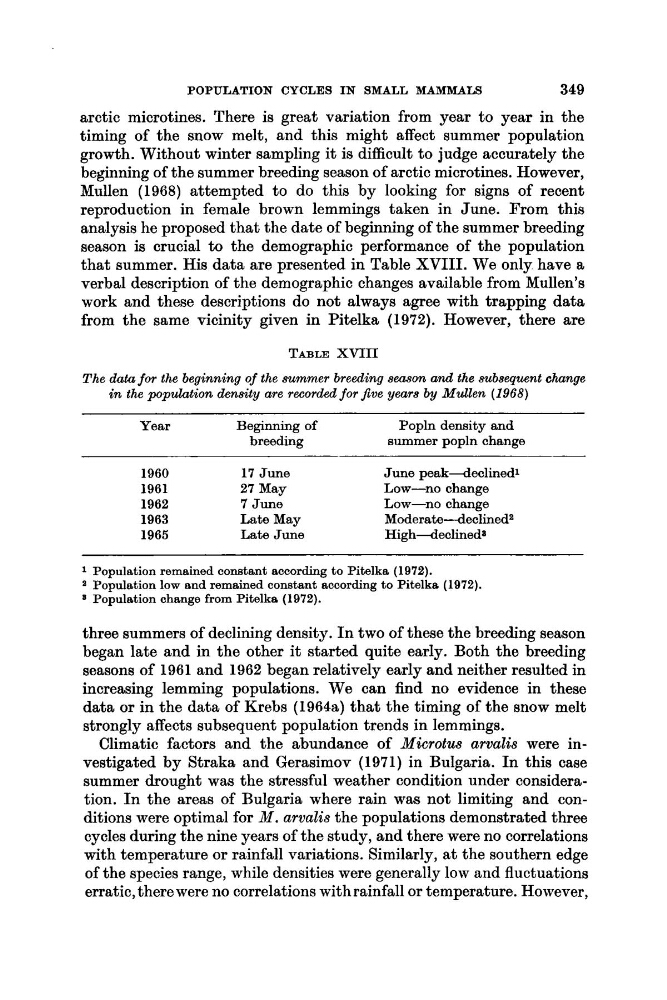
that summer. His data are presented in Table XVIII. We only have a
verbal description of the demographic changes available from Mullen’s
work and these descriptions do not always agree with trapping data
from the same vicinity given in Pitelka (1972). However, there are
TABLE XVIII
The data for the beginning of the summer breeding season and the subsequent change
in the population density are recorded for five years by Mullen (1968)
Year
Beginning of
Popln density and
breeding
summer popln change
~~
~
1960
17 June
June peakdeclinedl
1961
27 May
Low-no change
1962
7 June
Low-no change
1963
Late May
Moderate--declineda
1965
Late June
Highdeclined8
1 Population remained constant according to Pitelka (1972).
a Population low and remained constant according to Pitelka (1972).
8 Population change from Pitelka (1972).
three summers of declining density. I n two of these the breeding season
began late and in the other it started quite early. Both the breeding
seasons of 1961 and 1962 began relatively early and neither resulted in
increasing lemming populations. We can find no evidence in these
data or in the data of Krebs (1964a) that the timing of the snow melt
strongly affects subsequent population trends in lemmings.
Climatic factors and the abundance of Microtus arvalis were investigated by Straka and Gerasimov (1971) in Bulgaria. In this case
summer drought was the stressful weather condition under consideration. In the areas of Bulgaria where rain was not limiting and conditions were optimal for M . arvalis the populations demonstrated three
cycles during the nine years of the study, and there were no correlations
with temperature or rainfall variations. Similarly, at the southern edge
of the species range, while densities were generally low and fluctuations
erratic, there were no correlations with rainfall or temperature. However,
349
arctic microtines. There is great variation from year to year in the
timing of the snow melt, and this might affect summer population
growth. Without winter sampling it is difficult to judge accurately the
beginning of the summer breeding season of arctic microtines. However,
Mullen (1968) attempted to do this by looking for signs of recent
reproduction in female brown lemmings taken in June. From this
analysis he proposed that the date of beginning of the summer breeding
season is crucial to the demographic performance of the population
that summer. His data are presented in Table XVIII. We only have a
verbal description of the demographic changes available from Mullen’s
work and these descriptions do not always agree with trapping data
from the same vicinity given in Pitelka (1972). However, there are
TABLE XVIII
The data for the beginning of the summer breeding season and the subsequent change
in the population density are recorded for five years by Mullen (1968)
Year
Beginning of
Popln density and
breeding
summer popln change
~~
~
1960
17 June
June peakdeclinedl
1961
27 May
Low-no change
1962
7 June
Low-no change
1963
Late May
Moderate--declineda
1965
Late June
Highdeclined8
1 Population remained constant according to Pitelka (1972).
a Population low and remained constant according to Pitelka (1972).
8 Population change from Pitelka (1972).
three summers of declining density. I n two of these the breeding season
began late and in the other it started quite early. Both the breeding
seasons of 1961 and 1962 began relatively early and neither resulted in
increasing lemming populations. We can find no evidence in these
data or in the data of Krebs (1964a) that the timing of the snow melt
strongly affects subsequent population trends in lemmings.
Climatic factors and the abundance of Microtus arvalis were investigated by Straka and Gerasimov (1971) in Bulgaria. In this case
summer drought was the stressful weather condition under consideration. In the areas of Bulgaria where rain was not limiting and conditions were optimal for M . arvalis the populations demonstrated three
cycles during the nine years of the study, and there were no correlations
with temperature or rainfall variations. Similarly, at the southern edge
of the species range, while densities were generally low and fluctuations
erratic, there were no correlations with rainfall or temperature. However,