

344
CHARLES J. KREBS AND JUDITH H. MYERS
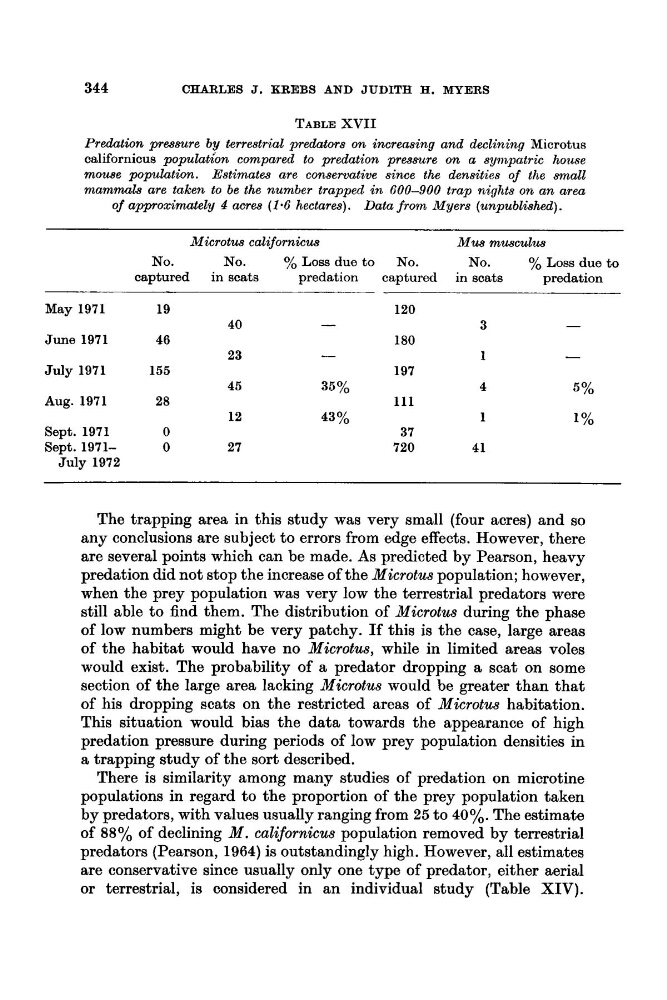
TABLE XVII
Predation pressure by terrestrial predators on increasing and declining Microtus
californicus populatibn compared to predation pressure on a sympatric house
mouse population. Estimates are conservative since the densities of the small
mammals are taken to be the number trapped in 600-900 trap nights on an area
of approximately 4 acres (1.6 hectares). Data from Myers (unpublished).
Microtus californicus
Mus muaculus
captured in scats
predation
captured in scats
predation
No.
No.
yo Loss due to No.
No.
yo Loss due to
May 1971
19
40
23
45
12
Sept. 19710
27
June 1971
46
July 1971
155
Aug. 1971
28
Sept. 1971
0
July 1972
120
180
197
111
37
-
3
1
-
-
-
35%
4
5%
43 %
1
1%
720
41
The trapping area in this study was very small (four acres) and so
any conclusions are subject to errors from edge effects. However, there
are several points which can be made. As predicted by Pearson, heavy
predation did not stop the increase of the Microtus population; however,
when the prey population was very low the terrestrial predators were
still able to find them. The distribution of Microtus during the phase
of low numbers might be very patchy. If this is the case, large areas
of the habitat would have no Microtus, while in limited areas voles
would exist. The probability of a predator dropping a scat on some
section of the large area lacking Microtus would be greater than that
of his dropping scats on the restricted areas of Microtus habitation.
This situation would bias the data towards the appearance of high
predation pressure during periods of low prey population densities in
a, trapping study of the sort described.
There is similarity among many studies of predation on microtine
populations in regard to the proportion of the prey population taken
by predators, with values usually ranging from 25 to 40%. The estimate
of 88% of declining M . californicus population removed by terrestrial
predators (Pearson, 1964) is outstandingly high. However, all estimates
are conservative since usually only one type of predator, either aerial
or terrestrial, is considered in an individual study (Table XIV).
CHARLES J. KREBS AND JUDITH H. MYERS
TABLE XVII
Predation pressure by terrestrial predators on increasing and declining Microtus
californicus populatibn compared to predation pressure on a sympatric house
mouse population. Estimates are conservative since the densities of the small
mammals are taken to be the number trapped in 600-900 trap nights on an area
of approximately 4 acres (1.6 hectares). Data from Myers (unpublished).
Microtus californicus
Mus muaculus
captured in scats
predation
captured in scats
predation
No.
No.
yo Loss due to No.
No.
yo Loss due to
May 1971
19
40
23
45
12
Sept. 19710
27
June 1971
46
July 1971
155
Aug. 1971
28
Sept. 1971
0
July 1972
120
180
197
111
37
-
3
1
-
-
-
35%
4
5%
43 %
1
1%
720
41
The trapping area in this study was very small (four acres) and so
any conclusions are subject to errors from edge effects. However, there
are several points which can be made. As predicted by Pearson, heavy
predation did not stop the increase of the Microtus population; however,
when the prey population was very low the terrestrial predators were
still able to find them. The distribution of Microtus during the phase
of low numbers might be very patchy. If this is the case, large areas
of the habitat would have no Microtus, while in limited areas voles
would exist. The probability of a predator dropping a scat on some
section of the large area lacking Microtus would be greater than that
of his dropping scats on the restricted areas of Microtus habitation.
This situation would bias the data towards the appearance of high
predation pressure during periods of low prey population densities in
a, trapping study of the sort described.
There is similarity among many studies of predation on microtine
populations in regard to the proportion of the prey population taken
by predators, with values usually ranging from 25 to 40%. The estimate
of 88% of declining M . californicus population removed by terrestrial
predators (Pearson, 1964) is outstandingly high. However, all estimates
are conservative since usually only one type of predator, either aerial
or terrestrial, is considered in an individual study (Table XIV).