

328
CHARLES J. KREBS AND JUDITH H. MYERS
75
2
U
0
& 50
P
P 3
0
n
C
.251
.- c
U
3
3
L
2
E
-
P
52
c
ii
B
36
C
.20
al
-
YEAR
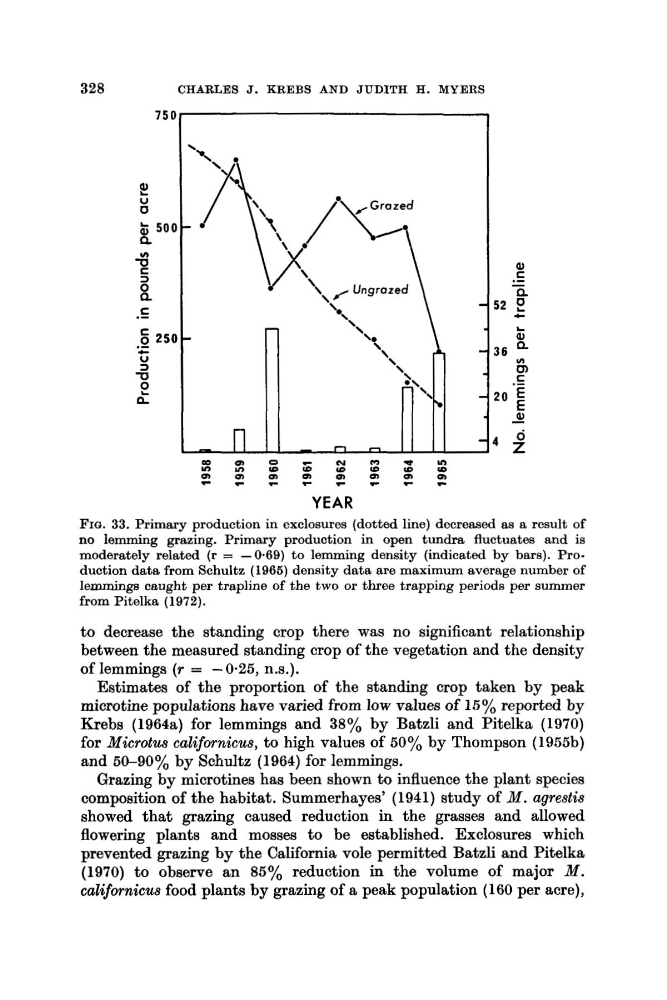
FIG. 33. Primary production in exclosures (dotted line) decreased as a result of
no lemming grazing. Primary production in open tundra fluctuates and is
moderately related (r = -0.69) to lemming density (indicated by bars). Production data from Schultz (1966) density data are maximum average number of
lemmings caught per trapline of the two or three trapping periods per summer
from Pitelka (1972).
to decrease the standing crop there was no significant relationship
between the measured standing crop of the vegetation and the density
of lemmings (r = -0.25, n.8.).
Estimates of the proportion of the standing crop taken by peak
microtine populations have varied from low values of 15% reported by
Krebs (1964a) for lemmings and 38% by Batzli and Pitelka (1970)
for Microtw californicus, to high values of 50% by Thompson (1955b)
and 50-90% by Schultz (1 964) for lemmings,
Grazing by microtines has been shown to influence the plant species
composition of the habitat. Summerhayes’ (1941) study of M . agrestis
showed that grazing caused reduction in the grasses and allowed
flowering plants and mosses to be established. Exclosures which
prevented grazing by the California vole permitted Batzli and Pitelka
(1970) to observe an 85% reduction in the volume of major M .
californicus food plants by grazing of a peak population (160 per acre),
CHARLES J. KREBS AND JUDITH H. MYERS
75
2
U
0
& 50
P
P 3
0
n
C
.251
.- c
U
3
3
L
2
E
-
P
52
c
ii
B
36
C
.20
al
-
YEAR
FIG. 33. Primary production in exclosures (dotted line) decreased as a result of
no lemming grazing. Primary production in open tundra fluctuates and is
moderately related (r = -0.69) to lemming density (indicated by bars). Production data from Schultz (1966) density data are maximum average number of
lemmings caught per trapline of the two or three trapping periods per summer
from Pitelka (1972).
to decrease the standing crop there was no significant relationship
between the measured standing crop of the vegetation and the density
of lemmings (r = -0.25, n.8.).
Estimates of the proportion of the standing crop taken by peak
microtine populations have varied from low values of 15% reported by
Krebs (1964a) for lemmings and 38% by Batzli and Pitelka (1970)
for Microtw californicus, to high values of 50% by Thompson (1955b)
and 50-90% by Schultz (1 964) for lemmings,
Grazing by microtines has been shown to influence the plant species
composition of the habitat. Summerhayes’ (1941) study of M . agrestis
showed that grazing caused reduction in the grasses and allowed
flowering plants and mosses to be established. Exclosures which
prevented grazing by the California vole permitted Batzli and Pitelka
(1970) to observe an 85% reduction in the volume of major M .
californicus food plants by grazing of a peak population (160 per acre),