

POPULATION CYCLES IN SMALL MAMMALS
313
some information on these possible mechanisms, we must measure
dispersal rates in fluctuating populations.
The measurement of dispersal rates is relatively simple in principle
but few workers have tried to monitor dispersal during a population
cycle. The “death rate” measured in live-trapping studies is more
properly called a loss rate, since individuals which emigrate are counted
in the same way as ones which die. Only one study has attempted to
separate loss-by-emigration from loss-by-death i n situ. Myers and
Krebs (1971b) maintained two grassland areas free of voles for two
years and measured the amount of colonization which occurred from
adjacent control areas. Some voles (Microtus pennsylvanicus and
M . ochroguster) which disappeared from the control areas turned up as
immigrants on the vole-free areas and hence we could obtain a minimum
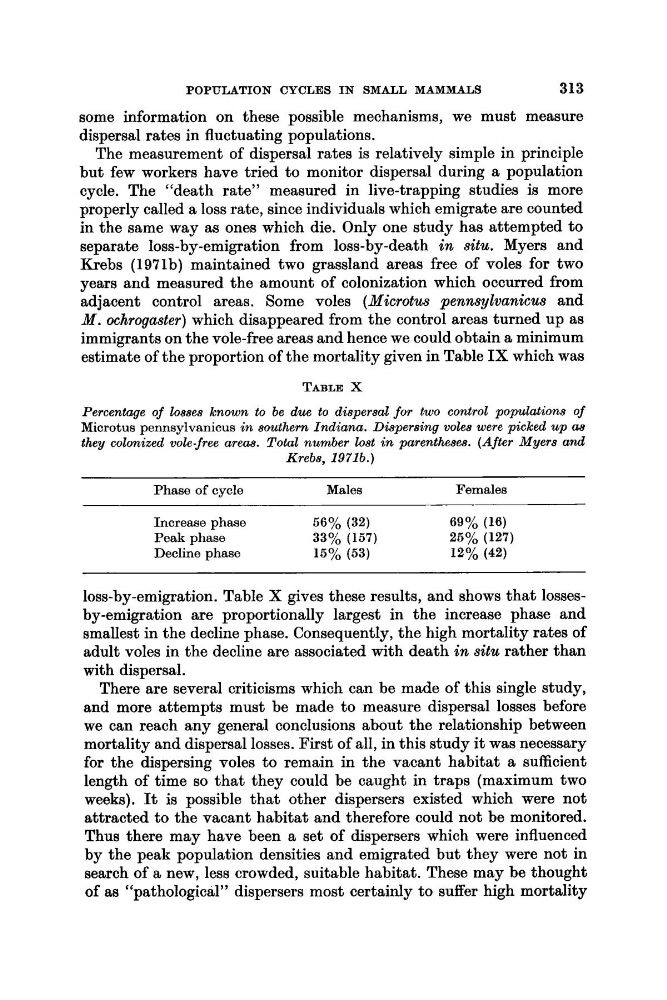
estimate of the proportion of the mortality given in Table I X which was
TABLE X
Percentage of losses known to be due to dispersal for two control popdations of
Microtus pennsylvanicus in southern Indiana. Dhpersing voles were picked up a8
they colonized vole-free arem. Total number lost in parentheses. (After Myers and
Krebs, 1971b.)
Phase of cycle
Males
Females
Increase phase
56% (32)
69% (16)
Decline phase
15% (53)
12% (42)
Peak phase
33% (157)
25% (127)
loss-by-emigration. Table X gives these results, and shows that lossesby-emigration are proportionally largest in the increase phase and
smallest in the decline phase. Consequently, the high mortality rates of
adult voles in the decline are associated with death i n situ rather than
with dispersal.
There are several criticisms which can be made of this single study,
and more attempts must be made to measure dispersal losses before
we can reach any general conclusions about the relationship between
mortality and dispersal losses. First of all, in this study it was necessary
for the dispersing voles to remain in the vacant habitat a sufficient
length of time so that they could be caught in traps (maximum two
weeks). It is possible that other dispersers existed which were not
attracted to the vacant habitat and therefore could not be monitored.
Thus there may have been a set of dispersers which were influenced
by the peak population densities and emigrated but they were not in
search of a new, less crowded, suitable habitat. These may be thought
of as “pathological” dispersers most certainly to suffer high mortality
313
some information on these possible mechanisms, we must measure
dispersal rates in fluctuating populations.
The measurement of dispersal rates is relatively simple in principle
but few workers have tried to monitor dispersal during a population
cycle. The “death rate” measured in live-trapping studies is more
properly called a loss rate, since individuals which emigrate are counted
in the same way as ones which die. Only one study has attempted to
separate loss-by-emigration from loss-by-death i n situ. Myers and
Krebs (1971b) maintained two grassland areas free of voles for two
years and measured the amount of colonization which occurred from
adjacent control areas. Some voles (Microtus pennsylvanicus and
M . ochroguster) which disappeared from the control areas turned up as
immigrants on the vole-free areas and hence we could obtain a minimum
estimate of the proportion of the mortality given in Table I X which was
TABLE X
Percentage of losses known to be due to dispersal for two control popdations of
Microtus pennsylvanicus in southern Indiana. Dhpersing voles were picked up a8
they colonized vole-free arem. Total number lost in parentheses. (After Myers and
Krebs, 1971b.)
Phase of cycle
Males
Females
Increase phase
56% (32)
69% (16)
Decline phase
15% (53)
12% (42)
Peak phase
33% (157)
25% (127)
loss-by-emigration. Table X gives these results, and shows that lossesby-emigration are proportionally largest in the increase phase and
smallest in the decline phase. Consequently, the high mortality rates of
adult voles in the decline are associated with death i n situ rather than
with dispersal.
There are several criticisms which can be made of this single study,
and more attempts must be made to measure dispersal losses before
we can reach any general conclusions about the relationship between
mortality and dispersal losses. First of all, in this study it was necessary
for the dispersing voles to remain in the vacant habitat a sufficient
length of time so that they could be caught in traps (maximum two
weeks). It is possible that other dispersers existed which were not
attracted to the vacant habitat and therefore could not be monitored.
Thus there may have been a set of dispersers which were influenced
by the peak population densities and emigrated but they were not in
search of a new, less crowded, suitable habitat. These may be thought
of as “pathological” dispersers most certainly to suffer high mortality