

276
CHARLES J. KREBS AND JUDITH H. MYERS
(Alopex lagopus) in Ungava from 1867 to 1924. Fur returns are unreliable indicators of absolute population changes but do tend to reflect
the observations of trappers and naturalists (Elton, 1942). These data
show a three- or four-year cycle in arctic fox populations, which
follow the abundance of lemmings.
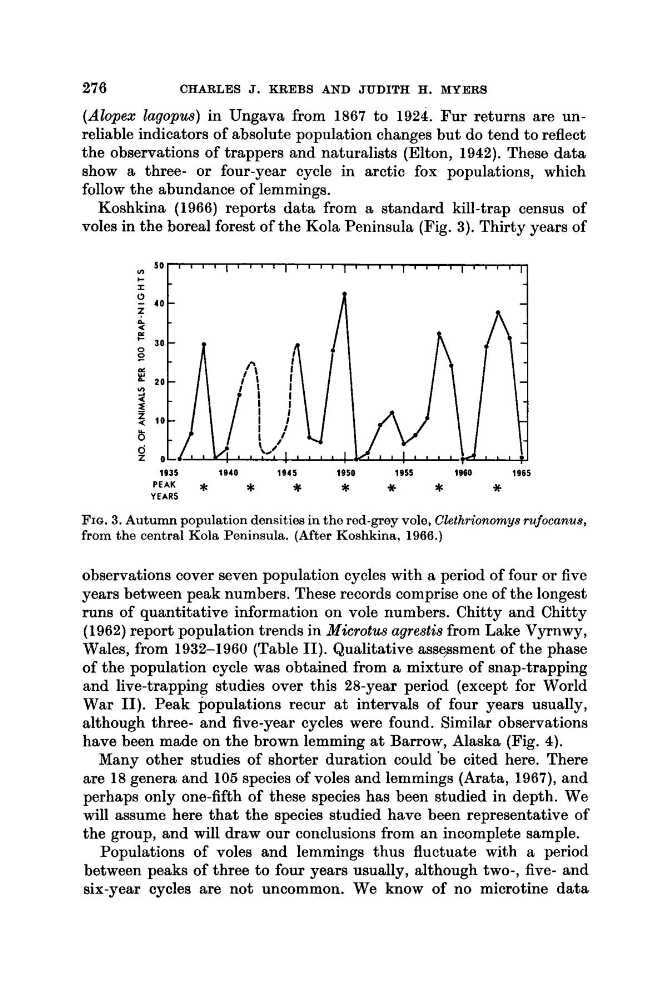
Koshkina (1966) reports data from a standard kill-trap census of
voles in the boreal forest of the Kola Peninsula (Fig. 3). Thirty years of
1935
1940
1945
1950
1955
1960
1965
* * * 8 *
*
PEAK
*
YEARS
FIG 3. Autumn population densities in the red-grey vole, Clethrionomys rwfocanws,
from the central Kola Peninsula. (After Koshkina, 1966.)
observations cover seven population cycles with a period of four or five
years between peak numbers. These records comprise one of the longest
runs of quantitative information on vole numbers. Chitty and Chitty
(1962) report population trends in Microtus agrestis from Lake Vyrnwy,
Wales, from 1932-1960 (Table 11). Qualitative assepsment of the phase
of the population cycle was obtained from a mixture of snap-trapping
and live-trapping studies over this 28-year period (except for World
War 11). Peak populations recur at intervals of four years usually,
although three- and five-year cycles were found. Similar observations
have been made on the brown lemming at Barrow, Alaska (Fig. 4).
Many other studies of shorter duration could 'be cited here. There
are 18 genera and 105 species of voles and lemmings (Arata, 1967), and
perhaps only one-fifth of these species has been studied in depth. We
will assume here that the species studied have been representative of
the group, and will draw our conclusions from an incomplete sample.
Populations of voles and lemmings thus fluctuate with a period
between peaks of three to four years usually, although two-, five- and
six-year cycles are not uncommon. We know of no microtine data
CHARLES J. KREBS AND JUDITH H. MYERS
(Alopex lagopus) in Ungava from 1867 to 1924. Fur returns are unreliable indicators of absolute population changes but do tend to reflect
the observations of trappers and naturalists (Elton, 1942). These data
show a three- or four-year cycle in arctic fox populations, which
follow the abundance of lemmings.
Koshkina (1966) reports data from a standard kill-trap census of
voles in the boreal forest of the Kola Peninsula (Fig. 3). Thirty years of
1935
1940
1945
1950
1955
1960
1965
* * * 8 *
*
PEAK
*
YEARS
FIG 3. Autumn population densities in the red-grey vole, Clethrionomys rwfocanws,
from the central Kola Peninsula. (After Koshkina, 1966.)
observations cover seven population cycles with a period of four or five
years between peak numbers. These records comprise one of the longest
runs of quantitative information on vole numbers. Chitty and Chitty
(1962) report population trends in Microtus agrestis from Lake Vyrnwy,
Wales, from 1932-1960 (Table 11). Qualitative assepsment of the phase
of the population cycle was obtained from a mixture of snap-trapping
and live-trapping studies over this 28-year period (except for World
War 11). Peak populations recur at intervals of four years usually,
although three- and five-year cycles were found. Similar observations
have been made on the brown lemming at Barrow, Alaska (Fig. 4).
Many other studies of shorter duration could 'be cited here. There
are 18 genera and 105 species of voles and lemmings (Arata, 1967), and
perhaps only one-fifth of these species has been studied in depth. We
will assume here that the species studied have been representative of
the group, and will draw our conclusions from an incomplete sample.
Populations of voles and lemmings thus fluctuate with a period
between peaks of three to four years usually, although two-, five- and
six-year cycles are not uncommon. We know of no microtine data