

270
CHARLES J. KREBS AND JUDITH IT. MYERS
111. DEFINITION O F T H E PROBLEM
The general problem of understanding cyclic fluctuations in small
rodent populations can be subdivided into four specific problems:
A. What prevents unlimited increase in the population?
B. What causes the cyclic periodicity of three to four years?
C. What produces synchrony of populations over large areas?
D. What determines the amplitude of the fluctuation?
A. W H A T P R E V E N T S U N L I M I T E D I N C R E A S E ?
This is a general problem which is not specific to rodents and does not
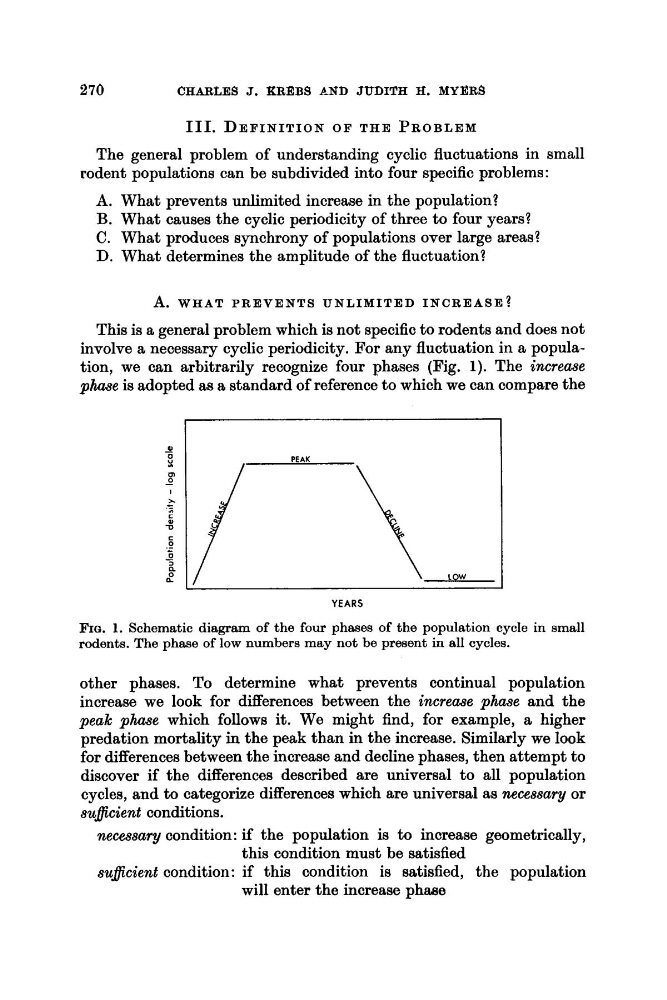
involve a necessary cyclic periodicity. For any fluctuation in a population, we can arbitrarily recognize four phases (Fig. 1). The increase
phase is adopted as a standard of reference to which we can compare the
YEARS
FIG. 1. Schematic diagram of the four phases of the population cycle in small
rodents. The phase of low numbers may not be present in all cycles.
other phases. To determine what prevents continual population
increase we look for differences between the increase phase and the
peak phase which follows it. We might find, for example, a higher
predation mortality in the peak than in the increase. Similarly we look
for differences between the increase and decline phases, then attempt to
discover if the differences described are universal to all population
cycles, and to categorize differences which are universal as necessary or
suficient conditions.
necessary condition: if the population is to increase geometrically,
this condition must be satisfied
suficient condition: if this condition is satisfied, the population
will enter the increase phase
CHARLES J. KREBS AND JUDITH IT. MYERS
111. DEFINITION O F T H E PROBLEM
The general problem of understanding cyclic fluctuations in small
rodent populations can be subdivided into four specific problems:
A. What prevents unlimited increase in the population?
B. What causes the cyclic periodicity of three to four years?
C. What produces synchrony of populations over large areas?
D. What determines the amplitude of the fluctuation?
A. W H A T P R E V E N T S U N L I M I T E D I N C R E A S E ?
This is a general problem which is not specific to rodents and does not
involve a necessary cyclic periodicity. For any fluctuation in a population, we can arbitrarily recognize four phases (Fig. 1). The increase
phase is adopted as a standard of reference to which we can compare the
YEARS
FIG. 1. Schematic diagram of the four phases of the population cycle in small
rodents. The phase of low numbers may not be present in all cycles.
other phases. To determine what prevents continual population
increase we look for differences between the increase phase and the
peak phase which follows it. We might find, for example, a higher
predation mortality in the peak than in the increase. Similarly we look
for differences between the increase and decline phases, then attempt to
discover if the differences described are universal to all population
cycles, and to categorize differences which are universal as necessary or
suficient conditions.
necessary condition: if the population is to increase geometrically,
this condition must be satisfied
suficient condition: if this condition is satisfied, the population
will enter the increase phase