

REALISTIC MODELS IN POPULATION ECOLOGY
263
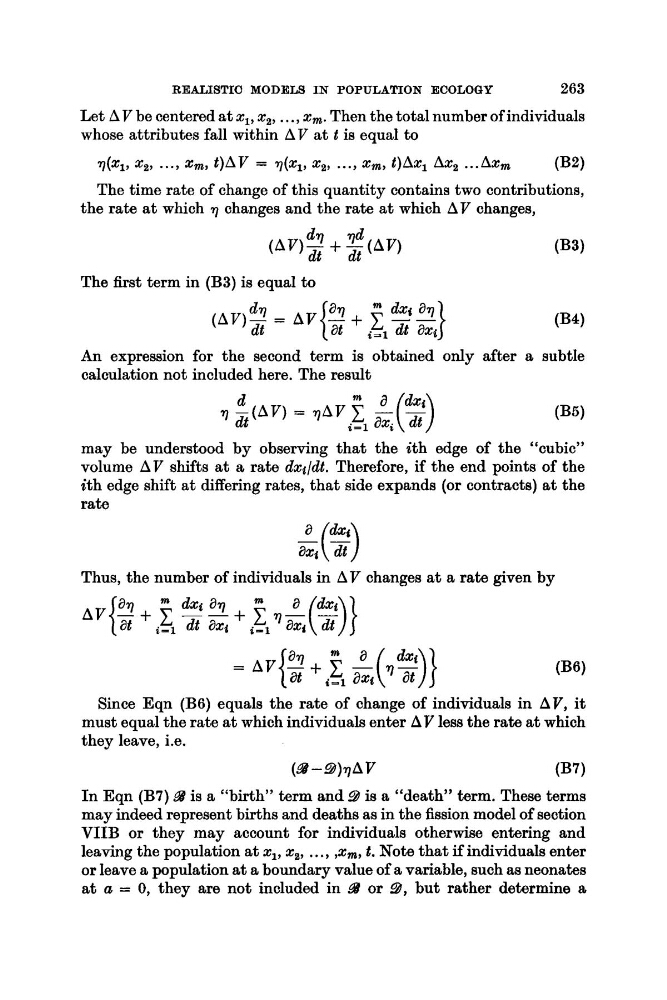
Let A V be centered a t x l , x2, . . . , xm. Then the total number of individuals
whose attributes fall within AV at t is equal to
V ( X ~ ,
~ 2 ,
. .., xm, t)AV = T ( x ~ ,
~ 2 ,
..., x m , t)AX1 Ax2 ... Axm
(B2)
The time rate of change of this quantity contains two contributions,
the rate at which q changes and the rate a t which AV changes,
The fist term in (B3) is equal to
I
An expression for the second term is obtained only after a subtle
calculation not included here. The result
i = l axi at
*
a
at
q - ( A V ) = qAV C - -
may be understood by observing that the ith edge of the “cubic”
volume AV shifts at a rate dxg/dt. Therefore, if the end points of the
ith edge shift at differing rates, that side expands (or contracts) at the
rate
Thus, the number of individuals in AT‘ changes at a rate given by
Since Eqn (B6) equals the rate of change of individuals in A V , it
must equal the rate at which individuals enter A V less the rate at which
they leave, i.e.
(a - 9 ) q A V
(B7)
In Eqn (B7) is a “birth” term and 9 is a “death” term. These terms
may indeed represent births and deaths as in the fission model of section
VIIB or they may account for individuals otherwise entering and
leaving the population at zl, x2, . . . , ,xm, t . Note that if individuals enter
or leave a population at a boundary value of a variable, such as neonates
at a = 0, they are not included in I or 9, but rather determine a
263
Let A V be centered a t x l , x2, . . . , xm. Then the total number of individuals
whose attributes fall within AV at t is equal to
V ( X ~ ,
~ 2 ,
. .., xm, t)AV = T ( x ~ ,
~ 2 ,
..., x m , t)AX1 Ax2 ... Axm
(B2)
The time rate of change of this quantity contains two contributions,
the rate at which q changes and the rate a t which AV changes,
The fist term in (B3) is equal to
I
An expression for the second term is obtained only after a subtle
calculation not included here. The result
i = l axi at
*
a
at
q - ( A V ) = qAV C - -
may be understood by observing that the ith edge of the “cubic”
volume AV shifts at a rate dxg/dt. Therefore, if the end points of the
ith edge shift at differing rates, that side expands (or contracts) at the
rate
Thus, the number of individuals in AT‘ changes at a rate given by
Since Eqn (B6) equals the rate of change of individuals in A V , it
must equal the rate at which individuals enter A V less the rate at which
they leave, i.e.
(a - 9 ) q A V
(B7)
In Eqn (B7) is a “birth” term and 9 is a “death” term. These terms
may indeed represent births and deaths as in the fission model of section
VIIB or they may account for individuals otherwise entering and
leaving the population at zl, x2, . . . , ,xm, t . Note that if individuals enter
or leave a population at a boundary value of a variable, such as neonates
at a = 0, they are not included in I or 9, but rather determine a