

224
WILLIAM STREIFER
required, one each for the male and female mass-specific birth rates.
These are given by
and
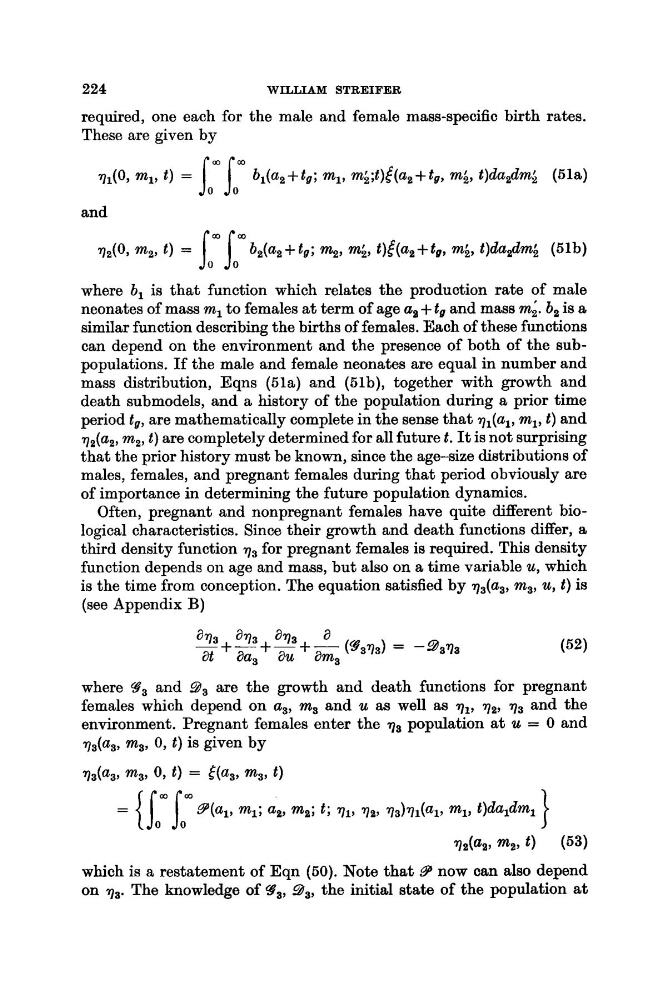
where b, is that function which relates the production rate of male
neonates of mass m, to females at term of age a, + t, and mass m6. b2 is a
similar function describing the births of females. Each of these functions
can depend on the environment and the presence of both of the subpopulations. If the male and female neonates are equal in number and
mass distribution, Eqns (51a) and (51b), together with growth and
death submodels, and a history of the population during a prior time
period t,, are mathematically complete in the sense that ql(a,, m,, t ) and
~ ~ ( a , ,
m2, t ) are completely determined for all future t . It is not surprising
that the prior history must be known, since the age-size distributions of
males, females, and pregnant females during that period obviously are
of importance in determining the future population dynamics.
Often, pregnant and nonpregnant females have quite different biological characteristics. Since their growth and death functions differ, a
third density function q3 for pregnant females is required. This density
function depends on age and mass, but also on a time variable u, which
is the time from conception. The equation satisfied by q3(a3, m3, u, t ) is
(see Appendix B)
&+-+-+- 8% a73 a (Y3q3) = - 9 3 7 3
at aa, au am3
where g3 and g3 are the growth and death functions for pregnant
females which depend on a3, m3 and u as well as q,, r12, q3 and the
environment. Pregnant females enter the q3 population at u = 0 and
~ ~ ( a , ,
m3, 0, t ) is given by
73(a3, m3, 0, t ) = ((a,, m3, t )
72(a,, m2, t ) (53)
which is a restatement of Eqn (50). Note that 9 now can also depend
on v3. The knowledge of Y, , g3, the initial state of the population at
WILLIAM STREIFER
required, one each for the male and female mass-specific birth rates.
These are given by
and
where b, is that function which relates the production rate of male
neonates of mass m, to females at term of age a, + t, and mass m6. b2 is a
similar function describing the births of females. Each of these functions
can depend on the environment and the presence of both of the subpopulations. If the male and female neonates are equal in number and
mass distribution, Eqns (51a) and (51b), together with growth and
death submodels, and a history of the population during a prior time
period t,, are mathematically complete in the sense that ql(a,, m,, t ) and
~ ~ ( a , ,
m2, t ) are completely determined for all future t . It is not surprising
that the prior history must be known, since the age-size distributions of
males, females, and pregnant females during that period obviously are
of importance in determining the future population dynamics.
Often, pregnant and nonpregnant females have quite different biological characteristics. Since their growth and death functions differ, a
third density function q3 for pregnant females is required. This density
function depends on age and mass, but also on a time variable u, which
is the time from conception. The equation satisfied by q3(a3, m3, u, t ) is
(see Appendix B)
&+-+-+- 8% a73 a (Y3q3) = - 9 3 7 3
at aa, au am3
where g3 and g3 are the growth and death functions for pregnant
females which depend on a3, m3 and u as well as q,, r12, q3 and the
environment. Pregnant females enter the q3 population at u = 0 and
~ ~ ( a , ,
m3, 0, t ) is given by
73(a3, m3, 0, t ) = ((a,, m3, t )
72(a,, m2, t ) (53)
which is a restatement of Eqn (50). Note that 9 now can also depend
on v3. The knowledge of Y, , g3, the initial state of the population at