

222
WILTJAM STREIFER
large rather than many small individuals. Evolution may act to maximize total biomass of a population rather than total numbers.
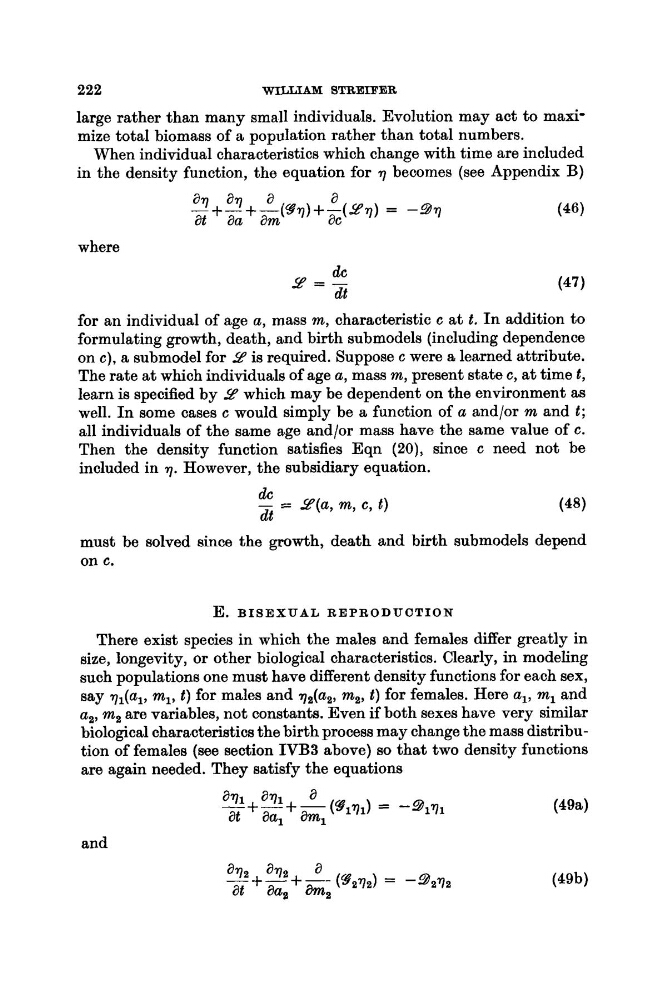
When individual characteristics which change with time are included
in the density function, the equation for 7 becomes (see Appendix B)
where
ac
9 = -
at
(47)
for an individual of age a, mass m, characteristic c at t . I n addition to
formulating growth, death, end birth submodels (including dependence
on c), a submodel for 49 is required. Suppose c were a learned attribute.
The rate at which individuals of age a, mass m, present state c, a t time t ,
learn is specified by 9 which may be dependent on the environment as
well. I n some cases c would simply be a function of a and/or m and t ;
all individuals of the same age and/or mass have the same value of c.
Then the density function satisfies Eqn (20), since c need not be
included in 7. However, the subsidiary equation.
(48)
dc
- = 9 ( a , m, c, t )
at
must be solved since the growth, death and birth submodels depend
on c.
E. B I S E X U A L REPRODUUTION
There exist species in which the males and females differ greatly in
size, longevity, or other biological characteristics. Clearly, in modeling
such populations one must have different density functions for each sex,
say 7,(ul, m,, t ) for males and r],(a,, m,, t ) for females. Here a,, m, and
a,, m, are variables, not constants. Even if both sexes have very similar
biological characteristics the birth process may change the mass distribution of females (see section IVB3 above) so that two density functions
are again needed. They satisfy the equations
871 ar], a
-+-+ - (Slr],) = -917,
at aa, am,
and
(494
WILTJAM STREIFER
large rather than many small individuals. Evolution may act to maximize total biomass of a population rather than total numbers.
When individual characteristics which change with time are included
in the density function, the equation for 7 becomes (see Appendix B)
where
ac
9 = -
at
(47)
for an individual of age a, mass m, characteristic c at t . I n addition to
formulating growth, death, end birth submodels (including dependence
on c), a submodel for 49 is required. Suppose c were a learned attribute.
The rate at which individuals of age a, mass m, present state c, a t time t ,
learn is specified by 9 which may be dependent on the environment as
well. I n some cases c would simply be a function of a and/or m and t ;
all individuals of the same age and/or mass have the same value of c.
Then the density function satisfies Eqn (20), since c need not be
included in 7. However, the subsidiary equation.
(48)
dc
- = 9 ( a , m, c, t )
at
must be solved since the growth, death and birth submodels depend
on c.
E. B I S E X U A L REPRODUUTION
There exist species in which the males and females differ greatly in
size, longevity, or other biological characteristics. Clearly, in modeling
such populations one must have different density functions for each sex,
say 7,(ul, m,, t ) for males and r],(a,, m,, t ) for females. Here a,, m, and
a,, m, are variables, not constants. Even if both sexes have very similar
biological characteristics the birth process may change the mass distribution of females (see section IVB3 above) so that two density functions
are again needed. They satisfy the equations
871 ar], a
-+-+ - (Slr],) = -917,
at aa, am,
and
(494