

184
0. R. POTTS A N D (f. P. VICKERMAN
14
12
3
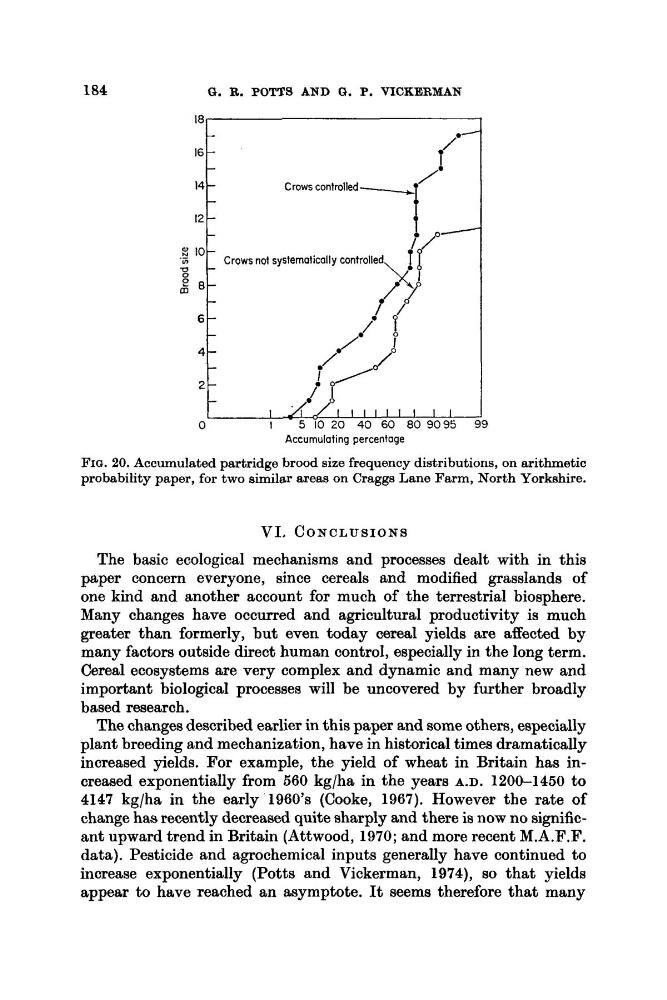
Accumulating percentage
FIG. 20. Accumulated partridge brood size frequency distributions, on arithmetic
probability paper, for two similar areas on Craggs Lane Farm, North Yorkahire.
VI. CONCLUSIONS
The basic ecological mechanisms and processes dealt with in this
paper concern everyone, since cereals and modified grasslands of
one kind and another account for much of the terrestrial biosphere.
Many changes have occurred and agricultural productivity is much
greater than formerly, but even today cereal yields are affected by
many factors outside direct human control, especially in the long term.
Cereal ecosystems are very complex and dynamic and many new and
important biological processes will be uncovered by further broadly
based research.
The changes described earlier in this paper and some others, especially
plant breeding and mechanization, have in historical times dramatically
increased yields. For example, the yield of wheat in Britain has increased exponentially from 560 kg/ha in the years A.D. 1200-1450 to
4147 kg/ha in the early 1960’s (Cooke, 1967). However the rate of
change has recently decreased quite sharply and there is now no significant upward trend in Britain (Attwood, 1970; and more recent M.A.F.F.
data). Pesticide and agrochemical inputs generally have continued to
increase exponentially (Potts and Vickerman, 1974), so that yields
appear to have reached an aaymptote. It seems therefore that many
0. R. POTTS A N D (f. P. VICKERMAN
14
12
3
Accumulating percentage
FIG. 20. Accumulated partridge brood size frequency distributions, on arithmetic
probability paper, for two similar areas on Craggs Lane Farm, North Yorkahire.
VI. CONCLUSIONS
The basic ecological mechanisms and processes dealt with in this
paper concern everyone, since cereals and modified grasslands of
one kind and another account for much of the terrestrial biosphere.
Many changes have occurred and agricultural productivity is much
greater than formerly, but even today cereal yields are affected by
many factors outside direct human control, especially in the long term.
Cereal ecosystems are very complex and dynamic and many new and
important biological processes will be uncovered by further broadly
based research.
The changes described earlier in this paper and some others, especially
plant breeding and mechanization, have in historical times dramatically
increased yields. For example, the yield of wheat in Britain has increased exponentially from 560 kg/ha in the years A.D. 1200-1450 to
4147 kg/ha in the early 1960’s (Cooke, 1967). However the rate of
change has recently decreased quite sharply and there is now no significant upward trend in Britain (Attwood, 1970; and more recent M.A.F.F.
data). Pesticide and agrochemical inputs generally have continued to
increase exponentially (Potts and Vickerman, 1974), so that yields
appear to have reached an aaymptote. It seems therefore that many