

182
0. R. POTTS AND 0 . P. VICKERMAN
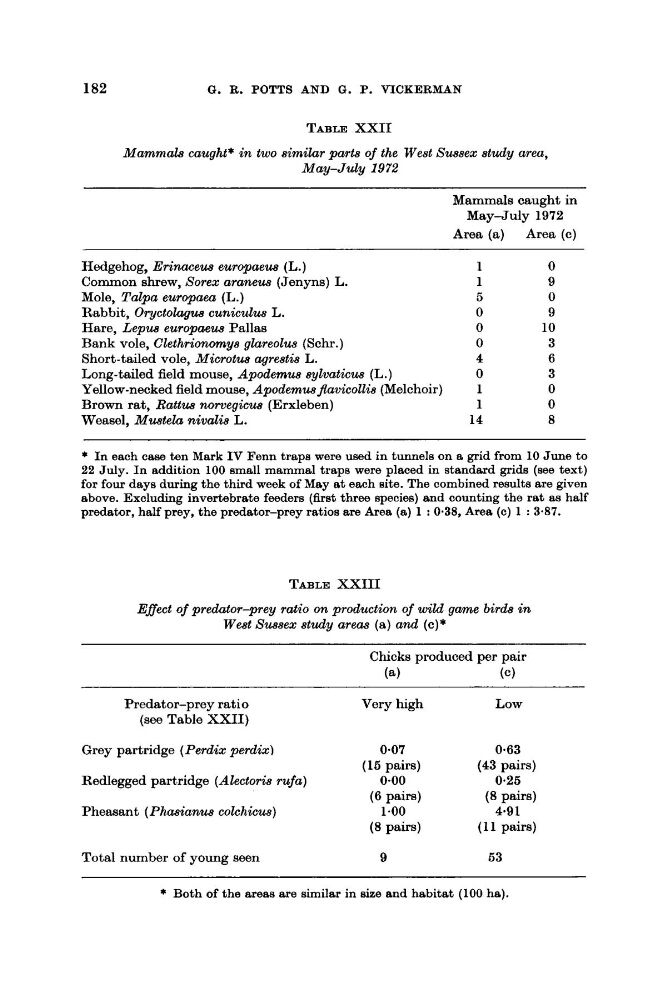
TABLE X X I I
Mammals caught* in two similar parts of the West Sussex study area,
May-July 1972
Mammals caught in
M a y J u l y 1972
Area (a) Area (c)
Hedgehog, Erinaceus europaeua (L.)
Common shrew, Sorex araneus (Jenyns) L.
Mole, Talpa europaea (L.)
Rabbit, Oryctolagua cuniculus L.
Hare, Lepus europaeua Pallas
Bank vole, Clethrionomys glareolus (Schr.)
Short-tailed vole, Microtus agrestis L.
Long-tailed field mouse, Apodemus sylvaticua (L.)
Yellow-necked field mouse, ApodemusJavicollis (Melchc
Brown rat, Rattus norvegicus (Erxleben)
Weasel, Mustela nivalis L.
1
1
5
0
0
0
4
0
Gr)
1
1
14
0
9
0
9
10
3
6
3
0
0
8
* In each case ten Mark I V Fenn traps were used in tunnels on a grid from 10 June to
22 July. In addition 100 small mammal traps were placed in standard grids (see text)
for four days during the third week of May at each site. The combined results are given
above. Excluding invertebrate feeders (first three species) and counting the rat as half
predator, half prey, the predator-prey ratios are Area (a) 1 : 0.38, Area (c) 1 : 3.87.
TABLE XXIII
Effect of predator-rey ratio on production of wild game birds in
Weet Suasex study areas (a) and (c)*
Chicks produced per pair
(4
(c)
Predator-prey ratio
(see Table XXII)
Very high
Low
Grey partridge (Perdix perdixl
0-07
0.63
Redlegged part.ridge (Alectoris rufa)
0.00
0.26
Pheasant (Phasianus colchicus)
1.00
4-9 1
(16 pairs)
(43 pairs)
(6 pairs)
(8 pairs)
(8 pairs)
(1 1 pairs)
Total number of young seen
9
53
* Both of the areas are similar in size and habitat (100 he).
0. R. POTTS AND 0 . P. VICKERMAN
TABLE X X I I
Mammals caught* in two similar parts of the West Sussex study area,
May-July 1972
Mammals caught in
M a y J u l y 1972
Area (a) Area (c)
Hedgehog, Erinaceus europaeua (L.)
Common shrew, Sorex araneus (Jenyns) L.
Mole, Talpa europaea (L.)
Rabbit, Oryctolagua cuniculus L.
Hare, Lepus europaeua Pallas
Bank vole, Clethrionomys glareolus (Schr.)
Short-tailed vole, Microtus agrestis L.
Long-tailed field mouse, Apodemus sylvaticua (L.)
Yellow-necked field mouse, ApodemusJavicollis (Melchc
Brown rat, Rattus norvegicus (Erxleben)
Weasel, Mustela nivalis L.
1
1
5
0
0
0
4
0
Gr)
1
1
14
0
9
0
9
10
3
6
3
0
0
8
* In each case ten Mark I V Fenn traps were used in tunnels on a grid from 10 June to
22 July. In addition 100 small mammal traps were placed in standard grids (see text)
for four days during the third week of May at each site. The combined results are given
above. Excluding invertebrate feeders (first three species) and counting the rat as half
predator, half prey, the predator-prey ratios are Area (a) 1 : 0.38, Area (c) 1 : 3.87.
TABLE XXIII
Effect of predator-rey ratio on production of wild game birds in
Weet Suasex study areas (a) and (c)*
Chicks produced per pair
(4
(c)
Predator-prey ratio
(see Table XXII)
Very high
Low
Grey partridge (Perdix perdixl
0-07
0.63
Redlegged part.ridge (Alectoris rufa)
0.00
0.26
Pheasant (Phasianus colchicus)
1.00
4-9 1
(16 pairs)
(43 pairs)
(6 pairs)
(8 pairs)
(8 pairs)
(1 1 pairs)
Total number of young seen
9
53
* Both of the areas are similar in size and habitat (100 he).