

STUDIES ON THE CEREAL ECOSYSTEM
179
were shown to take numbers of wild pheasant chicks (Heitkamp and
Van der Schoot, 1966). In I966 there were four known incidents of
large partridge chicks being killed by stoats in area B.
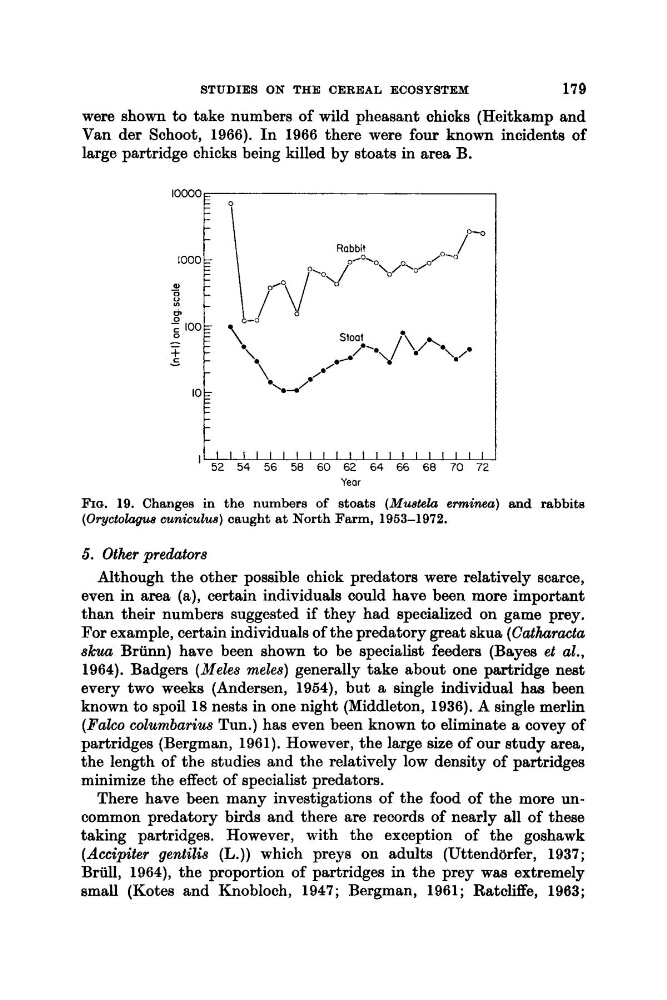
FIQ. 19. Changes in the numbers of stoats (Mueteb emninea) and rabbits
( O r y c t o ~ e
cunkuZua) caught at North Farm, 1963-1972.
5. Other predators
Although the other possible chick predators were relatively scarce,
even in area (a), certain individuals could have been more important
than their numbers suggested if they had specialized on game prey.
For example, certain individuals of the predatory great skua (Cathracta
s k m Briinn) have been shown to be specialist feeders (Bayes et al.,
1964). Badgers (Meles meles) generally take about one partridge nest
every two weeks (Andersen, 1964), but a single individual haa been
known to spoil 18 nests in one night (Middleton, 1936). A single merlin
(Falco columbariua Tun.) has even been known to eliminate a covey of
partridges (Bergman, 1961). However, the large size of our study area,
the length of the studies and the relatively low density of partridges
minimize the effect of specialist predators.
There have been many investigations of the food of the more uncommon predatory birds and there are records of nearly all of these
taking partridges. However, with the exception of the goshawk
(Accipiter gentilis (L.)) which preys on adults (Uttendtkfer, 1937;
Briill, 1964), the proportion of partridges in the prey was extremely
small (Kotes and Knobloch, 1947; Bergman, 1961; Ratcliffe, 1963;
179
were shown to take numbers of wild pheasant chicks (Heitkamp and
Van der Schoot, 1966). In I966 there were four known incidents of
large partridge chicks being killed by stoats in area B.
FIQ. 19. Changes in the numbers of stoats (Mueteb emninea) and rabbits
( O r y c t o ~ e
cunkuZua) caught at North Farm, 1963-1972.
5. Other predators
Although the other possible chick predators were relatively scarce,
even in area (a), certain individuals could have been more important
than their numbers suggested if they had specialized on game prey.
For example, certain individuals of the predatory great skua (Cathracta
s k m Briinn) have been shown to be specialist feeders (Bayes et al.,
1964). Badgers (Meles meles) generally take about one partridge nest
every two weeks (Andersen, 1964), but a single individual haa been
known to spoil 18 nests in one night (Middleton, 1936). A single merlin
(Falco columbariua Tun.) has even been known to eliminate a covey of
partridges (Bergman, 1961). However, the large size of our study area,
the length of the studies and the relatively low density of partridges
minimize the effect of specialist predators.
There have been many investigations of the food of the more uncommon predatory birds and there are records of nearly all of these
taking partridges. However, with the exception of the goshawk
(Accipiter gentilis (L.)) which preys on adults (Uttendtkfer, 1937;
Briill, 1964), the proportion of partridges in the prey was extremely
small (Kotes and Knobloch, 1947; Bergman, 1961; Ratcliffe, 1963;