

176
(3. R. POTTS AND (f. P. VICKERMAN
Detailed analysis of carrion crow food by Holyoak (1968) indicated
that the most important prey items in June-July were small mammals
and the larger invertebrates. Both these corvids are highly intelligent
predators and very quickly exploit new prey (e.g. Croze, 1970). For
example, one pair of carrion crows under observation in area A in 1972
fed their brood with at least 201 gamebirds’ eggs in a period of about
three weeks (pheasant 156, grey partridge 39, redlegged partridge 6).
When the crops are wet, the chicks coming out onto the tracks to
“dry out” would be easier to locate. This kind of pressure on the chicks
could be very important. However, both corvids have usually fledged
by mid June so that chicks would be eaten in the fields and would not
be brought back t o the nest.
Carrion crows and magpies are difficult t o control on small areas
but by June they were virtually eliminated in the area B (Table XVIII).
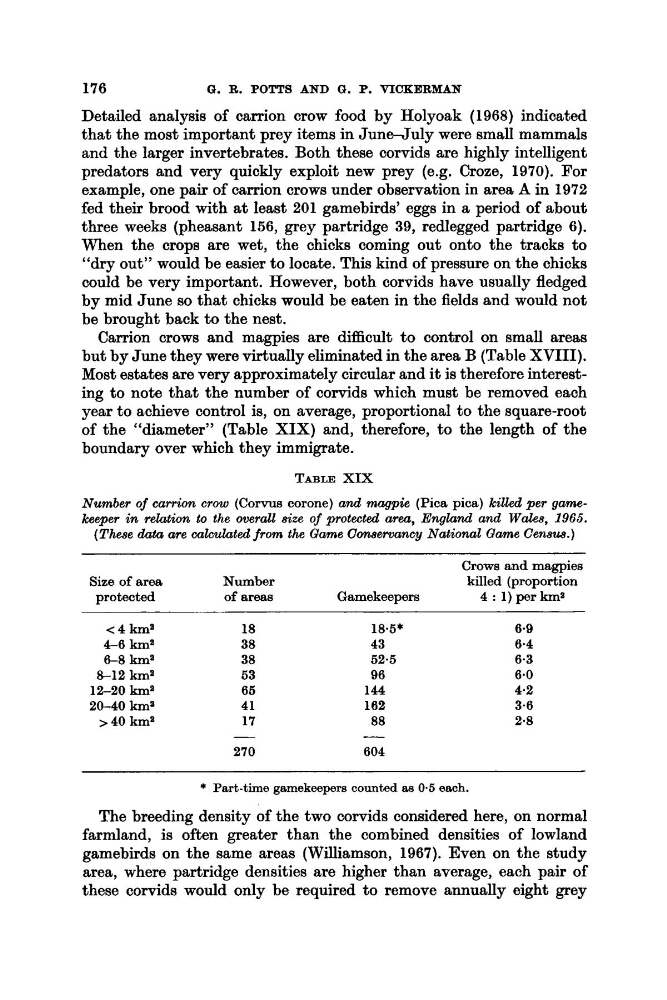
Most estates are very approximately circular and it is therefore interesting to note that the number of corvids which must be removed each
year to achieve control is, on average, proportional t o the square-root
of the “diameter” (Table XIX) and, therefore, to the length of the
boundary over which they immigrate.
TABLE XIX
Number of carrion c r w (Corvus corone) and magpie (Pica pica) killed per gamekeeper i n relation to the overall size of protected arm, England and Wales, 1965.
(These d& are calculated from the Game Conaervancy National Game Cenaus.)
~
Crows and magpies
Size of area
Number
killed (proportion
protected
of areas
Gamekeepers
4 : 1) per k m a
<4km’
18
4-6 kma
38
6-8 kma
38
8-12 k m a
53
12-20 k m a
66
20-40 k m l
41
> 40 kma
17
270
18*5*
43
52-5
96
144
162
88
604
-
6.9
6-4
6.3
6.0
4.2
3.6
2.8
* Part-time gamekeepers counted as 0.6 each.
The breeding density of the two corvids considered here, on normal
farmland, is often greater than the combined densities of lowland
gamebirds on the same areas (Williamson, 1967). Even on the study
area, where partridge densities are higher than average, each pair of
these corvids would only be required to remove annually eight grey
(3. R. POTTS AND (f. P. VICKERMAN
Detailed analysis of carrion crow food by Holyoak (1968) indicated
that the most important prey items in June-July were small mammals
and the larger invertebrates. Both these corvids are highly intelligent
predators and very quickly exploit new prey (e.g. Croze, 1970). For
example, one pair of carrion crows under observation in area A in 1972
fed their brood with at least 201 gamebirds’ eggs in a period of about
three weeks (pheasant 156, grey partridge 39, redlegged partridge 6).
When the crops are wet, the chicks coming out onto the tracks to
“dry out” would be easier to locate. This kind of pressure on the chicks
could be very important. However, both corvids have usually fledged
by mid June so that chicks would be eaten in the fields and would not
be brought back t o the nest.
Carrion crows and magpies are difficult t o control on small areas
but by June they were virtually eliminated in the area B (Table XVIII).
Most estates are very approximately circular and it is therefore interesting to note that the number of corvids which must be removed each
year to achieve control is, on average, proportional t o the square-root
of the “diameter” (Table XIX) and, therefore, to the length of the
boundary over which they immigrate.
TABLE XIX
Number of carrion c r w (Corvus corone) and magpie (Pica pica) killed per gamekeeper i n relation to the overall size of protected arm, England and Wales, 1965.
(These d& are calculated from the Game Conaervancy National Game Cenaus.)
~
Crows and magpies
Size of area
Number
killed (proportion
protected
of areas
Gamekeepers
4 : 1) per k m a
<4km’
18
4-6 kma
38
6-8 kma
38
8-12 k m a
53
12-20 k m a
66
20-40 k m l
41
> 40 kma
17
270
18*5*
43
52-5
96
144
162
88
604
-
6.9
6-4
6.3
6.0
4.2
3.6
2.8
* Part-time gamekeepers counted as 0.6 each.
The breeding density of the two corvids considered here, on normal
farmland, is often greater than the combined densities of lowland
gamebirds on the same areas (Williamson, 1967). Even on the study
area, where partridge densities are higher than average, each pair of
these corvids would only be required to remove annually eight grey