

: 100
- $ 4 0 -
m
-
= 50NE- 3 0 -
lC 2 0 -
0
lo:
u" 5 -
:
m
-
a
*
- a
a,
-
>r
0
0
U
L
-
L
0
L
The next stage in our investigations involves a more accurate
assessment of the Collembola, the role of the predatory mites and
the relationship between the general dynamics of the soil fauna and
that of the field layer.
*
-
a
-a
:a
a a
* a
- - a ,
.
-
* a *
*
*
a
,
=
-
-
-
-
:
*
a
*
a
a
- a
a
* *
a
.
a
a
r = t O 5 1
P C 0 0 1
V. P A R T R I D Q E S
A. I N T R O D U C T I O N
Partridge populations are maintained or increased when the proportion of young birds in the post breeding population exceeds 60%;
below this they decline. Over the years 1969 to 1972 the proportion of
young was only 32 f 3% in those parts of the study area with the lowest
density of food arthropods. This percentage rose steadily in proportion
to the increase of chick food, up to 68 k 1% in the areas where food was
not limiting.
162
a. R. POTTS AND Q. P. VICEERMAN
but the numbers of macroscopic Isotomidae picked up with the vacuum
insect net were recorded. The general abundance of the Isotomidae is
probably an index of the general abundance of Collembola in the soil.
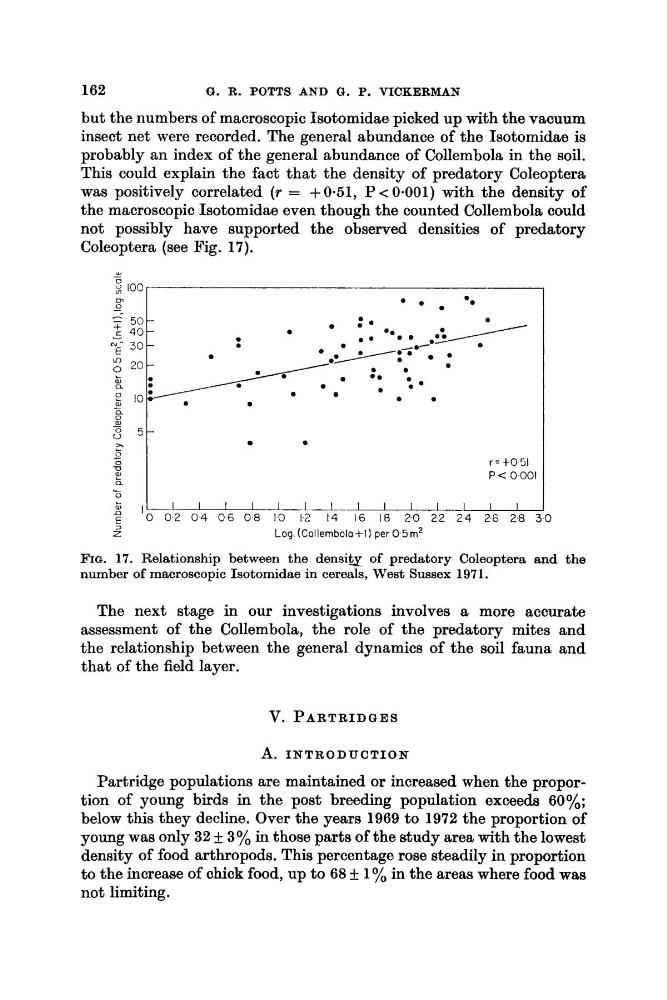
This could explain the fact that the density of predatory Coleoptera
was positively correlated (r = + 0.51, P c 0.001) with the density of
the macroscopic Isotomidae even though the counted Collembola could
not possibly have supported the observed densities of predatory
Coleoptera (see Fig. 17).
FIG. 17. Relationship between the density of predatory Coleoptera and the
number of macroscopic Isotomidae in cereals, West Sussex 1971.
- $ 4 0 -
m
-
= 50NE- 3 0 -
lC 2 0 -
0
lo:
u" 5 -
:
m
-
a
*
- a
a,
-
>r
0
0
U
L
-
L
0
L
The next stage in our investigations involves a more accurate
assessment of the Collembola, the role of the predatory mites and
the relationship between the general dynamics of the soil fauna and
that of the field layer.
*
-
a
-a
:a
a a
* a
- - a ,
.
-
* a *
*
*
a
,
=
-
-
-
-
:
*
a
*
a
a
- a
a
* *
a
.
a
a
r = t O 5 1
P C 0 0 1
V. P A R T R I D Q E S
A. I N T R O D U C T I O N
Partridge populations are maintained or increased when the proportion of young birds in the post breeding population exceeds 60%;
below this they decline. Over the years 1969 to 1972 the proportion of
young was only 32 f 3% in those parts of the study area with the lowest
density of food arthropods. This percentage rose steadily in proportion
to the increase of chick food, up to 68 k 1% in the areas where food was
not limiting.
162
a. R. POTTS AND Q. P. VICEERMAN
but the numbers of macroscopic Isotomidae picked up with the vacuum
insect net were recorded. The general abundance of the Isotomidae is
probably an index of the general abundance of Collembola in the soil.
This could explain the fact that the density of predatory Coleoptera
was positively correlated (r = + 0.51, P c 0.001) with the density of
the macroscopic Isotomidae even though the counted Collembola could
not possibly have supported the observed densities of predatory
Coleoptera (see Fig. 17).
FIG. 17. Relationship between the density of predatory Coleoptera and the
number of macroscopic Isotomidae in cereals, West Sussex 1971.