

146
a. R. POTTS AND a. P. VICKERMAN
species belonged to the genus Platychirus, although larvae of Syrphus
balteatw Deg. were fairly common in 1969.
The most important Chloropid genera present were Oscinella,
Chlorops, Meromyza and Elachiptera. The most important Oscinella
species was 0. frit. L. which was distributed fairly evenly on the
various cereals. Only a few individuals of 0. nitidissima Meig., 0.
vastator Curtis and 0. nigerrima Macq. were recorded.
3. The distribution of predatory Diptera
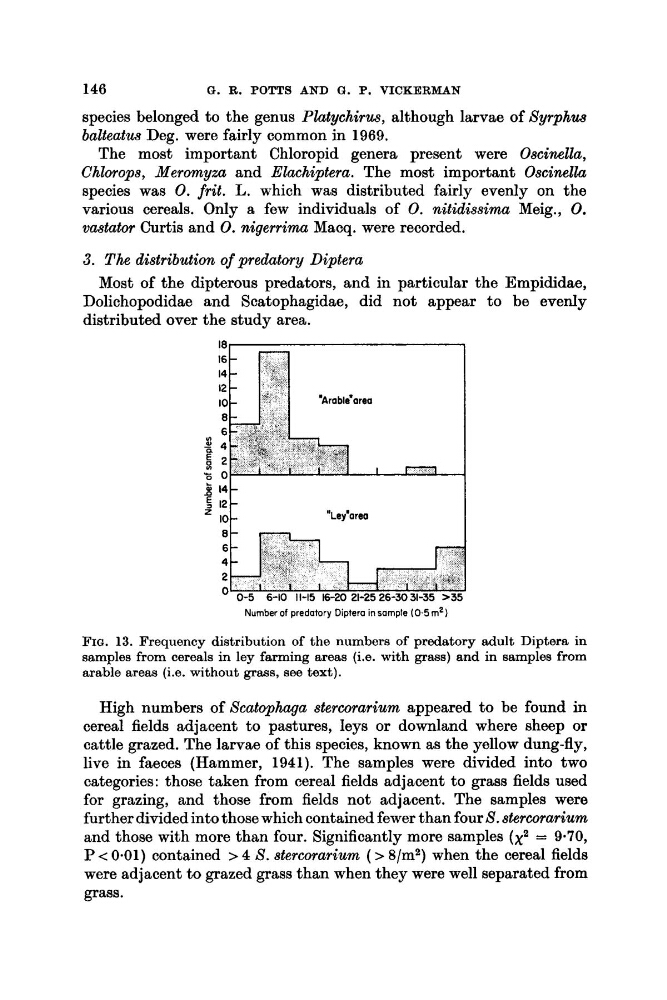
Most of the dipterous predators, and in particular the Empididae,
Dolichopodidae and Scatophagidae, did not appear to be evenly
distributed over the study area.
“Ley’area
Number of predatory Diptera in sample (0.5 m2)
FIG. 13. Frequency distribution of the numbers of predatory adult Diptera in
samples from cereals in ley farming areas (i.e. with grass) and in samples from
arable areas (i.e. without grass, see text).
High numbers of Scatophaga stercorarium appeared to be found in
cereal fields adjacent to pastures, leys or downland where sheep or
cattle grazed. The larvae of this species, known as the yellow dung-fly,
live in faeces (Hammer, 1941). The samples were divided into two
categories: those taken from cereal fields adjacent to grass fields used
for grazing, and those from fields not adjacent. The samples were
further divided into those which contained fewer than four S. stercorarium
and those with more than four. Significantly more samples (x2 = 9-70,
P < 0.01) contained > 4 S. stercorarium ( > 8/m2) when the cereal fields
were adjacent to grazed grass than when they were well separated from
grass.
a. R. POTTS AND a. P. VICKERMAN
species belonged to the genus Platychirus, although larvae of Syrphus
balteatw Deg. were fairly common in 1969.
The most important Chloropid genera present were Oscinella,
Chlorops, Meromyza and Elachiptera. The most important Oscinella
species was 0. frit. L. which was distributed fairly evenly on the
various cereals. Only a few individuals of 0. nitidissima Meig., 0.
vastator Curtis and 0. nigerrima Macq. were recorded.
3. The distribution of predatory Diptera
Most of the dipterous predators, and in particular the Empididae,
Dolichopodidae and Scatophagidae, did not appear to be evenly
distributed over the study area.
“Ley’area
Number of predatory Diptera in sample (0.5 m2)
FIG. 13. Frequency distribution of the numbers of predatory adult Diptera in
samples from cereals in ley farming areas (i.e. with grass) and in samples from
arable areas (i.e. without grass, see text).
High numbers of Scatophaga stercorarium appeared to be found in
cereal fields adjacent to pastures, leys or downland where sheep or
cattle grazed. The larvae of this species, known as the yellow dung-fly,
live in faeces (Hammer, 1941). The samples were divided into two
categories: those taken from cereal fields adjacent to grass fields used
for grazing, and those from fields not adjacent. The samples were
further divided into those which contained fewer than four S. stercorarium
and those with more than four. Significantly more samples (x2 = 9-70,
P < 0.01) contained > 4 S. stercorarium ( > 8/m2) when the cereal fields
were adjacent to grazed grass than when they were well separated from
grass.