

134
a. R. POTTS AND 0. P. VICKERMAN
A much earlier immigration took place in 1971 and the number of
alates in cereals a t the beginning of June averaged 41.4/m2. This
immigration was associated with a notable increase in the incidence of
barley yellow dwarf virus which is often carried by aphids from grassland (Watson, 1958; Doodson, 1967). There was no real peak of aphid
apterae, these averaging about 80/m2 throughout June, but the number
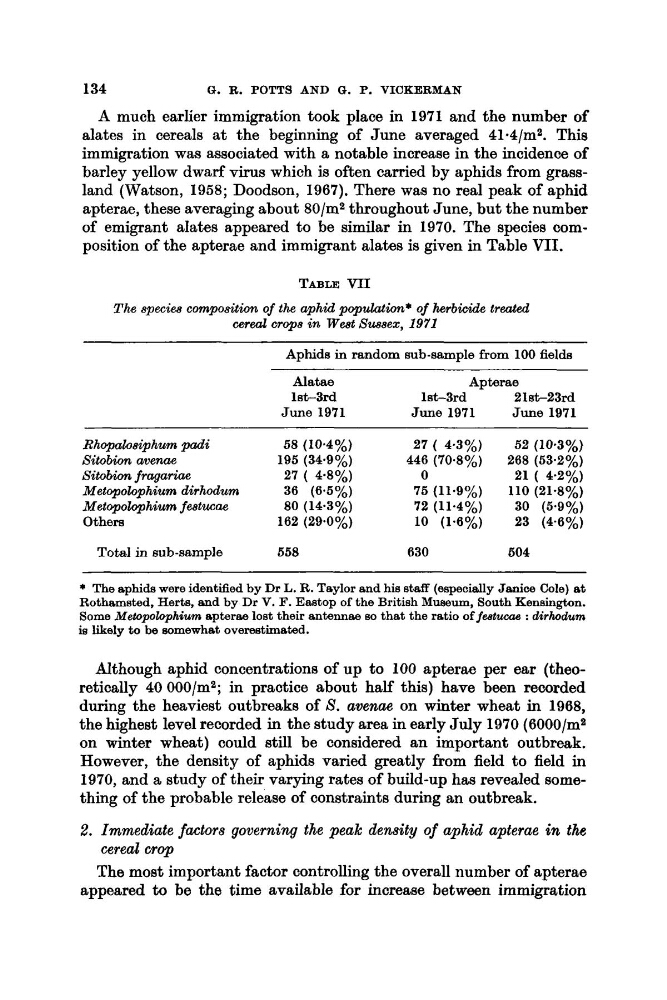
of emigrant alates appeared to be similar in 1970. The species composition of the apterae and immigrant alates is given in Table VII.
TABLE VII
cereal crops in West Swsex, 1971
The species compositim of the aphid populatwn* of hrbkide treated
~~~
~~
Aphids in random sub-sample from 100 fields
Alatae
Apterae
Ist-3rd
1st-3rd
2 lst-23rd
June 1971
June 1971
June 1971
Rhopalosiphum pa&
68 (10*4y0)
27 ( 4.3%)
62 (10.3%)
Sitobwn avenae
196 (34.9%)
446 (70.8%) 268 (63.2%)
S i t o h fragariae
27 ( 4.8%)
0
21 ( 4.2%)
Metopolophiurn dirhodum
36 (6*6y0)
76 (11.9yo)
110 (21*8y0)
Metopobhium festucae
80 (14.3%)
72 (11.4%)
30 (6.9%)
Others
162 (29.0%)
10 (1.6%)
23 (4.6%)
Total in sub-sample
668
630
604
* The aphids were identified by Dr L. R. Taylor and his staff (especially Jenice Cole) at
Rothamsted, Herts, and by Dr V. F. Eastop of the British Museum, South Kensington.
Some Metopolophiurn apteraa lost their antennae so that the ratio of featucas : dirhodum
is likely to be somewhat overestimated.
Although aphid concentrations of up to 100 apterae per ear (theoretically 40 000/m2; in practice about half this) have been recorded
during the heaviest outbreaks of 8. avenae on winter wheat in 1968,
the highest level recorded in the study area in early July 1970 (6000/ma
on winter wheat) could still be considered an important outbreak.
However, the density of aphids varied greatly from field to field in
1970, and a study of their varying rates of build-up has revealed something of the probable release of constraints during an outbreak.
2. Immediate factors governing the peak density of aphid apterae in the
cereal crop
The most important factor controlling the overall number of apterae
appeared to be the time available for increase between immigration
a. R. POTTS AND 0. P. VICKERMAN
A much earlier immigration took place in 1971 and the number of
alates in cereals a t the beginning of June averaged 41.4/m2. This
immigration was associated with a notable increase in the incidence of
barley yellow dwarf virus which is often carried by aphids from grassland (Watson, 1958; Doodson, 1967). There was no real peak of aphid
apterae, these averaging about 80/m2 throughout June, but the number
of emigrant alates appeared to be similar in 1970. The species composition of the apterae and immigrant alates is given in Table VII.
TABLE VII
cereal crops in West Swsex, 1971
The species compositim of the aphid populatwn* of hrbkide treated
~~~
~~
Aphids in random sub-sample from 100 fields
Alatae
Apterae
Ist-3rd
1st-3rd
2 lst-23rd
June 1971
June 1971
June 1971
Rhopalosiphum pa&
68 (10*4y0)
27 ( 4.3%)
62 (10.3%)
Sitobwn avenae
196 (34.9%)
446 (70.8%) 268 (63.2%)
S i t o h fragariae
27 ( 4.8%)
0
21 ( 4.2%)
Metopolophiurn dirhodum
36 (6*6y0)
76 (11.9yo)
110 (21*8y0)
Metopobhium festucae
80 (14.3%)
72 (11.4%)
30 (6.9%)
Others
162 (29.0%)
10 (1.6%)
23 (4.6%)
Total in sub-sample
668
630
604
* The aphids were identified by Dr L. R. Taylor and his staff (especially Jenice Cole) at
Rothamsted, Herts, and by Dr V. F. Eastop of the British Museum, South Kensington.
Some Metopolophiurn apteraa lost their antennae so that the ratio of featucas : dirhodum
is likely to be somewhat overestimated.
Although aphid concentrations of up to 100 apterae per ear (theoretically 40 000/m2; in practice about half this) have been recorded
during the heaviest outbreaks of 8. avenae on winter wheat in 1968,
the highest level recorded in the study area in early July 1970 (6000/ma
on winter wheat) could still be considered an important outbreak.
However, the density of aphids varied greatly from field to field in
1970, and a study of their varying rates of build-up has revealed something of the probable release of constraints during an outbreak.
2. Immediate factors governing the peak density of aphid apterae in the
cereal crop
The most important factor controlling the overall number of apterae
appeared to be the time available for increase between immigration