

STUDIES ON THE CEREAL ECOSYSTEM
131
IV. THE INVERTEBRATE FAUNA OF CEREALS
A. O O M P O S I T I O N
Although the insect pest species associated with cereal crops have
received considerable attention throughout the world, very little is
known about the taxonomic composition and trophic structure of the
community as a whole.
TABLE VI.
The percentccge compo8ition of the maoroecopic d i u d arthropod#
in the jield layer and ground z m e of cerealjields, W a t Sugmx, 1970 and 1971
1970
1971
June
June
1st-4th
16th-19th
l s t 4 t h
21st-26th
-1Y
“mid”
early
“mid”
Araneae
Orthoptera
Dermaptera
Psocoptera
Hemiptera
Neuroptera
Lepidoptera
Diptera
Hymenoptera
Coleoptera
3-76
0.00
0.02
0.00
14.11
0.02
0.29
29.24
13.33
39-23
2-88
0.01
0.06
0.00
42-30
0.06
0.06
24-61
12.90
17-26
0.99
0.00
0.14
0.01
27.08
0.03
0.09
20.76
17.06
33.84
2.63
0.01
0.11
0.01
18.01
0.06
0.01
36.46
22.90
19.82
Total per ma
233.21
821-00
466.46
706.66
* Collembole, Acari and Thyamoptere have been omittedtext.
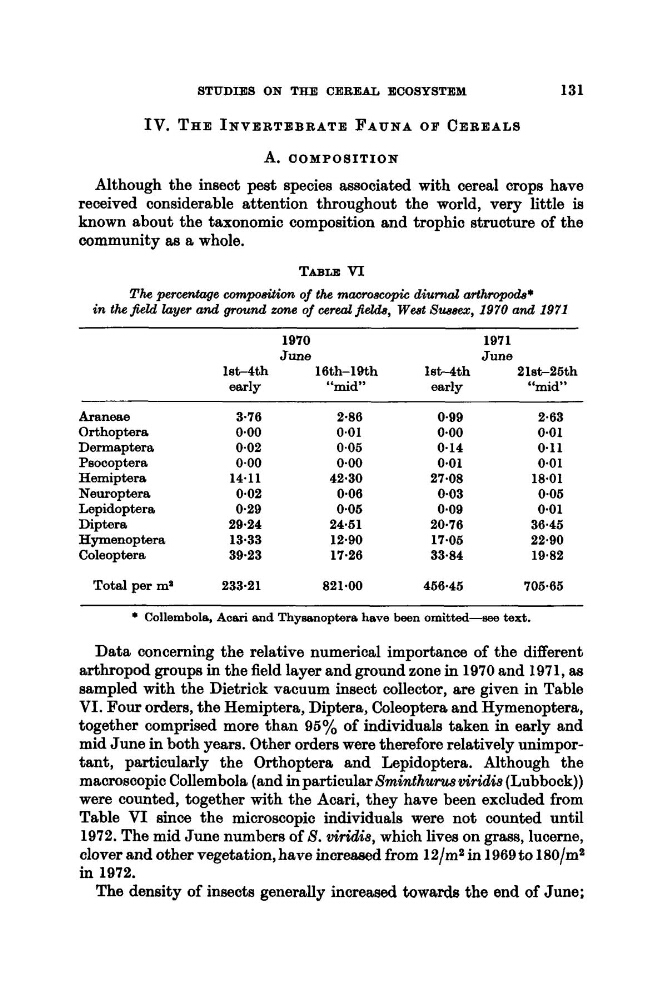
Data concerning the relative numerical importance of the different
arthropod groups in the field layer and ground zone in 1970 and 1971, as
sampled with the Dietrick vacuum insect collector, are given in Table
VI. Four orders, the Hemiptera, Diptera, Coleoptera and Hymenoptera,
together comprised more than 96% of individuals taken in early and
mid June in both years. Other orders were therefore relatively unimportant, particularly the Orthoptera and Lepidoptera. Although the
macroscopic Collembola (and in particular Sminthurus viridis (Lubbock))
were counted, together with the Acari, they have been excluded from
Table VI since the microscopic individuals were not counted until
1972. The mid June numbers of S. viridi~, which lives on grass, lucerne,
clover and other vegetation, have increased from 12/m2 in 1969 to 180/m2
in 1972.
The density of insects generally increased towards the end of June;
131
IV. THE INVERTEBRATE FAUNA OF CEREALS
A. O O M P O S I T I O N
Although the insect pest species associated with cereal crops have
received considerable attention throughout the world, very little is
known about the taxonomic composition and trophic structure of the
community as a whole.
TABLE VI.
The percentccge compo8ition of the maoroecopic d i u d arthropod#
in the jield layer and ground z m e of cerealjields, W a t Sugmx, 1970 and 1971
1970
1971
June
June
1st-4th
16th-19th
l s t 4 t h
21st-26th
-1Y
“mid”
early
“mid”
Araneae
Orthoptera
Dermaptera
Psocoptera
Hemiptera
Neuroptera
Lepidoptera
Diptera
Hymenoptera
Coleoptera
3-76
0.00
0.02
0.00
14.11
0.02
0.29
29.24
13.33
39-23
2-88
0.01
0.06
0.00
42-30
0.06
0.06
24-61
12.90
17-26
0.99
0.00
0.14
0.01
27.08
0.03
0.09
20.76
17.06
33.84
2.63
0.01
0.11
0.01
18.01
0.06
0.01
36.46
22.90
19.82
Total per ma
233.21
821-00
466.46
706.66
* Collembole, Acari and Thyamoptere have been omittedtext.
Data concerning the relative numerical importance of the different
arthropod groups in the field layer and ground zone in 1970 and 1971, as
sampled with the Dietrick vacuum insect collector, are given in Table
VI. Four orders, the Hemiptera, Diptera, Coleoptera and Hymenoptera,
together comprised more than 96% of individuals taken in early and
mid June in both years. Other orders were therefore relatively unimportant, particularly the Orthoptera and Lepidoptera. Although the
macroscopic Collembola (and in particular Sminthurus viridis (Lubbock))
were counted, together with the Acari, they have been excluded from
Table VI since the microscopic individuals were not counted until
1972. The mid June numbers of S. viridi~, which lives on grass, lucerne,
clover and other vegetation, have increased from 12/m2 in 1969 to 180/m2
in 1972.
The density of insects generally increased towards the end of June;