

STUDIES ON THE CEREAL ECOSYSTEM
117
E. F O L I A R D I S E A S E , I N S E C T P E S T S A N D C E R E A L V A R I E T I E S
There was considerable concern about the level of cereal leaf diseases
in the Arundel area of West Sussex in the mid 1960’s; the yield of
spring barley was seldom more than 3000 kg/ha. This led to the
A.D.A.S. (Agricultural Development Advisory Services) Arundel
Cereal Survey in the western part of the study area from 1967 to 1970;
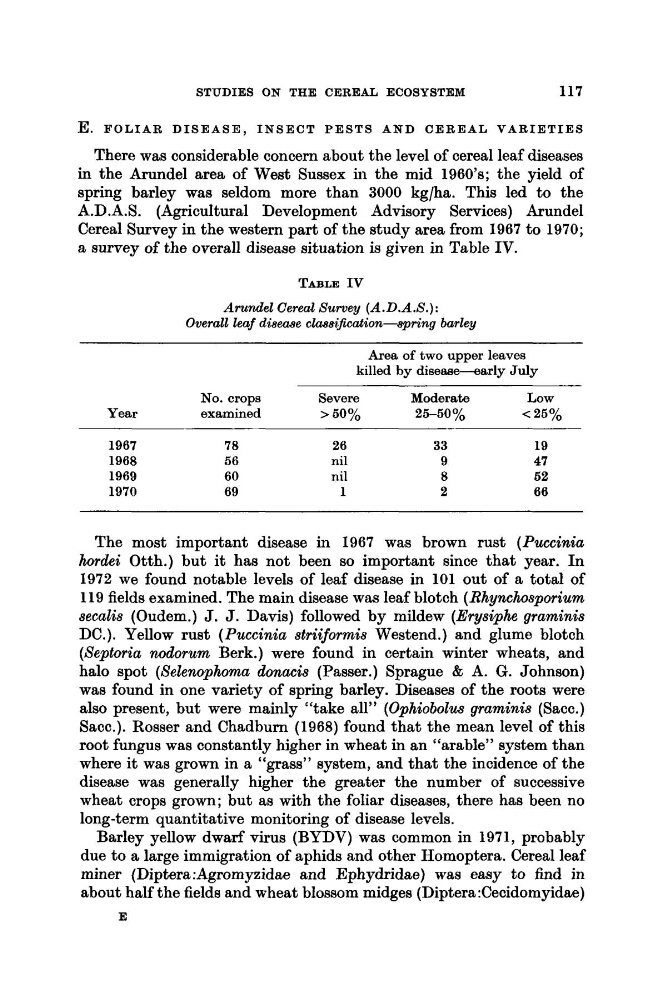
a survey of the overall disease situation is given in Table IV.
TABLE IV
Arundel Cereal Survey (A.D.A.S.):
Overall leaf diseaae clua&$cation-qvrining barley
Area of two upper leaves
killed by disease-emly July
No. crops
Severe
Moderate
Low
Year
examined
> 60%
26-50%
< 25%
1967
78
26
33
19
1968
66
nil
9
47
1969
60
nil
8
62
1970
69
1
2
66
The most important disease in I967 was brown rust (Puccinia
hordei Otth.) but it has not been so important since that year. In
1972 we found notable levels of leaf disease in 101 out of a total of
119 fields examined. The main disease was leaf blotch (Rhynchosporium
secaZis (Oudem.) J. J. Davis) followed by mildew (Erysiphe graminis
DC.). Yellow rust (Puccinia striiformis Westend.) and glume blotch
(Septoria nodorum Berk.) were found in certain winter wheats, and
halo spot (Selenophoma donucis (Passer.) Sprague & A. G. Johnson)
was found in one variety of spring barley. Diseases of the roots were
also present, but were mainly “take all” (OphioboZus graminis (Sacc.)
Sacc.). Rosser and Chadburn (1968) found that the mean level of this
root fungus was constantly higher in wheat in an “arable” system than
where it was grown in a “grass” system, and that the incidence of the
disease was generally higher the greater the number of successive
wheat crops grown; but as with the foliar diseases, there has been no
long-term quantitative monitoring of disease levels.
Barley yellow dwarf virus (BYDV) was common in 1971, probably
due to a large immigration of aphids and other Homoptera. Cereal leaf
miner (Diptera:Agromyzidae and Ephydridae) was easy to find in
about half the fields and wheat blossom midges (Diptera:Cecidomyidae)
E
117
E. F O L I A R D I S E A S E , I N S E C T P E S T S A N D C E R E A L V A R I E T I E S
There was considerable concern about the level of cereal leaf diseases
in the Arundel area of West Sussex in the mid 1960’s; the yield of
spring barley was seldom more than 3000 kg/ha. This led to the
A.D.A.S. (Agricultural Development Advisory Services) Arundel
Cereal Survey in the western part of the study area from 1967 to 1970;
a survey of the overall disease situation is given in Table IV.
TABLE IV
Arundel Cereal Survey (A.D.A.S.):
Overall leaf diseaae clua&$cation-qvrining barley
Area of two upper leaves
killed by disease-emly July
No. crops
Severe
Moderate
Low
Year
examined
> 60%
26-50%
< 25%
1967
78
26
33
19
1968
66
nil
9
47
1969
60
nil
8
62
1970
69
1
2
66
The most important disease in I967 was brown rust (Puccinia
hordei Otth.) but it has not been so important since that year. In
1972 we found notable levels of leaf disease in 101 out of a total of
119 fields examined. The main disease was leaf blotch (Rhynchosporium
secaZis (Oudem.) J. J. Davis) followed by mildew (Erysiphe graminis
DC.). Yellow rust (Puccinia striiformis Westend.) and glume blotch
(Septoria nodorum Berk.) were found in certain winter wheats, and
halo spot (Selenophoma donucis (Passer.) Sprague & A. G. Johnson)
was found in one variety of spring barley. Diseases of the roots were
also present, but were mainly “take all” (OphioboZus graminis (Sacc.)
Sacc.). Rosser and Chadburn (1968) found that the mean level of this
root fungus was constantly higher in wheat in an “arable” system than
where it was grown in a “grass” system, and that the incidence of the
disease was generally higher the greater the number of successive
wheat crops grown; but as with the foliar diseases, there has been no
long-term quantitative monitoring of disease levels.
Barley yellow dwarf virus (BYDV) was common in 1971, probably
due to a large immigration of aphids and other Homoptera. Cereal leaf
miner (Diptera:Agromyzidae and Ephydridae) was easy to find in
about half the fields and wheat blossom midges (Diptera:Cecidomyidae)
E