

110
a. R. POTTS AND 0. P. VICKERMAN
11. T H E STUDY A R E A
A. B R I E B H I S T O R Y
The study area is based at North Farm, Washington, West Sussex,
and covers an area of about 50 km2. The boundary to the west is the
flood plain water-meadow area of the Arun valley. The Adur valley
is to the east. The steep wooded (especially Beech, Fagus sylvatica L.)
or scrub-covered scarp slope of the South Downs faces north from the
boundary which averages 180 m above sea level (max. 250 m). Wooded
areas or coastal conurbations are to the south.
14
- 13
'\
,/- - 12
I I 6
- 9 5
- 8 5
2
\*/
-
-10
-7
-
, -6 . &!
2 -
8 -
6 -
4 -
Year
28
26
24
22
20
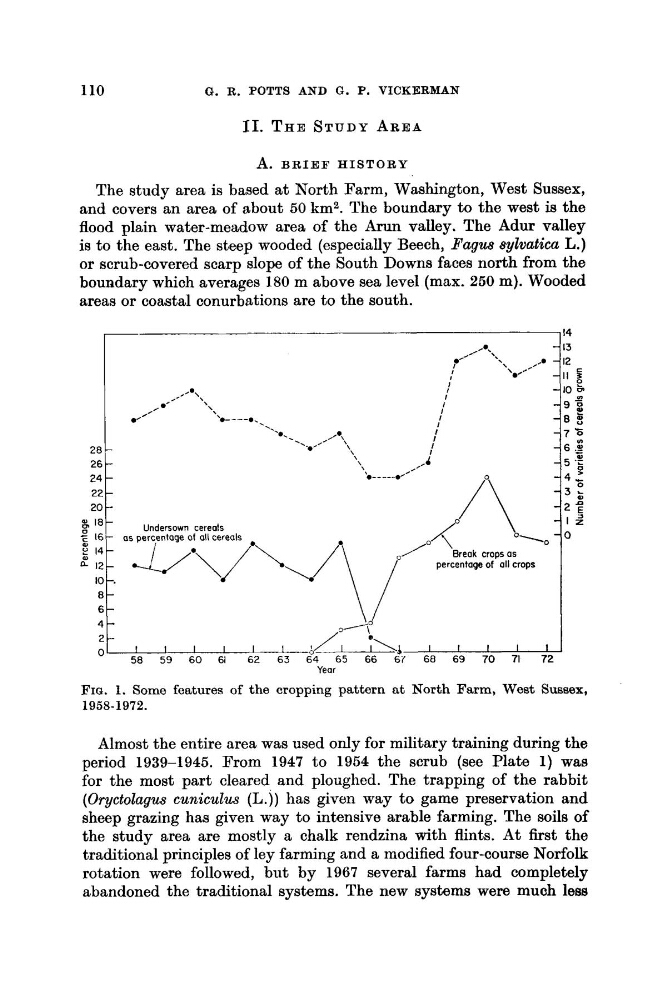
FIG. 1. Some features of the cropping pattern at North Farm, West Sussex,
1958-1972.
Almost the entire area was used only for military training during the
period 1939-1945. From 1947 to 1954 the scrub (see Plate 1) was
for the most part cleared and ploughed. The trapping of the rabbit
(Oryctolagus cuniculus (L.)) has given way to game preservation and
sheep grazing has given way to intensive arable farming. The soils of
the study area are mostly a chalk rendzina with flints. At first the
traditional principles of ley farming and a modified four-course Norfolk
rotation were followed, but by 1967 several farms had completely
abandoned the traditional systems. The new systems were much less
a. R. POTTS AND 0. P. VICKERMAN
11. T H E STUDY A R E A
A. B R I E B H I S T O R Y
The study area is based at North Farm, Washington, West Sussex,
and covers an area of about 50 km2. The boundary to the west is the
flood plain water-meadow area of the Arun valley. The Adur valley
is to the east. The steep wooded (especially Beech, Fagus sylvatica L.)
or scrub-covered scarp slope of the South Downs faces north from the
boundary which averages 180 m above sea level (max. 250 m). Wooded
areas or coastal conurbations are to the south.
14
- 13
'\
,/- - 12
I I 6
- 9 5
- 8 5
2
\*/
-
-10
-7
-
, -6 . &!
2 -
8 -
6 -
4 -
Year
28
26
24
22
20
FIG. 1. Some features of the cropping pattern at North Farm, West Sussex,
1958-1972.
Almost the entire area was used only for military training during the
period 1939-1945. From 1947 to 1954 the scrub (see Plate 1) was
for the most part cleared and ploughed. The trapping of the rabbit
(Oryctolagus cuniculus (L.)) has given way to game preservation and
sheep grazing has given way to intensive arable farming. The soils of
the study area are mostly a chalk rendzina with flints. At first the
traditional principles of ley farming and a modified four-course Norfolk
rotation were followed, but by 1967 several farms had completely
abandoned the traditional systems. The new systems were much less