

EOOTJC)QY, RYHTRMATJCW A N D EVOLOTION OF AUBTRAIJAN moo8 83
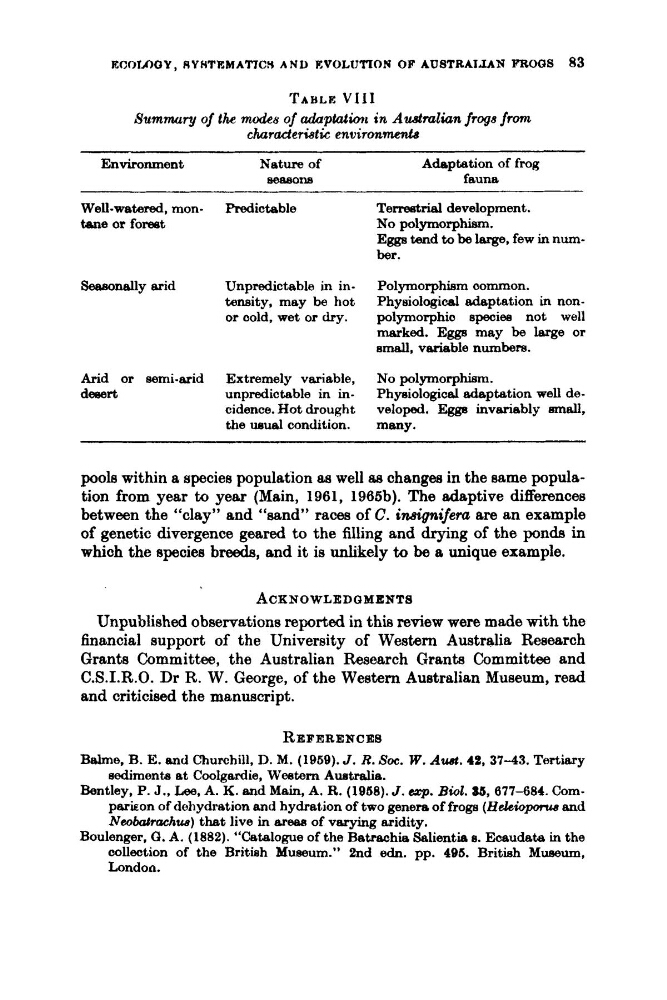
T A B L E V I I l
S u m m y of the modes of a d a p f a t h ~
in Austmliun frog8 from
eharaderietie environmate
Environment
Nature of
88880118
Adaptation of frog
faunm
~
~~
~
Well-watered, mon- Predictable
Terrestrial development.
tsne or foreat
N o polporphiam.
Eggs tand to be large, few in number.
Seasonally arid
Unpredictable in in- Polymorphism common.
tensity, may be hot
Physiological adaptation in nonor oold, wet or dry.
polymorphio speciea not well
marked. Eggs may be large or
emall, variable numbem.
Arid or semi-arid Extremely variabble, No polymorphism.
deeert
unpredictable in in- Phyeiological adaptation well decidence. Hot drought veloped. Egga invariably mall,
the usual condition.
many.
pools within a species population as well as changes in the same populetion from year to year (Main, 1961, 1966b). The adaptive differences
between the “clay” and “sand” races of C. insisnifera are an example
of genetic divergence geared to the filling and drylng of the ponds in
which the species breeds, and it is unlikely to be a unique example.
ACKNOWLEDGMENTS
Unpublished observations reported in this review were made with the
financial support of the University of Western Australia Research
Grants Committee, the Australian Research Grants Committee and
C.S.I.R.O. Dr R. W. George, of the Western Australian Museum, read
and criticised the manuscript.
REFERENCES
Balmo, B. E. and Churchill. D. M. (1969). J . R. SOC. W. A M . 42, 37-43. Tertiary
eedimente at Coolgardie, Western Auetralia.
Bentley, P. J., Lee, A. K. and Main, A. R. (1958). J. q. BWZ. 85, 677-684. Comparkon of dehydration and hydration of two genera of frogs (Helciupo~ua and
Neobdrochue) that live in B I ~ ~ R
of varying aridity.
Boulenger, Q. A, (1882). “Catalogue of the Batrachia Salientia a. Ecaudata in the
mllwtion of the Britieh Museum.” !&id edn. pp. 485. British Mueeum,
London.
T A B L E V I I l
S u m m y of the modes of a d a p f a t h ~
in Austmliun frog8 from
eharaderietie environmate
Environment
Nature of
88880118
Adaptation of frog
faunm
~
~~
~
Well-watered, mon- Predictable
Terrestrial development.
tsne or foreat
N o polporphiam.
Eggs tand to be large, few in number.
Seasonally arid
Unpredictable in in- Polymorphism common.
tensity, may be hot
Physiological adaptation in nonor oold, wet or dry.
polymorphio speciea not well
marked. Eggs may be large or
emall, variable numbem.
Arid or semi-arid Extremely variabble, No polymorphism.
deeert
unpredictable in in- Phyeiological adaptation well decidence. Hot drought veloped. Egga invariably mall,
the usual condition.
many.
pools within a species population as well as changes in the same populetion from year to year (Main, 1961, 1966b). The adaptive differences
between the “clay” and “sand” races of C. insisnifera are an example
of genetic divergence geared to the filling and drylng of the ponds in
which the species breeds, and it is unlikely to be a unique example.
ACKNOWLEDGMENTS
Unpublished observations reported in this review were made with the
financial support of the University of Western Australia Research
Grants Committee, the Australian Research Grants Committee and
C.S.I.R.O. Dr R. W. George, of the Western Australian Museum, read
and criticised the manuscript.
REFERENCES
Balmo, B. E. and Churchill. D. M. (1969). J . R. SOC. W. A M . 42, 37-43. Tertiary
eedimente at Coolgardie, Western Auetralia.
Bentley, P. J., Lee, A. K. and Main, A. R. (1958). J. q. BWZ. 85, 677-684. Comparkon of dehydration and hydration of two genera of frogs (Helciupo~ua and
Neobdrochue) that live in B I ~ ~ R
of varying aridity.
Boulenger, Q. A, (1882). “Catalogue of the Batrachia Salientia a. Ecaudata in the
mllwtion of the Britieh Museum.” !&id edn. pp. 485. British Mueeum,
London.