

52
A . R. MAIN
tiunlidity of' fJ(,%, tit, 20r'(: it i H only a matter of hourti for all Species to
dehydretc to tlt8trth. Fidd experience clhows that drought, extending
over mcnth8 or even yeare, hafi not killed all the frogs and in some
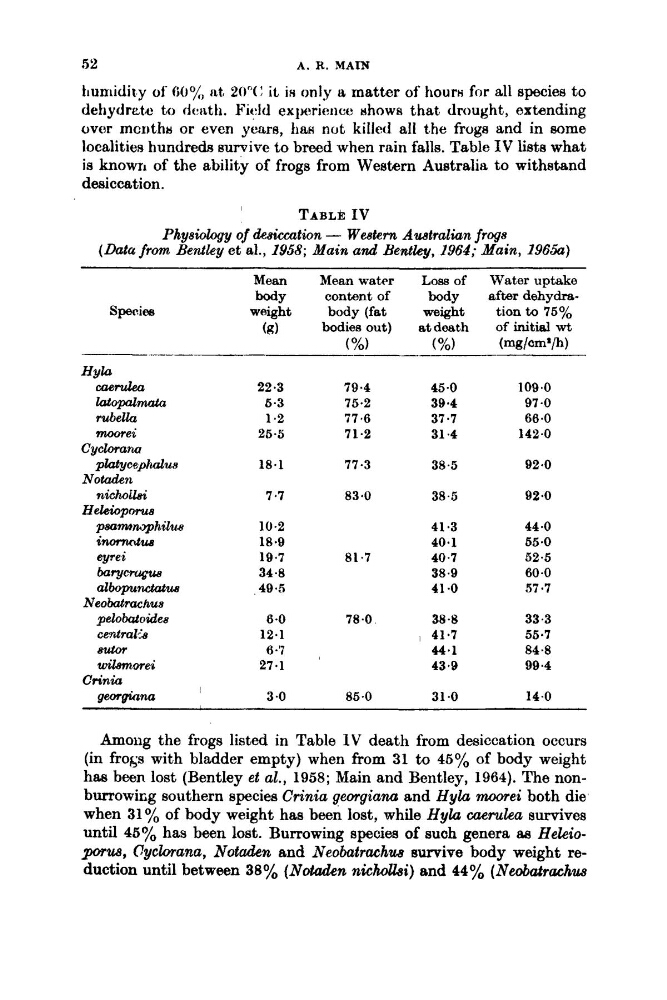
localities hundreds survive to breed when rain falls. Table f V lists what
is known of the ability of frogs from Western Australia to withstand
desiccation.
T A B L ~
IV
Physiology of desiccation - Western Awtralian frogs
(Data from Bentley et al., 1958; Main and Bentky, 1964; Main, 196%)
Mean
Mean water
Low of
Wabr uptake
body
content of
body
after dehydraSperies
weight
body (fat
weight
tion to 75%
(R)
bodies out)
et doath
of initial wt
(%)
(%I
(melcm'lh)
-Hyla
caerulea
22 -3
79.4
45 .O
109.0
bozxllmata
6.3
75.2
39.4
97 .O
rubella
1.2
77.6
37.7
66.0
moorei
25.5
71.2
31.4
142.0
Platy C e P w w
18.1
77.3
38.5
92.0
nichollsi
7 -7
83.0
38.5
92.0
psamrwphilus
10.2
41 *3
44.0
i-ua
18.9
40.1
55.0
eyaei
19.7
81.7
40.7
52.5
~ r y c l r c g u e
34 43
38.9
60.0
Cyclorana
Notaden
HeleiqpWU.9
albopzrnctatwr
49.5
41.0
57.7
pelobatoides
8.0
78.0
38.8
33.3
central&
12.1
, 41-7
56.7
Sulm
6 -7
44.1
84.8
wilemorei
27.1
43.9
99.4
gtTP.-a
3.0
85.0
31.0
14.0
Nwbatrachus
Crinia
Among the frogs listed in Table 1V death from desiccation occurs
(in frogs with bladder empty) when from 31 to 46% of body weight
hm been lost (Bentley et al., 1958; Main and Bentley, 1964). The nonburrowing southern species Crinia georgiana and Hyla nzoorei both die
when 31% of body weight has been lost, while Hyla caerulea survives
until 450/, has been lost. Burrowing species of such genera 88 Hekiop w , OycEorana, Notaden and Neobatrachw mrvive body weight reduction until between 38% (Noi!ud4!n nichdlsi) and 44% (Neobatrachus
A . R. MAIN
tiunlidity of' fJ(,%, tit, 20r'(: it i H only a matter of hourti for all Species to
dehydretc to tlt8trth. Fidd experience clhows that drought, extending
over mcnth8 or even yeare, hafi not killed all the frogs and in some
localities hundreds survive to breed when rain falls. Table f V lists what
is known of the ability of frogs from Western Australia to withstand
desiccation.
T A B L ~
IV
Physiology of desiccation - Western Awtralian frogs
(Data from Bentley et al., 1958; Main and Bentky, 1964; Main, 196%)
Mean
Mean water
Low of
Wabr uptake
body
content of
body
after dehydraSperies
weight
body (fat
weight
tion to 75%
(R)
bodies out)
et doath
of initial wt
(%)
(%I
(melcm'lh)
-Hyla
caerulea
22 -3
79.4
45 .O
109.0
bozxllmata
6.3
75.2
39.4
97 .O
rubella
1.2
77.6
37.7
66.0
moorei
25.5
71.2
31.4
142.0
Platy C e P w w
18.1
77.3
38.5
92.0
nichollsi
7 -7
83.0
38.5
92.0
psamrwphilus
10.2
41 *3
44.0
i-ua
18.9
40.1
55.0
eyaei
19.7
81.7
40.7
52.5
~ r y c l r c g u e
34 43
38.9
60.0
Cyclorana
Notaden
HeleiqpWU.9
albopzrnctatwr
49.5
41.0
57.7
pelobatoides
8.0
78.0
38.8
33.3
central&
12.1
, 41-7
56.7
Sulm
6 -7
44.1
84.8
wilemorei
27.1
43.9
99.4
gtTP.-a
3.0
85.0
31.0
14.0
Nwbatrachus
Crinia
Among the frogs listed in Table 1V death from desiccation occurs
(in frogs with bladder empty) when from 31 to 46% of body weight
hm been lost (Bentley et al., 1958; Main and Bentley, 1964). The nonburrowing southern species Crinia georgiana and Hyla nzoorei both die
when 31% of body weight has been lost, while Hyla caerulea survives
until 450/, has been lost. Burrowing species of such genera 88 Hekiop w , OycEorana, Notaden and Neobatrachw mrvive body weight reduction until between 38% (Noi!ud4!n nichdlsi) and 44% (Neobatrachus