

60
A. R. MAIN
All species inhabiting the dwert lay eggs in water and have an
aquatic larval lift:.
No qwoies of IfekiopoMle or species which lack an aquatic larval life
uuch tia Hetacrinia or Myobatrmhw enters the desert. Main et aZ. (1969)
related this exclusion from the deeert to dependence on reliable rainfall
and regularity of seasons. On the other hand Main et al. (op. cit.) believed thrct “successful” species of desert frogs were those which bred
opporturistically, had a short larval life, and larvae which tolercrted
heat, and burrowed as adulta.
Little io known of the actual temperatures experienced by frogs in
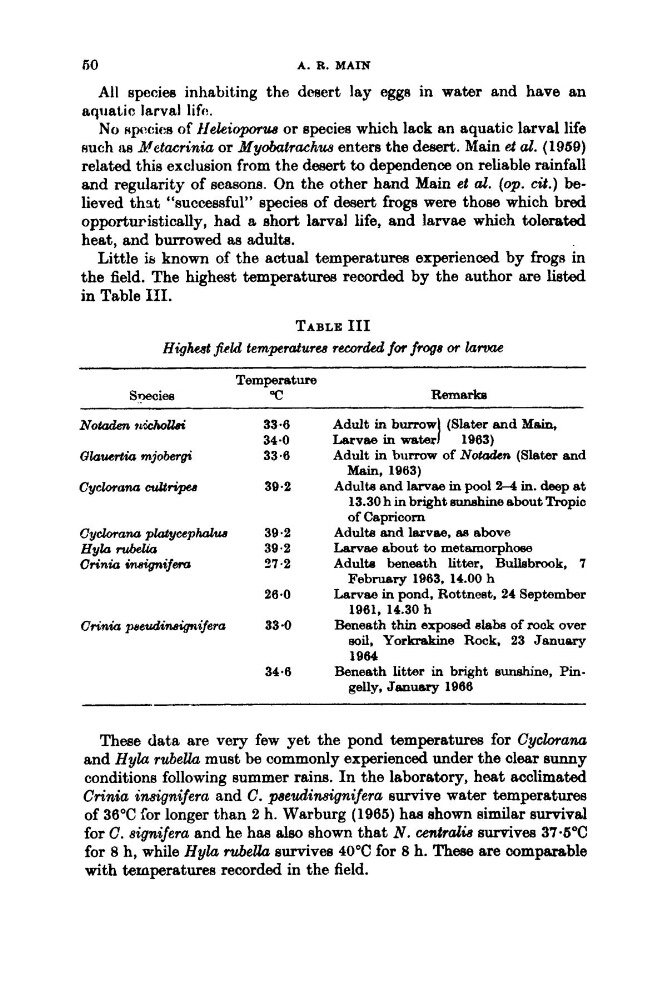
the field. The highest temperatures recorded by the author are listed
in Table 111.
TABLE 111
H i g W JieW temperaturee recora2d for frog8 or l a m
Temperature
S*cies
“c
Remarka
33-6
34.0
33.6
39.2
39.2
39.2
37.2
26.0
33 *O
34.6
Adult in burrow (Slater and Main,
Larvae in
1963)
Adult in burrow of Notaden (Slater end
Main, 1963)
Adulta and larvae in pool 2-4 in. deep at
13.30 h i n bright eunehine about Tcopic
of Capricorn
Adulta and lazvae, aa above
Larvae about to metamorphose
Adulte beneath litter, Bulbbrook, 7
February 1963, 14.00 h
Larvae in pond, Rottneat. 24 September
1961, 14.30 h
Beneath thin exposed ebbs of rook over
mil, Yorkrekine Rock, 23 Jsnuory
1964
Beneath litter in bright sunshine, Pingelly, Jenusry 1966
These data are very few yet the pond temperatures for Cyclotana
and Hyla rube& must be commonly experienced under the clear gunny
conditions following summer rains. In the laboratory, h a t acclimated
Crinia insignifera and C . peeudinsignifera survive water temperatures
of 36°C for longer than 2 h. Warburg (1965) has shown similar survival
for C. signifera and he has ale0 shown that N. central& survives 37.6OC
for 8 h, while Hyla rube& survives 40°C for 8 h. These are oomparable
with temperatures recorded in the field.
A. R. MAIN
All species inhabiting the dwert lay eggs in water and have an
aquatic larval lift:.
No qwoies of IfekiopoMle or species which lack an aquatic larval life
uuch tia Hetacrinia or Myobatrmhw enters the desert. Main et aZ. (1969)
related this exclusion from the deeert to dependence on reliable rainfall
and regularity of seasons. On the other hand Main et al. (op. cit.) believed thrct “successful” species of desert frogs were those which bred
opporturistically, had a short larval life, and larvae which tolercrted
heat, and burrowed as adulta.
Little io known of the actual temperatures experienced by frogs in
the field. The highest temperatures recorded by the author are listed
in Table 111.
TABLE 111
H i g W JieW temperaturee recora2d for frog8 or l a m
Temperature
S*cies
“c
Remarka
33-6
34.0
33.6
39.2
39.2
39.2
37.2
26.0
33 *O
34.6
Adult in burrow (Slater and Main,
Larvae in
1963)
Adult in burrow of Notaden (Slater end
Main, 1963)
Adulta and larvae in pool 2-4 in. deep at
13.30 h i n bright eunehine about Tcopic
of Capricorn
Adulta and lazvae, aa above
Larvae about to metamorphose
Adulte beneath litter, Bulbbrook, 7
February 1963, 14.00 h
Larvae in pond, Rottneat. 24 September
1961, 14.30 h
Beneath thin exposed ebbs of rook over
mil, Yorkrekine Rock, 23 Jsnuory
1964
Beneath litter in bright sunshine, Pingelly, Jenusry 1966
These data are very few yet the pond temperatures for Cyclotana
and Hyla rube& must be commonly experienced under the clear gunny
conditions following summer rains. In the laboratory, h a t acclimated
Crinia insignifera and C . peeudinsignifera survive water temperatures
of 36°C for longer than 2 h. Warburg (1965) has shown similar survival
for C. signifera and he has ale0 shown that N. central& survives 37.6OC
for 8 h, while Hyla rube& survives 40°C for 8 h. These are oomparable
with temperatures recorded in the field.