

TOWABD UNDEBSTANDINQ EQOBYSTEYB
23
transpiration is exercised and considerable oontrol over leaf temperature.
There ie also strong control over the rate at which carbon dioxide can
diffuse into the meaophyll through the stomatal channel and hence
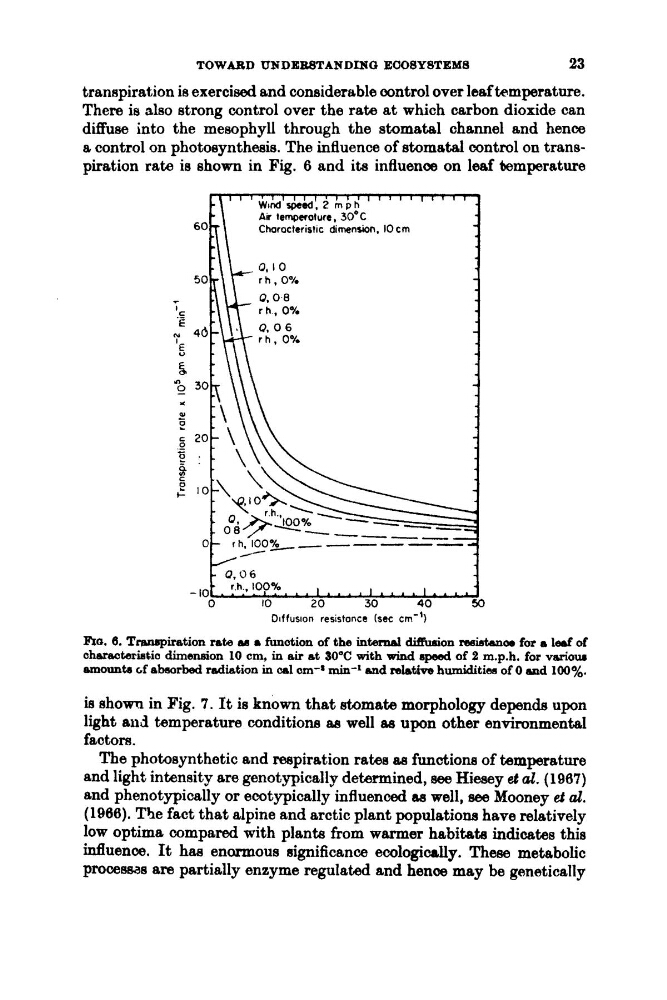
a control on photosynthesis. The influence of stornatal control on transpiration rate is shown in Fig. 6 and its influenm on leaf bemperature
Diffusion resls?once (sec cm-'1
Ffa. 6. Trgnspir8tion rate M a funotion of the intend -on
nuliotanoo for a l e d of
cherecteriabio dimension 10 cm, in 8ir s t 30°C with wind speed of 2 m.p.h. for various
nmounts tf ebaorbed radiation in osl cm-s rnin-' and mlative humidities of 0 and 100%.
ia shown in Fig. 7. It is known that atomate morphology depends upon
light and temperature conditions aa well aa upon other environmental
factors.
The photosynthetic and mapiration ratee aa functions of temperature
and light intensity are genotypically determined, ~ 8 8
Hiesey et d. (1967)
and phenotypically or ecotypically influenced (LB well, ~ 8 8
Mooney e.t d.
(1966). The fact that alpine and arctic plant populatione have relatively
low optima compared with plants from warmer habitata indioates this
influence. It haa enarmous significance ecologically. These metabolic
procewa are partially enzyme regulated and henos may be genetically
23
transpiration is exercised and considerable oontrol over leaf temperature.
There ie also strong control over the rate at which carbon dioxide can
diffuse into the meaophyll through the stomatal channel and hence
a control on photosynthesis. The influence of stornatal control on transpiration rate is shown in Fig. 6 and its influenm on leaf bemperature
Diffusion resls?once (sec cm-'1
Ffa. 6. Trgnspir8tion rate M a funotion of the intend -on
nuliotanoo for a l e d of
cherecteriabio dimension 10 cm, in 8ir s t 30°C with wind speed of 2 m.p.h. for various
nmounts tf ebaorbed radiation in osl cm-s rnin-' and mlative humidities of 0 and 100%.
ia shown in Fig. 7. It is known that atomate morphology depends upon
light and temperature conditions aa well aa upon other environmental
factors.
The photosynthetic and mapiration ratee aa functions of temperature
and light intensity are genotypically determined, ~ 8 8
Hiesey et d. (1967)
and phenotypically or ecotypically influenced (LB well, ~ 8 8
Mooney e.t d.
(1966). The fact that alpine and arctic plant populatione have relatively
low optima compared with plants from warmer habitata indioates this
influence. It haa enarmous significance ecologically. These metabolic
procewa are partially enzyme regulated and henos may be genetically