

TOWAaD U X D E B S T A N D ~ O ECOSYSTBMS
19
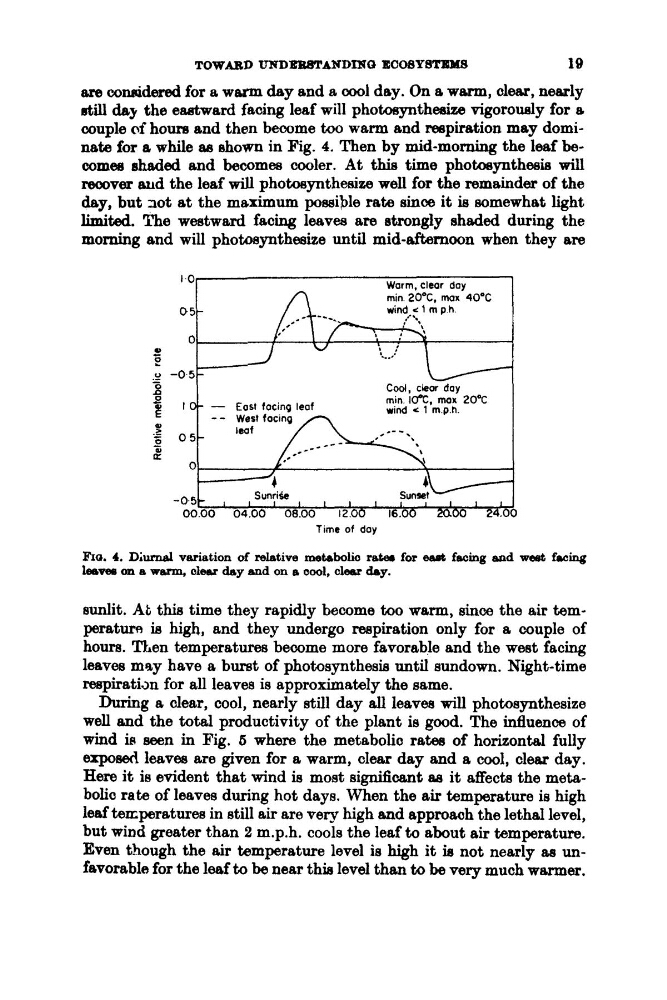
are conaidered for a warm day and a 0001 day. On a warm, clear, nearly
Still day the eastward facing leaf will photoeyntheaizs Vigorously for a
couple of hours and then become too warm and mapiration may dominate for a while aa ehown in Fig. 4. Then by mid-morning the leaf becomes shaded and becomes cooler. A t this time photasspthesis w i l l
m v e r md the leaf will photosynthesize well for the remainder of the
day, but =lot at the maximum possible rate since it is somewhat light
limited. The westward facing leaves are strongly shaded during the
morning and will photosynthesize until mid-afternoon when they are
Time of day
FIO. 4. Diurnal variation of mhtive metubolio re- for ead facing and Weet facing
lesver on s warm, o h day and on 8 0001, clea? day.
sunlit. At this time they rapidly become too warm, since the air temperature is high, and they undergo respiration only for 8 couple of
hours. !t%en temperatures become more favorable and the west facing
leaves may have a burst of photosynthesis until sundown. Night-time
respiratian for all leaves is approximately the same.
During a clear, cool, nearly still day a31 leaves will photosynthesize
well and the total productivity of the plant is good. The influence of
wind iR eeen in Fig. 6 where the metabolio rates of horizontal fully
exposed leaves are given for a warm, clear day and a cool, clear day.
Here it is evident that wind is most significant aa it affects the metabolic rate of leaves during hot days. When the air temperature is high
leafteqeratures in still air are very high and approach the lethal level,
but wind greater than 2 m.p.h. cools the leaf to about air temperature.
Even though the air temperature level is high it is not nearly m unfavorable for the leaf to be near this level than to be very much warmer.
19
are conaidered for a warm day and a 0001 day. On a warm, clear, nearly
Still day the eastward facing leaf will photoeyntheaizs Vigorously for a
couple of hours and then become too warm and mapiration may dominate for a while aa ehown in Fig. 4. Then by mid-morning the leaf becomes shaded and becomes cooler. A t this time photasspthesis w i l l
m v e r md the leaf will photosynthesize well for the remainder of the
day, but =lot at the maximum possible rate since it is somewhat light
limited. The westward facing leaves are strongly shaded during the
morning and will photosynthesize until mid-afternoon when they are
Time of day
FIO. 4. Diurnal variation of mhtive metubolio re- for ead facing and Weet facing
lesver on s warm, o h day and on 8 0001, clea? day.
sunlit. At this time they rapidly become too warm, since the air temperature is high, and they undergo respiration only for 8 couple of
hours. !t%en temperatures become more favorable and the west facing
leaves may have a burst of photosynthesis until sundown. Night-time
respiratian for all leaves is approximately the same.
During a clear, cool, nearly still day a31 leaves will photosynthesize
well and the total productivity of the plant is good. The influence of
wind iR eeen in Fig. 6 where the metabolio rates of horizontal fully
exposed leaves are given for a warm, clear day and a cool, clear day.
Here it is evident that wind is most significant aa it affects the metabolic rate of leaves during hot days. When the air temperature is high
leafteqeratures in still air are very high and approach the lethal level,
but wind greater than 2 m.p.h. cools the leaf to about air temperature.
Even though the air temperature level is high it is not nearly m unfavorable for the leaf to be near this level than to be very much warmer.