

16
DAVID M. GATES
a t any moment. All biochemical events are rate processes which are
temperature dependent. Some chemical reactions are light dependent
as well as temperature dependent and are therefore photochemical reactions. Respiration is largely a thermochemical process. Photosynthesis
involves three types of processes: namely photochemical events related
to the absorption of light quanta and the release of oxygen, diffusion
events with the aasimilation of carbon dioxide, and further thermochemical events which are enzyme controlled. It w i l l be possible eventually to predict for each type of biochemical event what might occur
during a diurnal cycle when the leaf temperature and transpiration
rate are responding to diurnal variations of the environmental factors.
At the present time, rather than separating the events, one can estimate
the diurnal rhythm of net photosynthesis on the baais of empirical
curves of net photosynthesis with light and temperature.
A. PHOTOSYNTHESIS A N D RESPIRATION
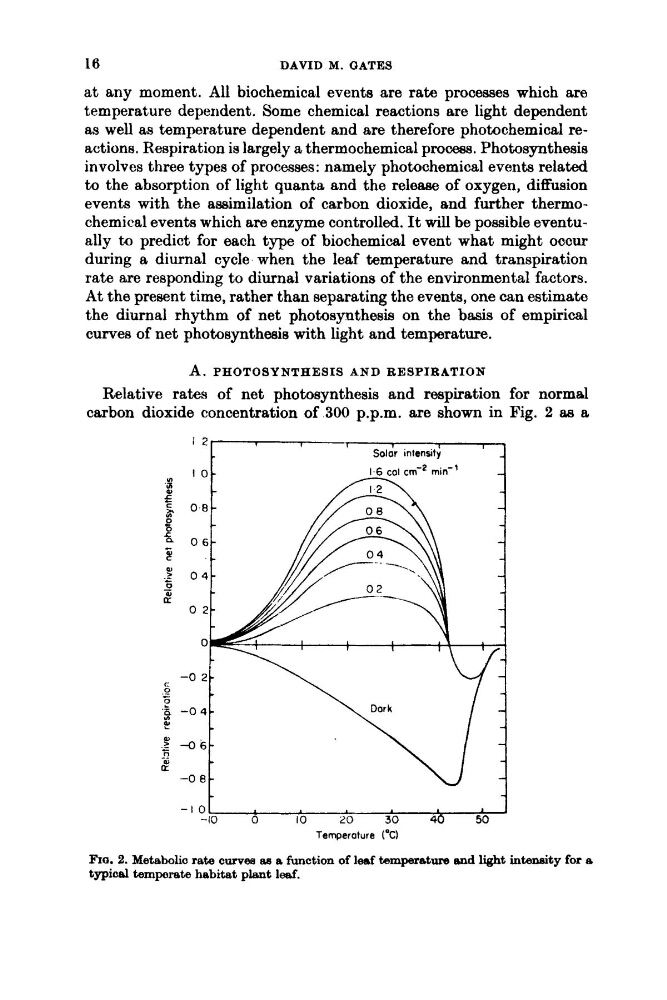
Relative rates of net photosynthesis and respiration for normal
carbon dioxide concentration of 300 p.p.m. are shown in Fig. 2 M I a
' 2
L
-
T
Soldr Intensit;
I
- I 0
1
-10
0
10
2 0
30
46
50
Temperature ('C)
FIG. 2. Metabolic rate curvea as a function of lesf tempematwe and light in&ty for a
typical temperate habitat plant leaf.
DAVID M. GATES
a t any moment. All biochemical events are rate processes which are
temperature dependent. Some chemical reactions are light dependent
as well as temperature dependent and are therefore photochemical reactions. Respiration is largely a thermochemical process. Photosynthesis
involves three types of processes: namely photochemical events related
to the absorption of light quanta and the release of oxygen, diffusion
events with the aasimilation of carbon dioxide, and further thermochemical events which are enzyme controlled. It w i l l be possible eventually to predict for each type of biochemical event what might occur
during a diurnal cycle when the leaf temperature and transpiration
rate are responding to diurnal variations of the environmental factors.
At the present time, rather than separating the events, one can estimate
the diurnal rhythm of net photosynthesis on the baais of empirical
curves of net photosynthesis with light and temperature.
A. PHOTOSYNTHESIS A N D RESPIRATION
Relative rates of net photosynthesis and respiration for normal
carbon dioxide concentration of 300 p.p.m. are shown in Fig. 2 M I a
' 2
L
-
T
Soldr Intensit;
I
- I 0
1
-10
0
10
2 0
30
46
50
Temperature ('C)
FIG. 2. Metabolic rate curvea as a function of lesf tempematwe and light in&ty for a
typical temperate habitat plant leaf.