

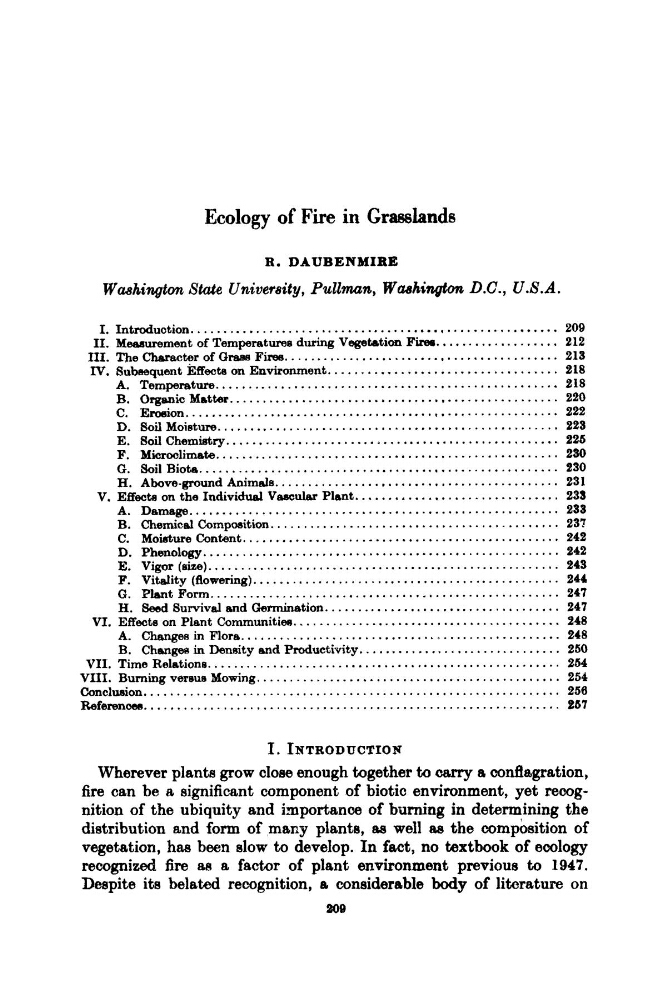
Ecology of Fire in Grasslands
R . DAUBENMIRE
Waahihington State Univeraity. Pullman. Waahi.itagton D.C., U.S.A.
I . Introduotion ........................................................ 209
I1 . Meesurement of Temperaturea during Vegetution F h ................... 212
I11 . The Character of oras8 F k .......................................... 213
IV . Subaequent Effeota on Environment ................................... 218
A . Temperature .................................................... 218
B . O%snicMst ter .................................................. 220
C . Ermion .........................................................
222
D . Soil Moiat ure .................................................... 223
E . Soil Chem istry ................................................... 226
F . Microoli mete .................................................... 230
G . Soil Bio te .......................................................
230
H . Above-ground Animals ........................................... 231
V . Effecta on the Individual Vascuku Plant ............................... 233
A . Dams ge ........................................................ 293
B . Chemical Composition ............................................ 297
C . Moisture Content ................................................ 242
D . Phenol0 gy ...................................................... 242
E . Vigor (size) ...................................................... 243
F . Vitality (flowering) ...............................................
244
G . Plsnt Form .....................................................
247
H . Seed Survival and (3erminetion .................................... 247
VI . Effeota on Plant Communitiea ......................................... 248
A . Changesin Flora .................................................
248
B . Changes in Density and Productivity ...............................
250
VII . Time Relations ...................................................... 264
VIII . Burning versus Mowing .............................................. 254
Conclusion ...............................................................
256
Referen oes ...............................................................
Z17
I . INTRODUCTION
Wherever plants grow close enough together to carry a conflagration.
fire can be R significant component of biotic environment. yet recognition of the ubiquity and importance of burning in determining the
distribution and form of many plants. as well as the compbsition of
vegetation. has been slow to develop . In fact. no textbook of ecology
recognized fire &B a factor of plant environment previous to 1947 .
Despite its belated recognition. a considerable body of literature on
209
R . DAUBENMIRE
Waahihington State Univeraity. Pullman. Waahi.itagton D.C., U.S.A.
I . Introduotion ........................................................ 209
I1 . Meesurement of Temperaturea during Vegetution F h ................... 212
I11 . The Character of oras8 F k .......................................... 213
IV . Subaequent Effeota on Environment ................................... 218
A . Temperature .................................................... 218
B . O%snicMst ter .................................................. 220
C . Ermion .........................................................
222
D . Soil Moiat ure .................................................... 223
E . Soil Chem istry ................................................... 226
F . Microoli mete .................................................... 230
G . Soil Bio te .......................................................
230
H . Above-ground Animals ........................................... 231
V . Effecta on the Individual Vascuku Plant ............................... 233
A . Dams ge ........................................................ 293
B . Chemical Composition ............................................ 297
C . Moisture Content ................................................ 242
D . Phenol0 gy ...................................................... 242
E . Vigor (size) ...................................................... 243
F . Vitality (flowering) ...............................................
244
G . Plsnt Form .....................................................
247
H . Seed Survival and (3erminetion .................................... 247
VI . Effeota on Plant Communitiea ......................................... 248
A . Changesin Flora .................................................
248
B . Changes in Density and Productivity ...............................
250
VII . Time Relations ...................................................... 264
VIII . Burning versus Mowing .............................................. 254
Conclusion ...............................................................
256
Referen oes ...............................................................
Z17
I . INTRODUCTION
Wherever plants grow close enough together to carry a conflagration.
fire can be R significant component of biotic environment. yet recognition of the ubiquity and importance of burning in determining the
distribution and form of many plants. as well as the compbsition of
vegetation. has been slow to develop . In fact. no textbook of ecology
recognized fire &B a factor of plant environment previous to 1947 .
Despite its belated recognition. a considerable body of literature on
209