

STUDIES ON THE INSECT FAUNA ON SCOTCH BROOM
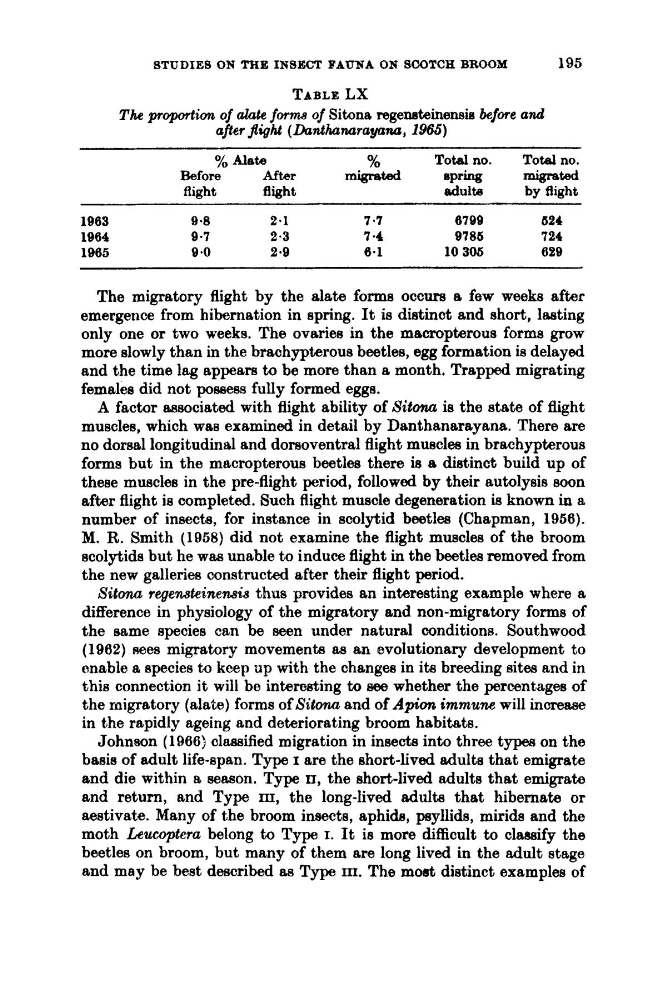
TABLE LX
The proportion of alate fm of Sitona regensteinensis before and
after jig& (Danthanurayrmtz, 1965)
yo Alate
%
TOM no.
Totel no.
epring
migrated
edulte
by flight
195
Before
After
migreted
flight
flight
1963
9 *8
2.1
7 -7
6799
524
1964
9 -7
2 -3
7 4
9786
724
1965
9 -0
2.9
6.1
10 306
029
The migratory flight by the alate forms occurs a few weeks after
emergence from hibernation in spring. It is distinct and short, lasting
only one or two weeks. The ovaries in the mampterous forms grow
more slowly than in the brachypterous beetles, egg formation is delayed
and the time lag appears to be more than a month. Trapped migrating
females did not possess fully formed eggs.
A factor associated with flight ability of Sitona is the state of flight
muscles, which was examined in detail by Danthanarayana. There are
no dorsal longitudinal and dorsoventral flight muscles in brachypterous
forms but in the macropterous beetles there is a distinct build up of
these muscles in the pre-flight period, followed by their autolysis soon
after flight is completed. Such flight muscle degeneration is known in a
number of insects, for instance in scolytid beetles (Chapman, 1966).
M. R. Smith (1968) did not examine the flight muscles of the broom
scolytids but he w m unable to induce flight in the beetles removed from
the new galleries constructed after their flight period.
Sitona regemteinensis thus provides an interesting example where a
difference in physiology of the migratory and non-migratory forms of
the same species can be seen under natural conditiona. Southwood
(1962) Rees migratory movementa as an evolutionary development to
enable a species to keep up with the changes in its breeding sites and in
this connection it will be interesting to 888 whether the percentages of
the migratory (alate) forms of Sitona and of Apion immune will increase
in the rapidly ageing and deteriorating broom habitats.
Johnson (1966) classified migration in insects into three typea on the
basis of adult life-span. Type I are the short-lived adults that emigrate
and die within a season. Type n, the short-lived adults that emigrata
and return, and Type rn, the long-lived adults that hibernate or
aestivate. Many of the broom insects, aphids, psyllids, mirids and the
moth Leucoptera belong to Type I. It is more difficult to classify the
beetles on broom, but many of them are long lived in the adult stage
and may be best described as Type m. The most distinct examples of
TABLE LX
The proportion of alate fm of Sitona regensteinensis before and
after jig& (Danthanurayrmtz, 1965)
yo Alate
%
TOM no.
Totel no.
epring
migrated
edulte
by flight
195
Before
After
migreted
flight
flight
1963
9 *8
2.1
7 -7
6799
524
1964
9 -7
2 -3
7 4
9786
724
1965
9 -0
2.9
6.1
10 306
029
The migratory flight by the alate forms occurs a few weeks after
emergence from hibernation in spring. It is distinct and short, lasting
only one or two weeks. The ovaries in the mampterous forms grow
more slowly than in the brachypterous beetles, egg formation is delayed
and the time lag appears to be more than a month. Trapped migrating
females did not possess fully formed eggs.
A factor associated with flight ability of Sitona is the state of flight
muscles, which was examined in detail by Danthanarayana. There are
no dorsal longitudinal and dorsoventral flight muscles in brachypterous
forms but in the macropterous beetles there is a distinct build up of
these muscles in the pre-flight period, followed by their autolysis soon
after flight is completed. Such flight muscle degeneration is known in a
number of insects, for instance in scolytid beetles (Chapman, 1966).
M. R. Smith (1968) did not examine the flight muscles of the broom
scolytids but he w m unable to induce flight in the beetles removed from
the new galleries constructed after their flight period.
Sitona regemteinensis thus provides an interesting example where a
difference in physiology of the migratory and non-migratory forms of
the same species can be seen under natural conditiona. Southwood
(1962) Rees migratory movementa as an evolutionary development to
enable a species to keep up with the changes in its breeding sites and in
this connection it will be interesting to 888 whether the percentages of
the migratory (alate) forms of Sitona and of Apion immune will increase
in the rapidly ageing and deteriorating broom habitats.
Johnson (1966) classified migration in insects into three typea on the
basis of adult life-span. Type I are the short-lived adults that emigrate
and die within a season. Type n, the short-lived adults that emigrata
and return, and Type rn, the long-lived adults that hibernate or
aestivate. Many of the broom insects, aphids, psyllids, mirids and the
moth Leucoptera belong to Type I. It is more difficult to classify the
beetles on broom, but many of them are long lived in the adult stage
and may be best described as Type m. The most distinct examples of