

STUDIES ON THE INSECT FAUNA ON SCOTCH BROOM
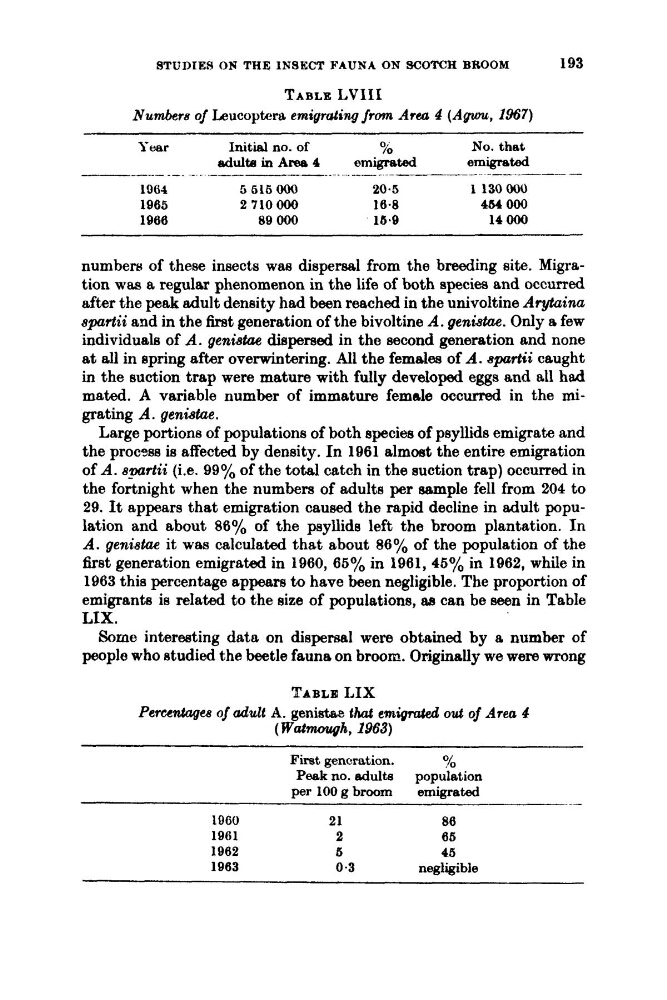
TABLE LVIII
Number8 of Leucoptercl emigrating from Area 4 ( A p m , 1967)
Tear
Initial no. of
0 ;
/O
No. that
emigrated
1064
5 615 OOO
20.5
1130000
1965
2 710000
16.8
4 M OOO
1966
89 000
16.9
14 OOO
193
-
d u l t a i n h 4
omigrated
___
~
- .
. . . -..
-. .- -
numbers of these insects was dispersal from the breeding site. Migration wm a regular phenomenon in the life of both species and occurred
after the peak adult density had been reached in the univoltine Ayfaina
syxcrtii and in the first generation of the bivoltine A . genistae. Only a few
individuals of A. genistue. dispersed in the second generation and none
at all in spring after overwintering. All the females of A . sprtii caught
in the suction trap were mature with fully developed eggs and all had
mated. A variable number of immature female occurred in the migrating A. genistae.
Large portione of populations of both species of psyllids emigrate and
the procztss is affected by density. In 1961 almoat the entire emigration
of A. s-mrtii (i.e. 99% of the total catch in the auction trap) occurred in
the fortnight when the numbers of adults per eample fell from 204 to
29. It appears that emigration caused the rapid decline in adult population and about 86% of the psyllids left the broom plantation. In
A. geniatue it was calculated that about S6y0 of the population of the
first generation emigrated in 1960, 65% in 1961, 45% in 1962, while in
1963 this percentage appears to have been negligible. The proportion of
emigrants is related to the size of populations, aa can be wen in Table
LIX.
k%rne intereeting data on dispersal were obtained by a number of
people who studied the beetle fauna on broom. Originally we were wrong
TABLE LIX
Percentagee of adult A. genistae that emn;sraterl out of Area 4
( Watmouqh, 1963)
~
~~~
~~
First generation.
:43
Peak no. adults populetion
per 100 g broom
emigrated
. -
1060
21
86
1961
2
66
1962
6
45
1963
0.3
negligible
TABLE LVIII
Number8 of Leucoptercl emigrating from Area 4 ( A p m , 1967)
Tear
Initial no. of
0 ;
/O
No. that
emigrated
1064
5 615 OOO
20.5
1130000
1965
2 710000
16.8
4 M OOO
1966
89 000
16.9
14 OOO
193
-
d u l t a i n h 4
omigrated
___
~
- .
. . . -..
-. .- -
numbers of these insects was dispersal from the breeding site. Migration wm a regular phenomenon in the life of both species and occurred
after the peak adult density had been reached in the univoltine Ayfaina
syxcrtii and in the first generation of the bivoltine A . genistae. Only a few
individuals of A. genistue. dispersed in the second generation and none
at all in spring after overwintering. All the females of A . sprtii caught
in the suction trap were mature with fully developed eggs and all had
mated. A variable number of immature female occurred in the migrating A. genistae.
Large portione of populations of both species of psyllids emigrate and
the procztss is affected by density. In 1961 almoat the entire emigration
of A. s-mrtii (i.e. 99% of the total catch in the auction trap) occurred in
the fortnight when the numbers of adults per eample fell from 204 to
29. It appears that emigration caused the rapid decline in adult population and about 86% of the psyllids left the broom plantation. In
A. geniatue it was calculated that about S6y0 of the population of the
first generation emigrated in 1960, 65% in 1961, 45% in 1962, while in
1963 this percentage appears to have been negligible. The proportion of
emigrants is related to the size of populations, aa can be wen in Table
LIX.
k%rne intereeting data on dispersal were obtained by a number of
people who studied the beetle fauna on broom. Originally we were wrong
TABLE LIX
Percentagee of adult A. genistae that emn;sraterl out of Area 4
( Watmouqh, 1963)
~
~~~
~~
First generation.
:43
Peak no. adults populetion
per 100 g broom
emigrated
. -
1060
21
86
1961
2
66
1962
6
45
1963
0.3
negligible