

TOWABD tTD1CR.STANDLNQ ECOSYSTEMS
7
What are the environmental factor8 which may conceivably affect an
organism: air, water, or soil temperature; electromagnetic radiation
(including light and heat); ionizing radiation; wind (air or water movement); water vapor, oarbon dioxide, oxygen, and other gwes; chemicals and nutrients; moving particles of sand, soil, or rock; electric,
magnetic and gravitational fields; and perhaps others. Each environmental factor depends upon the time. On earth certain environmentai
factors are ubiquitous, 0.8. magnetic and gravitational fields. Electric
fielda are nearly ubiquitous and in air and space radiation is ubiquitous,
but not in soil and water. Several or all of these environmental factors
may act simultaneously. The first important step towards an understanding of the interaction between the environment and organisms is
to make reasonable approximations concerning which environmental
factors and plant or animal properties are of primary importance and
which are of only secondary significance. One can first consider certain
factors, such as sand blasting, m occurring only under specid circumstances and therefore neglected for a fundamental analysis. One can
consider for a first approximation the relative lack of variability of such
factors as the gravitational field. One can and must be even more willing
to assume that other factors such tbs the electric and magnetic fields or
ionizing radiation, are genertllly not of first order significance, but may
be very significant under special circumstances.
c. ENELlQY BUDGET
To first approximation what are the significant environmental factors affecting the energy budget of an organism and by what procew
do they act? How are the environmental factors coupled to the organism
and what are the first consequences to the organism? The energy budget
of an organism is written in the following form, see Gates (1967), where
the &’s are energy in calories per unit area (in om9) per unit time
(in min):
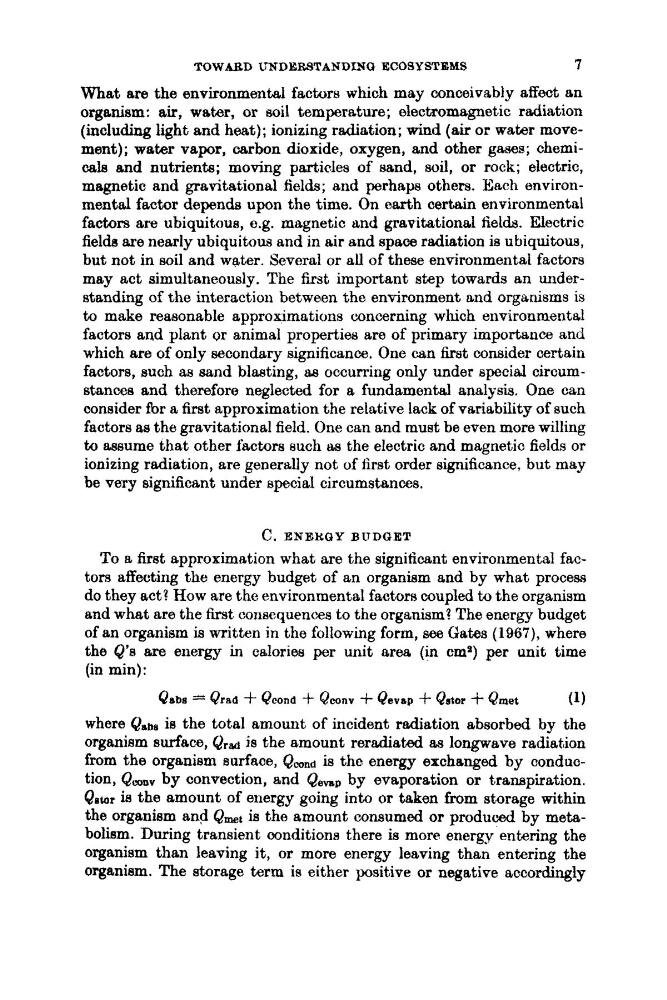
(1)
where Qabs is the total amount of incident radiation absorbed by the
organism surface, Qra is the amount reradiated as longwave radiation
from the organism surfwe, Qmnd is the energy exchanged by conduotion, QmV by convection, and Qevap by evaporation or transpiration.
QBwr is the amount of energy going into or taken from storage within
the organism and &met is the amount consumed or produced by metabolism. During transient oonditions there is more energy entering the
organism than leaving it, or more energy leaving than entering the
organism. The storage term is either positive or negative accordingly
Qabs = &ma -k Qcond -I- &cony f & e n p 4- &#tor -i- &met
7
What are the environmental factor8 which may conceivably affect an
organism: air, water, or soil temperature; electromagnetic radiation
(including light and heat); ionizing radiation; wind (air or water movement); water vapor, oarbon dioxide, oxygen, and other gwes; chemicals and nutrients; moving particles of sand, soil, or rock; electric,
magnetic and gravitational fields; and perhaps others. Each environmental factor depends upon the time. On earth certain environmentai
factors are ubiquitous, 0.8. magnetic and gravitational fields. Electric
fielda are nearly ubiquitous and in air and space radiation is ubiquitous,
but not in soil and water. Several or all of these environmental factors
may act simultaneously. The first important step towards an understanding of the interaction between the environment and organisms is
to make reasonable approximations concerning which environmental
factors and plant or animal properties are of primary importance and
which are of only secondary significance. One can first consider certain
factors, such as sand blasting, m occurring only under specid circumstances and therefore neglected for a fundamental analysis. One can
consider for a first approximation the relative lack of variability of such
factors as the gravitational field. One can and must be even more willing
to assume that other factors such tbs the electric and magnetic fields or
ionizing radiation, are genertllly not of first order significance, but may
be very significant under special circumstances.
c. ENELlQY BUDGET
To first approximation what are the significant environmental factors affecting the energy budget of an organism and by what procew
do they act? How are the environmental factors coupled to the organism
and what are the first consequences to the organism? The energy budget
of an organism is written in the following form, see Gates (1967), where
the &’s are energy in calories per unit area (in om9) per unit time
(in min):
(1)
where Qabs is the total amount of incident radiation absorbed by the
organism surface, Qra is the amount reradiated as longwave radiation
from the organism surfwe, Qmnd is the energy exchanged by conduotion, QmV by convection, and Qevap by evaporation or transpiration.
QBwr is the amount of energy going into or taken from storage within
the organism and &met is the amount consumed or produced by metabolism. During transient oonditions there is more energy entering the
organism than leaving it, or more energy leaving than entering the
organism. The storage term is either positive or negative accordingly
Qabs = &ma -k Qcond -I- &cony f & e n p 4- &#tor -i- &met