

STUDIES ON THE INSECT FAUNA ON SCOTCH BROOM
183
The eggs were laid very close to aphids, usually at a distance of 0-5 mm
and this was confirmed in P. scutntw experimentally. Moreover, ovipoaitions occurred more frequently when the syrphid was presented
with larger aphid colonies. Recently, Chandler (1967) has shown that
the age of an aphidophagous syrphid may greatly affect oviposition
behaviour and that experimental S. luniger show a marked decline of
precision of response with age.
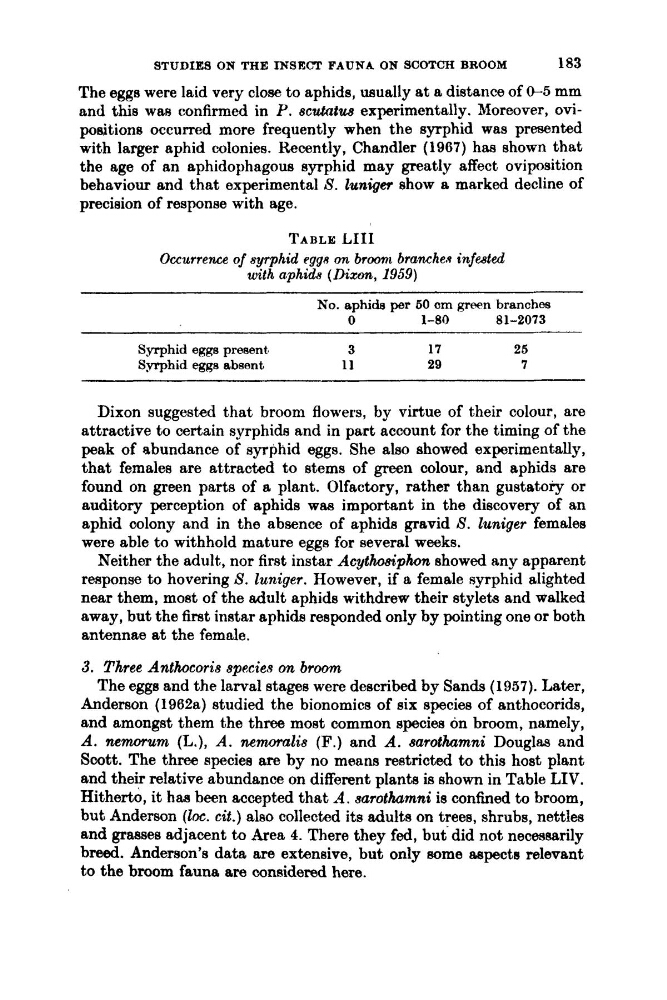
TABLE LIII
Occurrence of syrphid egg8 on broom brancheqq infested
with aphidu ( D i m , 1959)
No. aphids per 60 om grew branches
0
1-80
81-2073
Syrphid eggs present,
3
17
25
Syrphid eggs absent
11
29
7
Dixon suggested that broom flowers, by virtue of their colour, are
attractive to certain syrphids and in part account for the timing of the
peak of abundance of syrphid eggs. She also showed experimentally,
that females are attracted to stems of green colour, and aphids are
found on green parts of a plant. Olfactory, rather than gustatory or
auditory perception of aphids was important in the discovery of an
aphid colony and in the absence of aphids gravid S. Zuniger females
were able to withhold mature eggs for several weeks.
Neither the adult, nor first instar Acythmiphon showed any apparent
response to hovering S. Zudger. However, if a female syrphid alighted
near them, most of the adult aphids withdrew their stylets and walked
away, but the first instar aphids responded only by pointing one or both
antennas at the female.
3. Three Anthoeoris species on broom
The eggs and the larval stages were described by Sands (1957). Later,
Anderson (1962a) studied the bionomics of six species of anthocorids,
and amongst them the three most common species on broom, namely,
A. nemorum (L.), A . n e m l i s (F.) and A . sarothamni Douglas and
Scott. The three species are by no means restricted to this host plant
and their relative abundance on different planta is shown in Table LIV.
Hitherto, it haa been accepted that ,4. sarothamni is confined to broom,
but Anderson (Em. cit.) also collected its adults on trees, shrubs, nettles
and grasses adjacent to Area 4. There they fed, but did not necesearily
breed. Anderson’s data are extensive, but only some aspects relevant
t o the broom fauna are considered here.
183
The eggs were laid very close to aphids, usually at a distance of 0-5 mm
and this was confirmed in P. scutntw experimentally. Moreover, ovipoaitions occurred more frequently when the syrphid was presented
with larger aphid colonies. Recently, Chandler (1967) has shown that
the age of an aphidophagous syrphid may greatly affect oviposition
behaviour and that experimental S. luniger show a marked decline of
precision of response with age.
TABLE LIII
Occurrence of syrphid egg8 on broom brancheqq infested
with aphidu ( D i m , 1959)
No. aphids per 60 om grew branches
0
1-80
81-2073
Syrphid eggs present,
3
17
25
Syrphid eggs absent
11
29
7
Dixon suggested that broom flowers, by virtue of their colour, are
attractive to certain syrphids and in part account for the timing of the
peak of abundance of syrphid eggs. She also showed experimentally,
that females are attracted to stems of green colour, and aphids are
found on green parts of a plant. Olfactory, rather than gustatory or
auditory perception of aphids was important in the discovery of an
aphid colony and in the absence of aphids gravid S. Zuniger females
were able to withhold mature eggs for several weeks.
Neither the adult, nor first instar Acythmiphon showed any apparent
response to hovering S. Zudger. However, if a female syrphid alighted
near them, most of the adult aphids withdrew their stylets and walked
away, but the first instar aphids responded only by pointing one or both
antennas at the female.
3. Three Anthoeoris species on broom
The eggs and the larval stages were described by Sands (1957). Later,
Anderson (1962a) studied the bionomics of six species of anthocorids,
and amongst them the three most common species on broom, namely,
A. nemorum (L.), A . n e m l i s (F.) and A . sarothamni Douglas and
Scott. The three species are by no means restricted to this host plant
and their relative abundance on different planta is shown in Table LIV.
Hitherto, it haa been accepted that ,4. sarothamni is confined to broom,
but Anderson (Em. cit.) also collected its adults on trees, shrubs, nettles
and grasses adjacent to Area 4. There they fed, but did not necesearily
breed. Anderson’s data are extensive, but only some aspects relevant
t o the broom fauna are considered here.