

STUDIES ON THE MSECrr FAUNA ON SCOTCH BROOM
171
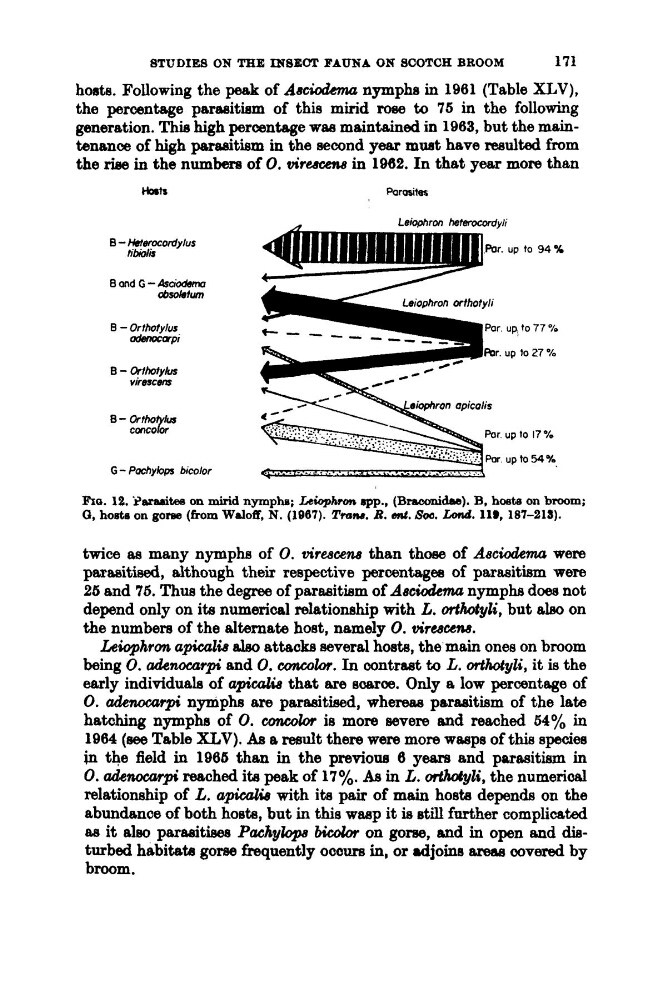
hosts. Following the peak of Asciodcma nymphs in 1961 (Table XLV),
the percentage parasitism of this mirid rose to 76 in the following
generation. This high percentage was maintained in 1963, but the maintenance of high parseitism in the second year muat have reeulted from
the rim in the numbere of 0. v i r e u m in 1962. In that year more than
Hosts
Parasites
0 - Orthotylus
OdWltXffpi
0 - ~thoty/us
virescens
G - Pachybps bicolor
+ - - -
FXQ. 12. Peraritea on mirid nymphs; I;tiophron qp., (Brsconidss). B, hosts on broom;
G, hosts on game (from Wdoff, N. (1987). Trow. R. enl. Soa. M . 11). 187-21s).
twice as many nymphs of 0. virerrcens than those of Aeciodemcr were
pasaaitieed, although their respective perwntagea of parasitism were
26 and 76. Thus the degree of parrteitism of Asciodcma nymphs doea not
depend only on its numerical relationship with L. orthtyti, but ale0 on
the numbers of the alternate host, namely 0. vircsccne.
Leiophron apicalie also attach several hoets, the main ones on broom
being 0. &noearpi and 0. concolor. In contrast to L. orthotyli, it is the
early individuals of cvpiccrlis that are scarce. Only a low percentage of
0. a d e m * nymphs are p d t i s e d , whereas paraaitism of the late
hatching nymphs of 0. wnmh is more severe and reached 54% in
1964 (we Table XLV). As a result there were more wasps of this speciea
in the field in 1965 than in the previoua 6 years and parasitism in
0. ademcarpi reached its peak of 17%. As i n L. &li,
the numerical
relationship of L. a -
with its pair of main hoata depends on the
abundance of both hoete, but in this waap it is &,ill fnrther complicated
as it ale0 parasitises Pachybp biedor on gorse, and in open and disturbed habitata gorse frequently ocom in, or adjoins areaa oovered by
broom.
171
hosts. Following the peak of Asciodcma nymphs in 1961 (Table XLV),
the percentage parasitism of this mirid rose to 76 in the following
generation. This high percentage was maintained in 1963, but the maintenance of high parseitism in the second year muat have reeulted from
the rim in the numbere of 0. v i r e u m in 1962. In that year more than
Hosts
Parasites
0 - Orthotylus
OdWltXffpi
0 - ~thoty/us
virescens
G - Pachybps bicolor
+ - - -
FXQ. 12. Peraritea on mirid nymphs; I;tiophron qp., (Brsconidss). B, hosts on broom;
G, hosts on game (from Wdoff, N. (1987). Trow. R. enl. Soa. M . 11). 187-21s).
twice as many nymphs of 0. virerrcens than those of Aeciodemcr were
pasaaitieed, although their respective perwntagea of parasitism were
26 and 76. Thus the degree of parrteitism of Asciodcma nymphs doea not
depend only on its numerical relationship with L. orthtyti, but ale0 on
the numbers of the alternate host, namely 0. vircsccne.
Leiophron apicalie also attach several hoets, the main ones on broom
being 0. &noearpi and 0. concolor. In contrast to L. orthotyli, it is the
early individuals of cvpiccrlis that are scarce. Only a low percentage of
0. a d e m * nymphs are p d t i s e d , whereas paraaitism of the late
hatching nymphs of 0. wnmh is more severe and reached 54% in
1964 (we Table XLV). As a result there were more wasps of this speciea
in the field in 1965 than in the previoua 6 years and parasitism in
0. ademcarpi reached its peak of 17%. As i n L. &li,
the numerical
relationship of L. a -
with its pair of main hoata depends on the
abundance of both hoete, but in this waap it is &,ill fnrther complicated
as it ale0 parasitises Pachybp biedor on gorse, and in open and disturbed habitata gorse frequently ocom in, or adjoins areaa oovered by
broom.