

STUDIES ON THE INSECT FAUNA ON SCOTCH BROOM
169
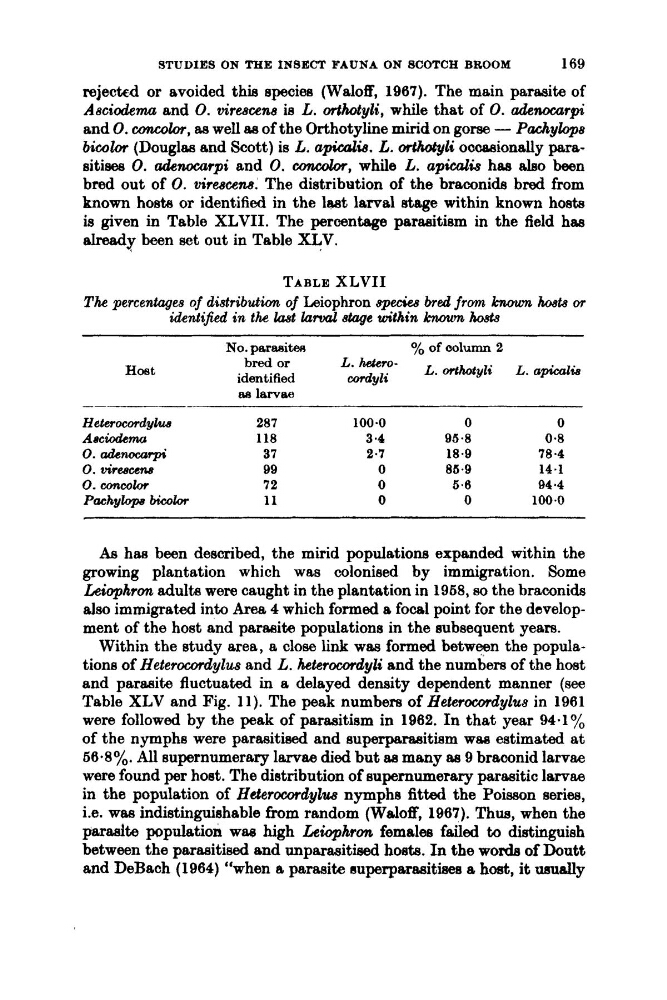
rejected or avoided this species (Waloff, 1967). The main parasite of
Aeciodema and 0. wirescene is L. orthotyli, while that of 0. &nocar(pi
and 0. cancolor, as well as of the Orthotyline mirid on gorse - P d y r O p s
bicolm (Douglas and Scott) is L. upicdis. L. ortlrdyli omaaionally parasitisea 0. &noearpi and 0. C071CO1OTY while L. api4i.s has also been
bred out of 0. vireecem. The distribution of the braconids bred from
known hosts or identified in the last larval stage within known hosta
is given in Table XLVII. The percentage parasitism in the field has
crlrsculy been set out in Table XLV.
TABLE XLVII
The percentages of distribution of Leiophron ep&
bred from knuwn h i % OT
identi$& in th luat l a d stage within knoum hods
Host
No. paraaitm
yo of mlUmn2
'
. hstero- L. wthotyli L. a w i e
bred or
identified
wrdyli
Heterocordylue
287
100.0
0
0
0. adcnocorpi
37
2 -7
18.9
78.4
PachyrOpe bioofor
11
0
0
100.0
AUCiodcma
118
3 *4
95 -8
0 -8
0. vireeccne
99
0
86.9
14.1
0. concolor
72
0
5.6
94.4
As has been described, the mirid populations expanded within the
growing plantation which was colonised by immigration. Some
Leiwphron adults were caught in the plantation in 1958,so the braconids
also immigrated into Area 4 which formed a focal point for the development of the host and parasite populations in the subsequent years.
Within the study area, a close link was formed between the populations of H e t e r d g l u s and L. Iseterocordyli and the numbers of the host
and parasite fluctuated in a delayed density dependent manner (see
Table XLV and Fig. 11). The peak numbers of Heterocordylue in 1961
were followed by the peak of parasitism in 1962. In that year 94.1%
of the nymphs were parasitiaed and superparasitism was estimated at
56.8%. All supernumerary larvae died but as many as 9 braconid larvae
were found per host. The distribution of supernumerary parasitic larvae
in the population of H e t e r m d y Z w nymphs fitted the Poisson series,
i.e. was indistinguishable from random (Waloff, 1967). Thus, when the
pardte population wm high Lebphron females failed to distinguish
between the parasitised and unparasitised hosts. In the wonh of Doutt
and DeBach (1964) "when a parasite auperparasitiaes a host, it urnally
169
rejected or avoided this species (Waloff, 1967). The main parasite of
Aeciodema and 0. wirescene is L. orthotyli, while that of 0. &nocar(pi
and 0. cancolor, as well as of the Orthotyline mirid on gorse - P d y r O p s
bicolm (Douglas and Scott) is L. upicdis. L. ortlrdyli omaaionally parasitisea 0. &noearpi and 0. C071CO1OTY while L. api4i.s has also been
bred out of 0. vireecem. The distribution of the braconids bred from
known hosts or identified in the last larval stage within known hosta
is given in Table XLVII. The percentage parasitism in the field has
crlrsculy been set out in Table XLV.
TABLE XLVII
The percentages of distribution of Leiophron ep&
bred from knuwn h i % OT
identi$& in th luat l a d stage within knoum hods
Host
No. paraaitm
yo of mlUmn2
'
. hstero- L. wthotyli L. a w i e
bred or
identified
wrdyli
Heterocordylue
287
100.0
0
0
0. adcnocorpi
37
2 -7
18.9
78.4
PachyrOpe bioofor
11
0
0
100.0
AUCiodcma
118
3 *4
95 -8
0 -8
0. vireeccne
99
0
86.9
14.1
0. concolor
72
0
5.6
94.4
As has been described, the mirid populations expanded within the
growing plantation which was colonised by immigration. Some
Leiwphron adults were caught in the plantation in 1958,so the braconids
also immigrated into Area 4 which formed a focal point for the development of the host and parasite populations in the subsequent years.
Within the study area, a close link was formed between the populations of H e t e r d g l u s and L. Iseterocordyli and the numbers of the host
and parasite fluctuated in a delayed density dependent manner (see
Table XLV and Fig. 11). The peak numbers of Heterocordylue in 1961
were followed by the peak of parasitism in 1962. In that year 94.1%
of the nymphs were parasitiaed and superparasitism was estimated at
56.8%. All supernumerary larvae died but as many as 9 braconid larvae
were found per host. The distribution of supernumerary parasitic larvae
in the population of H e t e r m d y Z w nymphs fitted the Poisson series,
i.e. was indistinguishable from random (Waloff, 1967). Thus, when the
pardte population wm high Lebphron females failed to distinguish
between the parasitised and unparasitised hosts. In the wonh of Doutt
and DeBach (1964) "when a parasite auperparasitiaes a host, it urnally