

BTUDIE8 ON THE MBEOT FAUNA ON BCOTUH BBOOM
161
functional type (Holling, 1961) &R the numbers of prey eaten greatly
i n c r o d with the incroasod larval density in 1965. To gauge the effects
of bird8 further, in 1906 four potted broom plante with a total of 100
Leucopfera mines were placed under a cage in Area 4 for a week, and
another six plante with a total of 178 mines were left exposed by the
cage. As waa anticipated, 6.1% of the minea were slit o’pn by birds on
the exposed plants and none on the protected onea.
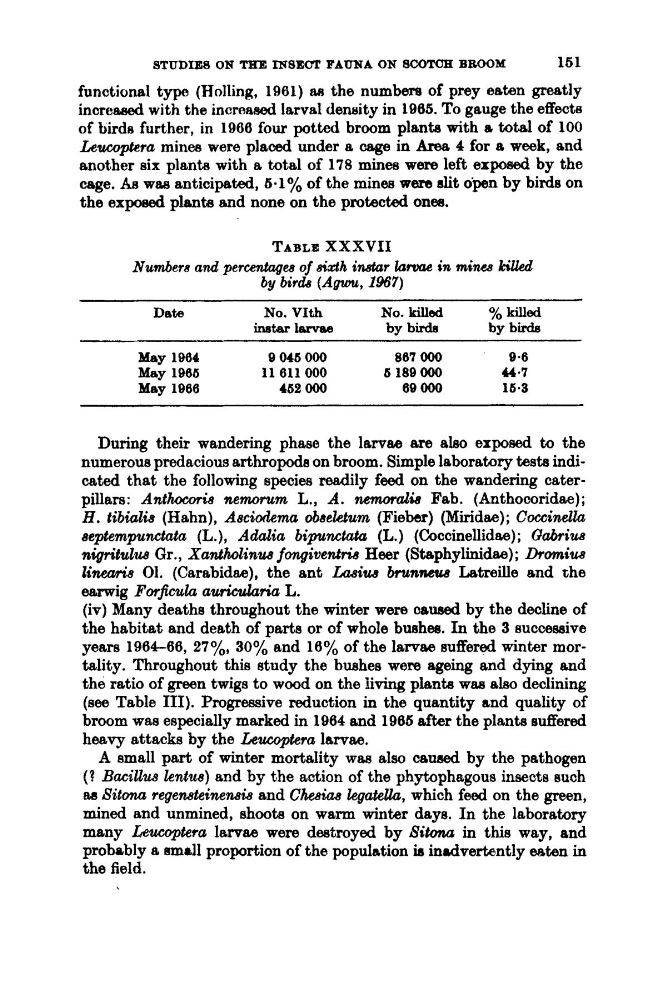
TABLE XXXVII
Numbere and pereentrylee of d h in8tar h m in minea kikd
by b i r h (Agwu, 1967)
D8h
No. VIth
No. killed
yo killed
inst8r lervee
by birda
by birds
Mey 1964
9 046 000
867 OOO
9.6
M8y 1966
462 OOO
69 OOO
16.3
May 1966
11 611 000
6 189 OOO
44.7
During their wandering phase the larvae are also exposed to the
numerous predacious arthropods on broom. Simple laboratory testa indicated that the following species readily feed on the wandering caterpillars: Anthoeoris nemopum L., A . nenordk Fab. (Anthocoridae);
H . tibialis (Hahn), Aeckd+?ma obseletum (Fieber) (Miridae); Coccindlu
eeptempunctata (L.), Adalia bipunctata (L.) (Coccinellidae); Gabriw
nigritulm Gr., Xantholinvs fongiventria Heer (Stephylinidae); Drmiw
l i d 8 01. (Carabidae), the ant Lasiua brunneue Latreille and the
earwig Fmjcula auricularia L.
(iv) Many deaths throughout the winter were (u~uaed by the dealine of
the habitat and death of parts or of whole bushea. In the 3 succeaaive
years 1964-66, 27%, 30% and 16% of the larvae suffered winter mortality. Throughout this study the bushes were ageing and dying and
the ratio of green twigs to wood on the living plante was also declining
(see Table 111). Progressive reduction in the quantity and quality of
broom was especially marked in 1964 and 1966 after the plants suffered
heavy attacks by the Lezccoptera larvae.
A small part of winter mortality ww also cawed by the pathogen
(1 BaciUua tentus) and by the action of the phytophagous inaeats such
aa S i t m regenateinensis and Chesias legate&, which feed on the green,
mined and unmined, shoote on warm winter days. In the laboratory
many Leumptera larvae were destroyed by Sitma in this way, and
probably a small proportion of the population is inadvertently a t a n in
the field.
161
functional type (Holling, 1961) &R the numbers of prey eaten greatly
i n c r o d with the incroasod larval density in 1965. To gauge the effects
of bird8 further, in 1906 four potted broom plante with a total of 100
Leucopfera mines were placed under a cage in Area 4 for a week, and
another six plante with a total of 178 mines were left exposed by the
cage. As waa anticipated, 6.1% of the minea were slit o’pn by birds on
the exposed plants and none on the protected onea.
TABLE XXXVII
Numbere and pereentrylee of d h in8tar h m in minea kikd
by b i r h (Agwu, 1967)
D8h
No. VIth
No. killed
yo killed
inst8r lervee
by birda
by birds
Mey 1964
9 046 000
867 OOO
9.6
M8y 1966
462 OOO
69 OOO
16.3
May 1966
11 611 000
6 189 OOO
44.7
During their wandering phase the larvae are also exposed to the
numerous predacious arthropods on broom. Simple laboratory testa indicated that the following species readily feed on the wandering caterpillars: Anthoeoris nemopum L., A . nenordk Fab. (Anthocoridae);
H . tibialis (Hahn), Aeckd+?ma obseletum (Fieber) (Miridae); Coccindlu
eeptempunctata (L.), Adalia bipunctata (L.) (Coccinellidae); Gabriw
nigritulm Gr., Xantholinvs fongiventria Heer (Stephylinidae); Drmiw
l i d 8 01. (Carabidae), the ant Lasiua brunneue Latreille and the
earwig Fmjcula auricularia L.
(iv) Many deaths throughout the winter were (u~uaed by the dealine of
the habitat and death of parts or of whole bushea. In the 3 succeaaive
years 1964-66, 27%, 30% and 16% of the larvae suffered winter mortality. Throughout this study the bushes were ageing and dying and
the ratio of green twigs to wood on the living plante was also declining
(see Table 111). Progressive reduction in the quantity and quality of
broom was especially marked in 1964 and 1966 after the plants suffered
heavy attacks by the Lezccoptera larvae.
A small part of winter mortality ww also cawed by the pathogen
(1 BaciUua tentus) and by the action of the phytophagous inaeats such
aa S i t m regenateinensis and Chesias legate&, which feed on the green,
mined and unmined, shoote on warm winter days. In the laboratory
many Leumptera larvae were destroyed by Sitma in this way, and
probably a small proportion of the population is inadvertently a t a n in
the field.