

146
1. WALOFF
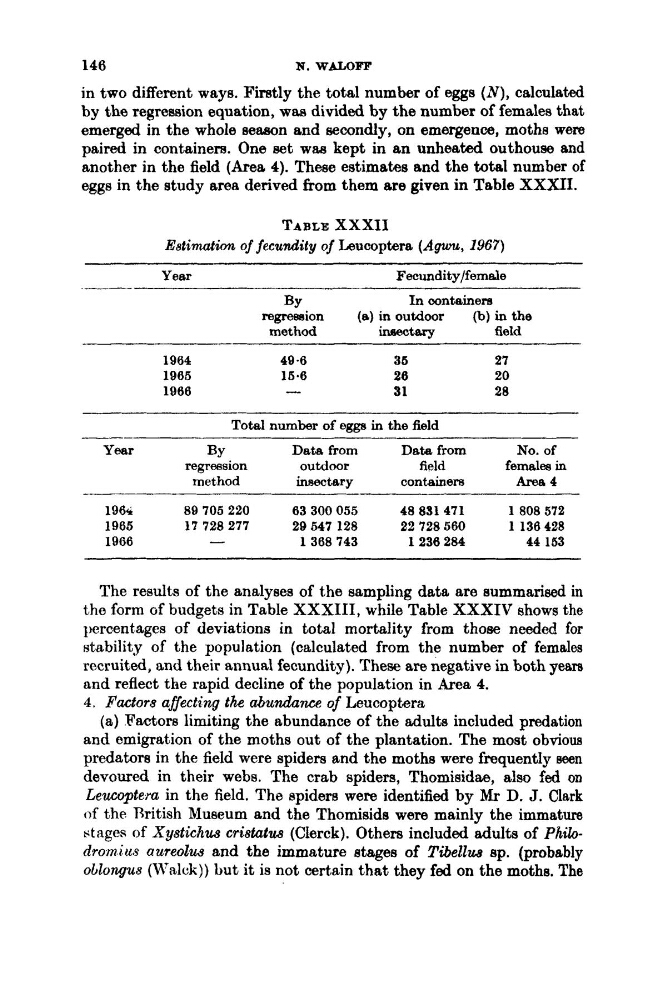
in two different ways. Firstly the total number of eggs (N), calculated
by the regression equation, wa8 divided by the number of females that
emerged in the whole season and secondly, on emergence, moths were
paired in containers. One set waa kept in an unheated outhouse and
another in the field (Area 4). These estimates and the total number of
eggs in the study area derived from them are given in Table XXXII.
TABLE XXXII
Eetimation of fecundity of LeuCoptera ( A m , 1967)
Year
Fecundity/femde
BY
In oontainera
regremion
(a) in outdoor
(b) in the
method
insectary
field
1964
49 -6
36
27
1965
15.6
26
20
1966
-
31
28
Total number of eggs in the field
Year
BY
Data from
Data from
No. of
regremion
outdoor
field
females in
method
insectary
containers
Area 4
__
-
1964
89 705 220
03 300 055
48 851 471
1 808 572
1966
17 720 277
29 547 128
22 728 560
1136428
19G6
-
1 368 743
1 236 284
44 153
The results of the analyses of the sampling data are eummarised in
tho form cjf budgets in Table XXXIII, while Table XXXIV shows the
percentages of deviations in total mortality from those needed for
&ability of the population (calculated from the number of females
recruited, and their annual fecundity). These are negative in both years
and reflect the rapid decline of the population in Area 4.
4. Factors affecting the abundunce of Leucoptera
(a) Factors limiting the abundance of the adults included predation
and emigration of the moths out of the plantation. The most obvious
predators in the field were spiders and the moths were frequently Been
devoured in their webs. The crab spiders, Thomisidae, also fed on
Lemptera in the field. The spiders were identified by Mr D. J. Clark
of the British Museum and the Thornisids were mainly the immature
stages of Xystichus cristatua (CIerck). Others included adults of Philodrornius aureolw and the immature stages of Tibellus 8p. (probsbly
oblongus (Walck)) but it is not certain that they fed on the moths. The
1. WALOFF
in two different ways. Firstly the total number of eggs (N), calculated
by the regression equation, wa8 divided by the number of females that
emerged in the whole season and secondly, on emergence, moths were
paired in containers. One set waa kept in an unheated outhouse and
another in the field (Area 4). These estimates and the total number of
eggs in the study area derived from them are given in Table XXXII.
TABLE XXXII
Eetimation of fecundity of LeuCoptera ( A m , 1967)
Year
Fecundity/femde
BY
In oontainera
regremion
(a) in outdoor
(b) in the
method
insectary
field
1964
49 -6
36
27
1965
15.6
26
20
1966
-
31
28
Total number of eggs in the field
Year
BY
Data from
Data from
No. of
regremion
outdoor
field
females in
method
insectary
containers
Area 4
__
-
1964
89 705 220
03 300 055
48 851 471
1 808 572
1966
17 720 277
29 547 128
22 728 560
1136428
19G6
-
1 368 743
1 236 284
44 153
The results of the analyses of the sampling data are eummarised in
tho form cjf budgets in Table XXXIII, while Table XXXIV shows the
percentages of deviations in total mortality from those needed for
&ability of the population (calculated from the number of females
recruited, and their annual fecundity). These are negative in both years
and reflect the rapid decline of the population in Area 4.
4. Factors affecting the abundunce of Leucoptera
(a) Factors limiting the abundance of the adults included predation
and emigration of the moths out of the plantation. The most obvious
predators in the field were spiders and the moths were frequently Been
devoured in their webs. The crab spiders, Thomisidae, also fed on
Lemptera in the field. The spiders were identified by Mr D. J. Clark
of the British Museum and the Thornisids were mainly the immature
stages of Xystichus cristatua (CIerck). Others included adults of Philodrornius aureolw and the immature stages of Tibellus 8p. (probsbly
oblongus (Walck)) but it is not certain that they fed on the moths. The